The average price per m² in Betton is 3 411 €/m² for an apartment, based on actual notarised (DVF) sales. About 53 transactions are recorded each year.

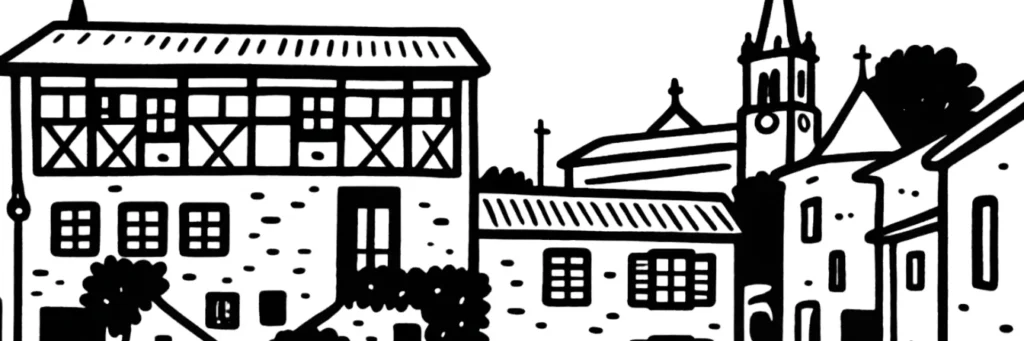
Ambience illustration of Betton, in the Ille-et-Vilaine.
In Betton, the average price comes out at 3 411 €/m². This municipality north of Rennes has a stock largely dominated by the detached house, with recent housing estates and buildings often later than 1990, completed by housing developments closer to the centre and to the canal. The average therefore covers above all family houses, with a smaller share of apartments. The gaps depend on closeness to Rennes, on transport and on the canal d'Ille-et-Rance. This figure comes from the DVF data, which records the sales actually registered before notaries, and is a market benchmark, not an individual valuation.
Prices from the DVF file (Demandes de valeurs foncières, published by the DGFiP), transactions actually recorded at the notary at municipality level. Cross-referenced with the Notaires de France - INSEE indices. Learn more about our methodology.
The market in Betton is driven first of all by the momentum of Rennes Métropole, one of the most attractive conurbations of the Grand Ouest. The demographic and economic growth of Rennes pushes families towards the well served outlying municipalities, among them Betton, thanks to its station and to its closeness to the ring road. This family buying demand, supported by a lively employment area, keeps a steady volume of transactions in the house segment. The scarcity of building land in the immediate vicinity of Rennes adds pressure on the first-ring municipalities such as Betton.
The second driver lies in the residential profile of the municipality. Betton combines recent building, a natural setting around the canal and the Ille, and the services of a medium-sized town, which answers what families look for. The quality of the rail service towards Rennes and Saint-Malo strengthens that appeal. Conversely, the market remains little diversified: dominated by the house, it offers few small dwellings and depends heavily on buying demand. Changes in interest rates and in household borrowing capacity therefore bear directly on the volume of sales.
Betton sits at an intermediate level among the municipalities of Rennes Métropole: below the central city, but above several municipalities in the west of the conurbation. The comparison with Rennes, Chantepie and Le Rheu makes that position clearer, without quoting an amount.
The name of Betton is thought to derive from the Gallo-Roman betudunum, translated as the fort or the hill of the birch. In Antiquity, the site held fortifications commanding the Chemin de la Reine, a Roman road linking Rennes to Avranches. That position as a road lock, on a height overlooking the valley of the Ille, fixed occupation of the place very early. The old town grew close to these routes, about ten kilometres north of Rennes. This ancient legacy explains the location of the historic core, distinct from the later low-rise detached housing extensions.
The modern history of Betton is marked by the canal d'Ille-et-Rance, which crosses the municipality over about seven thousand five hundred metres. Long imagined as a way to link the Manche to the Atlantic across Brittany, the canal saw work begin only in 1804, under Napoléon, after studies launched in 1783. It was opened on 6 May 1832. In Betton, the canal became an axis of life and of leisure, with its locks and its towpaths. This 19th-century scheme lastingly shaped the landscape of the municipality and remains a strong marker of identity.
The present shape of Betton owes much to the growth of the Rennes conurbation. Long a rural town, the municipality has become one of the most populated of Rennes Métropole, carried by the arrival of families looking for a house and a garden close to the city. A large part of the housing stock was built after 1990, which gives Betton a recent residential fabric, organised in successive estates around the old centre. The municipality has sought to preserve its natural areas, in particular the wetlands and the surroundings of the canal, while accompanying this continuous demographic expansion.
Betton has nearly 13 000 inhabitants, according to INSEE, the French national statistics institute, which makes it one of the significant municipalities of Rennes Métropole. The buyer profile is clearly family-oriented: working households employed in Rennes, first-time buyers and families looking for a house with a garden in a setting quieter than the metropolitan centre. The stock is dominated by the detached house, with mostly recent building, and a minority of apartments. Main residences are very largely in the majority, second homes being marginal. That structure steers the market towards family buying demand, sensitive to the links towards Rennes and to the quality of the setting.
The average price in Betton is 3 411 €/m², according to the DVF data drawn from the transactions registered before notaries. That average bears above all on detached houses, with a smaller share of apartments. It gives a general benchmark: the price of a given property depends on its sector, its floor area, its condition and its closeness to transport towards Rennes. An online valuation refines that benchmark for your own dwelling.
Betton lies about ten kilometres north of Rennes and has a rail service: its station, on the line towards Saint-Malo, puts the centre of Rennes a few minutes away by train. Bus routes of the metropolitan network complete the service, and the road quickly reaches the Rennes ring road. That accessibility to the heart of the metropolitan area is one of the main drivers of residential demand and a price criterion according to closeness to the station.
The market in Betton is dominated by the detached house, which accounts for most transactions and for family demand. Apartments do exist, above all in the more recent developments close to the centre and to the station, but they remain in the minority. For a first-time buyer or an investor, the apartment can be a more affordable entry point. For a family project, the house with a garden remains the product most represented in the municipality.
The canal d'Ille-et-Rance, which crosses Betton, adds to the quality of the setting with its towpaths, its locks and its walking areas. The surroundings of the canal and the natural areas of the municipality are an argument sought by buyers attentive to the environment. Without mechanically setting prices, this amenity contributes to the residential appeal of Betton and can add value to properties in the immediate vicinity of the banks and the green spaces.
Betton is aimed first at families and at working people employed in the Rennes conurbation, who are looking for a house with a garden without moving away from the centre. The recent building, largely put up after 1990, offers dwellings with often decent energy performance, an advantage for running costs and for resale. The municipality suits less those looking for a small apartment in a dense town centre, rarer here. Before buying, it is useful to compare sectors, closeness to the station and period of construction.
This analysis is published by Immover, an independent observatory founded by Antony Barbier. Data sourced from official sources (DVF, INSEE, Notaries of France).