The average price per m² in Canet-en-Roussillon is 3 849 €/m² for an apartment, based on actual notarised (DVF) sales. About 340 transactions are recorded each year.

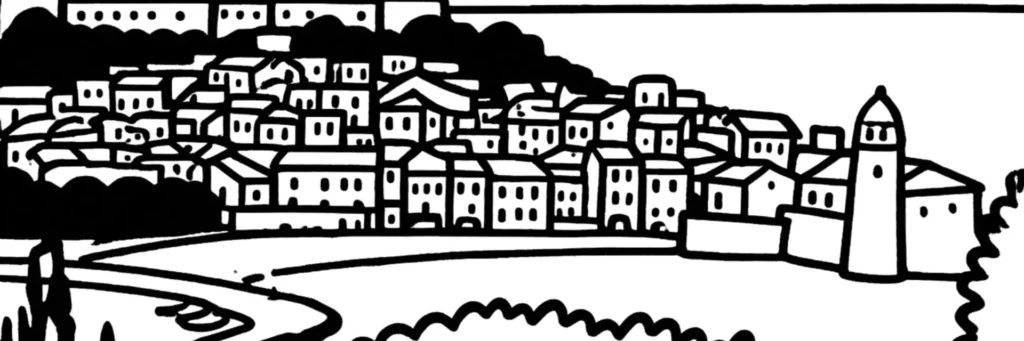
Atmospheric illustration of Canet-en-Roussillon, a seaside resort of the Pyrénées-Orientales.
The average price recorded in Canet-en-Roussillon stands at 3 849 €/m². This average covers two markets brought together in a single municipality. Canet-Plage lines up seafront buildings and holiday developments, where floor level, the view and the distance from the sand explain most of the gaps. Canet-Village, a few kilometres inland around the former castrum, remains a fabric of houses and small blocks occupied year-round. The figures come from the DVF database (the French record of notarised property sales), which lists the transactions actually registered with notaries, not the prices shown in listings.
Prices from the DVF file (Demandes de valeurs foncières, published by the DGFiP), transactions actually recorded at the notary at municipality level. Cross-referenced with the Notaires de France - INSEE indices. Learn more about our methodology.
After 3 369 €/m² in 2021, the average price in Canet-en-Roussillon reaches 3 849 €/m² in 2026, around +14 % over the period.
The Canet-en-Roussillon market depends on two drivers. The first is residential: the municipality works as a seaside extension of the Perpignan urban area, about 9 kilometres away, and attracts households who work in the city while living by the sea. The second is demographic: with more than 28 % of inhabitants aged 65 to 79 according to INSEE, the municipality attracts retirees settling year-round and regularly sees long-held properties come back onto the market. These two flows sustain a steady transaction volume throughout the year.
Supply, for its part, remains bounded. The loi Littoral to the south and east, and the protected lagoon to the north, contain development within an envelope that barely moves: new schemes come mainly from redeveloping already built plots. Tourism plays the opposite role on demand, with more than half the stock in second homes according to INSEE and seasonal letting supporting the value of small units close to the beach and the marina. This seasonality also paces the market: properties come up for sale mainly outside the summer period.
A seaside resort backing onto the Perpignan urban area, Canet-en-Roussillon sits well above its neighbouring city and above Béziers. It remains behind Collioure, whose market is narrower and more sought after.
The name of the municipality appears very early in the Roussillon archives, in the form villa Kanedo in 1017, then castellum de Caned in 1050 and Canetum in 1052. The castle was built around 1050 under Count Gausfred II of Roussillon, on the height overlooking the plain and the lagoon. The lordship was raised to a viscounty in 1322. The medieval territory also included the hamlet of Sant Miquel de Forques and the lordship of Vilarnau, both now vanished. By 1688, the castle was already in ruins, and its stones long served as a quarry for the inhabitants. The old village grew around this core, away from the shore.
The seaside resort was born in the 19th century, with the opening of a first bath house in 1849. From September 1900, an electric metre-gauge tramway linked Perpignan to Canet and carried bathers from the town to the sea. Canet-Plage obtained official classification as a seaside resort in 1909. The introduction of paid holidays in 1936, then heavy post-war visitor numbers, turned seasonal attendance into permanent development. The tramway closed on 31 December 1953 and the line was dismantled, replaced by the road and the car, which shape the municipality's present geography, with a village on one side and a beach on the other.
The post-war years saw a succession of development schemes, housing estates and seafront buildings, on a more diffuse model than the purpose-built resorts of the neighbouring Languedoc. Canet merged with Saint-Nazaire in 1971 under the name Canet-en-Roussillon-Saint-Nazaire, then the two municipalities separated in 1983: the present name dates from that separation. The marina, with around 1 300 berths on 25 hectares of water, structures the south of the resort. To the north, the Canet-Saint-Nazaire lagoon is protected, owned by the Conservatoire du littoral and part of the Natura 2000 network, which has frozen the limit of development on that side.
According to INSEE, Canet-en-Roussillon has 13 227 inhabitants for 16 293 dwellings, of which 53.2 % are second homes and 45.6 % main residences. Apartments account for 66.1 % of the stock, houses 33.6 %, and 58.8 % of households in main residences are owner-occupiers. The population is old: more than 28 % of inhabitants are aged between 65 and 79. Buyers are split between retirees settling year-round, often from northern France or the region, households from the Perpignan urban area looking for a base close by, and landlords positioned on seasonal letting.
The average price recorded is 3 849 €/m², calculated from transactions registered by notaries and published in the DVF database. It is a municipal average, mixing the seafront apartments of Canet-Plage and more modest properties set back or in the village. A home with a sea view and a terrace sits above, an older apartment in the second row below. Valuing a specific property depends on its area, its condition and its aspect.
The municipality reads as two distinct entities. Canet-Village is the historic core, set inland around the ruins of the viscount's castle, with houses, local shops and year-round life. Canet-Plage, on the coast, concentrates apartment blocks, holiday developments, the marina and tourist activity. The two areas do not behave the same way on the market: the first attracts mainly permanent residents, the second seasonal buyers.
Yes, unlike in resorts built in one go. According to INSEE, houses account for 33.6 % of the municipality's dwellings, against 66.1 % apartments. They are found mainly in the village and in the intermediate residential districts, between the old core and the coast, as well as in a few residential areas close to the lagoon. Transaction volume there is lower than for apartments, which leaves fewer price references and sometimes lengthens selling times.
Perpignan is about 9 kilometres away, some fifteen minutes by car on the road across the plain. Public transport is provided by a regular bus line of the urban area network, linking the seafront to the centre of Perpignan. It is this route, once taken by the electric tramway until 1953, that explains the municipality's daily reliance on its neighbouring city for jobs, the railway station and services.
Several frameworks overlap. The loi Littoral (France's coastal planning law) limits the extension of development in the strip close to the shore and in practice closes the door to new seafront building. To the north, the Canet-Saint-Nazaire lagoon comes under the Conservatoire du littoral and the Natura 2000 network, which lastingly protects its surroundings. Before buying, ask for the property's statutory hazard disclosure and check with the planning department what the local plan actually allows in terms of works or extensions.
This analysis is published by Immover, an independent observatory founded by Antony Barbier. Data sourced from official sources (DVF, INSEE, Notaries of France).