The average price per m² in Cerbère is 2 814 €/m² for an apartment, based on actual notarised (DVF) sales. About 22 transactions are recorded each year.

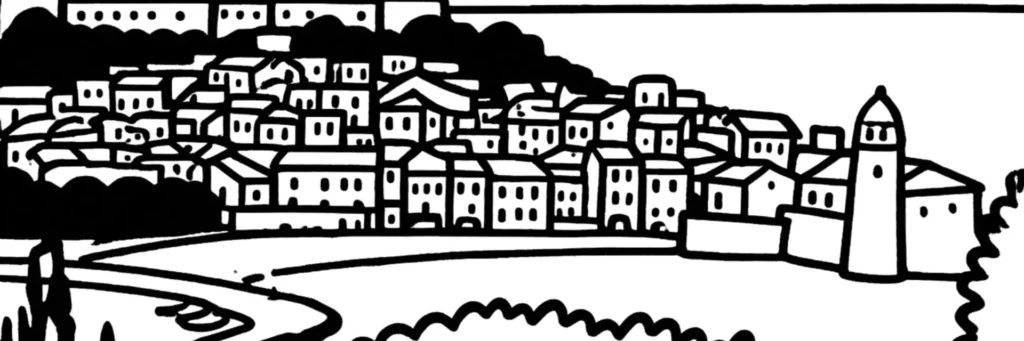
Atmospheric illustration of Cerbère, the last municipality on the French coast before Spain, on the Côte Vermeille in the Pyrénées-Orientales.
The average price recorded in Cerbère stands at 2 814 €/m². This average covers a stock made up mainly of apartments, spread between the seafront buildings, the sloping streets around the bay and the homes close to the station. Village houses and villas on the heights, fewer in number, round out the supply. The gaps around this average come mainly from the type of property, floor area, condition and the sea view, a decisive criterion on this coastline. Proximity to the harbour, the beach and the Côte Vermeille coastal paths also weighs on values. These figures come from the DVF database, which lists the sales actually signed before notaries, and give a municipal benchmark to be refined property by property.
Prices from the DVF file (Demandes de valeurs foncières, published by the DGFiP), transactions actually recorded at the notary at municipality level. Cross-referenced with the Notaires de France - INSEE indices. Learn more about our methodology.
The Cerbère market rests on its status as a seaside resort of the Côte Vermeille, the last coastal municipality before Spain. Demand comes both from local households looking for a main residence and from second-home buyers drawn by the sea, the harbour and the direct rail service. The view over the bay, proximity to the beach and access to the coastal paths and the marine reserve are among the most valued criteria. This demand bears mainly on apartments, which make up most of the available stock.
Supply remains constrained by the topography: a site squeezed between the sea and schist hills, where building land is limited and housing already dense around the bay. In the second-hand market, the condition of the property, aspect and energy performance have become bargaining points, particularly for older homes in the centre. Buyers weigh the sea view, proximity to the harbour and the quiet of the heights according to their plans. The municipality, whose population is slightly declining, keeps a market kept alive by second-home buyers.
The last municipality of the Côte Vermeille before Spain, Cerbère shows a price level below that of its neighbours Banyuls-sur-Mer and Port-Vendres, and well below Collioure, the most sought-after in the area.
The name Cerbère derives from the Latin cervaria, denoting a place frequented by deer. As early as the 1st century, the Roman geographer Pomponius Mela described this area as a crossing point at the southern end of Gaul. Long merely a coastal section of Banyuls-sur-Mer, Cerbère became an independent municipality on 22 June 1888, and Dominique Mitjaville became its first mayor on 15 July of the same year. The town owes its growth to the railway far more than to any old village core.
The history of Cerbère is inseparable from its international station. Studies for a rail link with Spain began in 1846 and transformed the village, whose population swelled with the arrival of construction workers. The station became the French terminus of the line towards Portbou: the different track gauges in France and Spain meant goods and passengers had to be transferred at the border. This traffic supported the municipality for decades. In 1906, the transbordeuses, the women workers who moved crates of oranges from one train to another, staged a strike lasting almost a year, regarded as one of the first exclusively female labour movements.
Seaside tourism developed in the wake of the station. Between 1928 and 1932, the Perpignan architect Léon Baille built the Belvédère du Rayon Vert hotel, a vast reinforced-concrete building in the Ocean Liner style inspired by the great transatlantic ships, listed as a historic monument in 1987. The territory belongs to the Côte Vermeille, where vines are grown on schist terraces for the wines of Banyuls and Collioure. In 1974, the Cerbère-Banyuls marine nature reserve, the first exclusively marine reserve in France, was created along this rocky coast. The last French municipality before Spain, Cerbère today lives mainly from its harbour, its beaches and this tourist economy.
Cerbère has around 1 209 inhabitants. As is often the case on the Mediterranean coast, the municipality has a high share of second homes, driven by the seaside appeal of the Côte Vermeille. The stock consists mainly of apartments, from the studios and small units of the seafront to the more family-sized homes of the sloping streets, while village houses and villas remain in the minority. Buyers are split between permanent residents, often local households or retirees attached to this maritime setting, and second-home purchasers looking for proximity to the sea and a direct rail service. First-time buyers turn to small units, more affordable than properties with an open view over the bay.
The average price recorded in Cerbère stands at 2 814 €/m², based on sales registered with notaries and published in the DVF database. This figure brings together varied properties, mostly apartments. The type of property, floor area, condition, aspect and above all the sea view explain most of the gaps around this average. For a reliable valuation, it is better to rely on sales of comparable properties than on the municipal average alone.
Cerbère is the last municipality on the French coast before Spain, on the Côte Vermeille. Its international station, the French terminus of the line towards Portbou, provides a direct rail service along the coast, towards Banyuls-sur-Mer, Port-Vendres, Collioure and Perpignan. The departmental road running along the shore also links the municipality to its neighbours and to the border post at the Balitres pass. This border position and this rail service are among the landmarks that shape its property market.
The municipality is organised around a bay and a sheltered harbour, framed by the terraced schist hills of the Côte Vermeille. The Cerbère-Banyuls marine nature reserve, the first exclusively marine reserve in France, protects the rocky seabed and attracts divers and nature lovers. The Belvédère du Rayon Vert hotel, an Ocean Liner style building listed as a historic monument, marks the entrance to the town. Between beaches, coastal paths and the vineyards of Banyuls and Collioure, the setting remains turned towards the sea.
The Cerbère market consists mainly of apartments, from the seafront studio to the family home in the sloping streets. Buying an apartment therefore matches the dominant profile of the municipality, particularly for a second home or a first purchase. Village houses and villas, rarer, trade on the heights and offer more space, sometimes with a view over the bay. Your choice will depend on your budget, your need for space and the intended use, main or second home.
Cerbère spreads around its bay: the seafront and the harbour concentrate the buildings and the shops, while the streets climb towards the heights on either side of the valley. The station area, marked by the town's railway history, forms a district of its own. The most sought-after villas and houses occupy the slopes overlooking the sea, with open views over the Mediterranean. Each area has its own building and aspect characteristics, worth examining closely according to your plans.
This analysis is published by Immover, an independent observatory founded by Antony Barbier. Data sourced from official sources (DVF, INSEE, Notaries of France).