The average price per m² in Combourg is 2 433 €/m² for an apartment, based on actual notarised (DVF) sales. About 14 transactions are recorded each year.

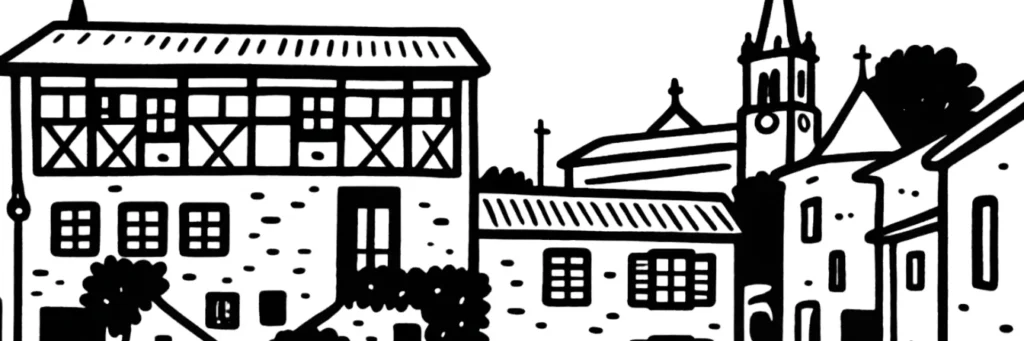
Mood illustration of Combourg, in the Ille-et-Vilaine, halfway between Rennes and Saint-Malo.
The average price recorded in Combourg stands at 2 433 €/m². That average covers a stock that is overwhelmingly made of houses: according to INSEE, the French national statistics institute, more than 80 % of the dwellings in the municipality are houses, against less than 18 % apartments. The tight old town around the chateau and the rue Notre-Dame, the low-rise housing estates on the outskirts and the renovated farmhouses of the surrounding countryside do not sell at the same level. Main residences account for nearly 87 % of the stock, the sign of a municipality of permanent residents rather than of holidaymakers. The figures come from the DVF database, which records the transactions actually registered before notaries.
Prices from the DVF file (Demandes de valeurs foncières, published by the DGFiP), transactions actually recorded at the notary at municipality level. Cross-referenced with the Notaires de France - INSEE indices. Learn more about our methodology.
The Combourg market depends first on its position in the triangle formed by Rennes, Saint-Malo and the Baie du Mont-Saint-Michel. As the market town of the Bretagne romantique, the municipality captures demand from families and working people looking for a house at a contained price without moving far from the Rennes metropolitan area or from the coast. The low share of second homes recorded by INSEE confirms a market of permanent residents, less exposed to seasonal swings than the coastal municipalities.
Two factors will shape the coming years. On one hand, land pressure from the Rennes area spreads towards the north of the department and supports demand in market towns well served by rail. On the other, the scarcity of older houses in good condition and the cost of the energy renovation of pre-1990 buildings weigh on selling times and become a bargaining argument. New supply remains dependent on the pace of housing estates and on the availability of building land around the town.
As the market town of the Bretagne romantique, Combourg sits below the tight markets of the Rennes metropolitan area and of the Saint-Malo coast. It remains closer to the municipalities of its rural area than to the neighbouring poles turned towards the city or the sea.
The chateau of Combourg was built around 1025 by Junguené, archbishop of Dol, who entrusted it to his brother Riwallon, first lord of Combourg. The fortress, with its four large round towers, commanded a strategic crossing point on the borders of Brittany and Normandy, at the edge of the former dioceses of Dol, Saint-Malo and Rennes. The town grew at its foot, around the church of Notre-Dame and the stretch of water now called the lac Tranquille, an expanse of 22 hectares along which the old town extends.
In 1761, René-Auguste de Chateaubriand bought the lordship and settled his family in the chateau. His son François-René de Chateaubriand, the future writer and politician, spent part of his adolescence there. From it he drew, in the Mémoires d'outre-tombe, the pages that made Combourg a place associated with the birth of French romanticism, summed up by the line that has remained famous: I became what I am in the woods of Combourg. The chateau, still held by the writer's descendants, is open to visitors and houses a museum devoted to his memory.
The main town of its canton, Combourg modernised through the 20th century without losing its status as a small country town. It is served by a station on the railway line from Rennes to Saint-Malo and gathers the services of a market town: schools up to secondary and sixth-form level, medical and sports facilities, shops. It belongs to the communauté de communes of the Bretagne romantique, a grouping of municipalities of which it is one of the poles.
According to INSEE, Combourg has 6 411 inhabitants and a stock of about 2 800 dwellings, of which nearly 87 % are main residences. Second homes weigh only 3 to 4 % of the stock: the municipality lives first from its permanent residents, not from a holiday clientele. Houses make up more than 80 % of the dwellings and nearly two thirds of households own their main residence. Buyers are above all families from the local area and working people looking for a house with a garden at a measured price, within reasonable distance of Rennes and of the Saint-Malo coast. To these are added households from Rennes or Saint-Malo in search of a more rural setting, and a few purchasers drawn by the heritage and the surroundings of the town.
The average price recorded is 2 433 €/m², calculated from the transactions registered by notaries and published in the DVF database. It is a municipal average, which brings together very different properties: an old house in the town, a recent house on an estate and a renovated longère, the traditional long farmhouse of the region, do not belong to the same segment. The condition of the property, the size of the plot and closeness to the centre explain a good share of the gaps.
The market is overwhelmingly one of houses. According to INSEE, more than 80 % of the dwellings in the municipality are houses, against less than 18 % apartments. The supply of flats is therefore limited and concentrated for the most part in the town. A buyer looking for an apartment will have few points of comparison, whereas the market for houses, from the estate house to the country longère, is deeper.
The old town, around the chateau, the church of Notre-Dame and the lac Tranquille, brings together older town houses, sometimes subject to heritage constraints because of the closeness of the monument. The outskirts gather the low-rise housing estates of recent decades, with larger plots. Beyond, the countryside offers farmhouses and longères, whose value depends heavily on their condition and on the works carried out.
The municipality lies halfway between Rennes and Saint-Malo, some forty kilometres from each, and has a station on the railway line linking the two towns. That position supports demand from working people employed in Rennes or on the Saint-Malo coast while living in a country town. Accessibility weighs on the market: it widens the pool of buyers beyond the residents of the Bretagne romantique alone.
Near the chateau, a listed historic monument, works on facades, roofing and joinery may require the opinion of the architecte des Bâtiments de France, the state heritage architect: this is worth checking before any renovation project. On an older stock, the energy performance certificate is decisive in anticipating the cost of works and the resale value. For country properties, the drainage system, the access and the condition of the roof structure deserve close examination.
This analysis is published by Immover, an independent observatory founded by Antony Barbier. Data sourced from official sources (DVF, INSEE, Notaries of France).