The average price per m² in Fontainebleau is 4 505 €/m² for an apartment, based on actual notarised (DVF) sales. About 179 transactions are recorded each year.

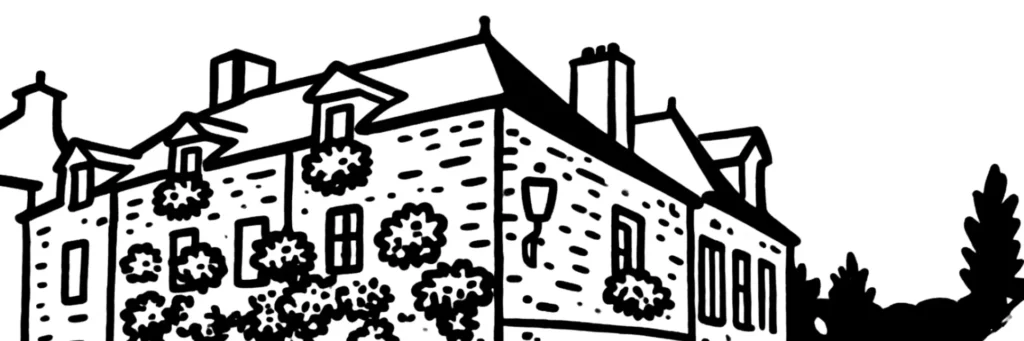
Atmospheric illustration of Fontainebleau, the town of the royal château in the heart of its forest, in Seine-et-Marne.
In Fontainebleau, the average price of an apartment stands at 4 505 €/m², calculated on 184 sales completed in 2025 and taken from DVF data, the French notarised sales database, which records the transactions actually registered by notaries. The housing stock is overwhelmingly made up of flats: old buildings and private mansions in the centre, around the château and the rue Grande, and more recent residential blocks at the edge of the forest. The municipality, enclosed by the forest massif, has little building land, which limits new-build supply. The address, the floor, the view and the condition of the building explain significant differences around this average.
Prices from the DVF file (Demandes de valeurs foncières, published by the DGFiP), transactions actually recorded at the notary at municipality level. Cross-referenced with the Notaires de France - INSEE indices. Learn more about our methodology.
After 4 447 €/m² in 2021, the average price in Fontainebleau reaches 4 505 €/m² in 2026, around +3 % over the period.
The population of Fontainebleau has changed little for several decades, for lack of available land: the state forest covers most of the 17 205 hectares of the municipality. The market therefore relies mainly on resales of the existing stock, with around 180 apartment sales a year. Tourism also weighs in the local economy, the château having received around 450 000 visitors in 2011 and the forest nearly 13 million walkers, which supports the shops of the rue Grande and demand for short-term rentals.
Price differences depend mainly on the quality of the properties. Renovated old apartments in the centre, near the château and the park, find buyers more quickly than homes in more recent residential blocks that need energy renovation. Service on line R, less frequent than the RER, steers some buyers towards properties close to the station. The presence of recognised educational institutions, including Insead and the lycée international François-Ier, sustains steady demand from families and expatriates.
Fontainebleau sits well above Melun and Dammarie-les-Lys, and also exceeds Brie-Comte-Robert, the most expensive municipality in this selection after it.
The château is first mentioned in 1137: it was then a fortified hunting lodge in the middle of a vast royal forest. Thomas Becket consecrated a chapel there in 1169, and Philip the Fair was born there in 1268 before dying there in 1314. The town that formed at the foot of the château long depended on the neighbouring parish of Avon, where the inhabitants went to Mass. It was not until 1661 that Fontainebleau became a separate parish, with the construction of the église Saint-Louis commissioned by Louis XIV and Anne of Austria. During the Revolution, the municipality was briefly named Fontaine-la-Montagne and Fontaine-le-Vallon.
In 1528, François I decided to transform the old manor into a palace, and the project attracted artists from Italy. The château remained a residence of the sovereigns for centuries: Louis XIV signed the Edict of Fontainebleau there on 18 October 1685, and Louis XV married Marie Leszczynska there in 1725. Napoléon I had it restored, held Pope Pius VII there from 1812 to 1814, then bade farewell to his Guard in the main courtyard on 20 April 1814, after his first abdication. Napoléon III stayed there between 1856 and 1869. The palace and its park were inscribed on the Unesco World Heritage List in 1981.
In the 19th century, the town became a garrison and a resort. The railway arrived in 1849, the town has been a sub-prefecture since 1879 and the Solle racecourse was inaugurated in 1862. The town hall dates from 1864. From 1949 to 1967, Fontainebleau hosted NATO headquarters, including that of the Allied Forces Central Europe, which brought a large foreign population. The International Union for Conservation of Nature was founded there on 5 October 1948. Insead, a business school founded in 1957, moved in 1967 to its campus on boulevard de Constance, and the military equestrian sports centre still occupies the former stables of the château.
Fontainebleau has 15 583 inhabitants. According to INSEE, the French national statistics institute, apartments account for 74,9 % of homes and houses 24,9 %. Only 40,1 % of households own their main residence, compared with 61,8 % in Seine-et-Marne, a sign of a very present rental market. Second homes account for 4,2 % of the stock. Buyers are families from the Paris region drawn by the forest and the schools, managers who work in Paris or in the south of Seine-et-Marne, and retirees. The presence of Insead, the schools and the military sustains constant rental demand, particularly for small units in the centre.
In 2026, the Immover benchmark for an apartment in Fontainebleau stands at 4 505 €/m². It is calculated on 184 sales actually completed before notaries in 2025, and not on asking prices in listings. A renovated apartment in an old building in the centre and a home to renovate in a residential block from the 1960s or 1970s can differ markedly from this average. Our online valuation tool lets you refine it according to the floor area, the floor and the condition of your property.
The town combines an old built heritage, a setting surrounded by forest and a rich educational and cultural offer, with the château, Insead and several secondary schools. Its territory, overwhelmingly forested, leaves almost no room for new neighbourhoods, which limits construction. Demand, fed by families, managers and foreign buyers alike, therefore meets a restricted supply, hence a price level higher than that of the municipalities of the Melun conurbation.
The Fontainebleau-Avon station, located in the neighbouring municipality of Avon, is served by line R of the Transilien suburban rail network, which links Paris-Gare de Lyon to Montereau and Montargis. Town buses link the station to the town centre and the château. By road, the A6 motorway is accessible towards Paris and Lyon. The distance between the station and your future address is worth checking, as some neighbourhoods of the centre are several kilometres away from it.
As the château is listed as a historic monument, a large part of the town centre lies within its protection perimeter. Works visible from outside, such as facade restoration, replacement of windows or roof repairs, require the opinion of the Architecte des Bâtiments de France, the State heritage architect, which may impose materials and lengthen lead times. Before buying a property to renovate, ask the town hall's planning department about the rules that apply to the address.
With fewer than four households in ten owning their home according to INSEE, renting holds an important place. Students and managers in training at Insead, the military personnel of the equestrian sports centre and young working people mainly look for furnished studios and two-room flats close to the centre. Homes rated G on the energy performance certificate (DPE) can no longer be offered under a new lease since 2025, a point to check in old buildings.
This analysis is published by Immover, an independent observatory founded by Antony Barbier. Data sourced from official sources (DVF, INSEE, Notaries of France).