The average price per m² in Frontignan is 3 735 €/m² for an apartment, based on actual notarised (DVF) sales. About 202 transactions are recorded each year.

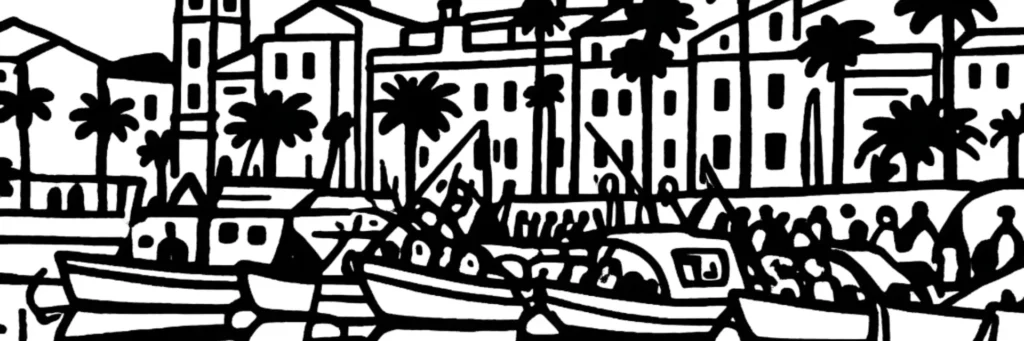
Illustration of Frontignan, between the Thau lagoon and the Mediterranean.
The average price recorded in Frontignan stands at 3 735 €/m². This average brings together three distinct markets. The old centre, tightly set around the covered market and the canal, lines up narrow town houses and small residential blocks. Frontignan-Plage, on the sandbar, concentrates the seaside residences, where the view and the distance to the sand make up most of the gap. La Peyrade and the housing estates backing onto the Gardiole massif form a suburban fabric occupied year-round. The figures come from the DVF database, which records the transactions actually recorded at the notary (DVF is the French notarised sales database), not the prices asked in listings.
Prices from the DVF file (Demandes de valeurs foncières, published by the DGFiP), transactions actually recorded at the notary at municipality level. Cross-referenced with the Notaires de France - INSEE indices. Learn more about our methodology.
Frontignan is the seventh-largest municipality in the Hérault by population and holds a pivotal position between Sète, 7 kilometres away, and the Montpellier area, about twenty kilometres away. This location feeds demand: households working in one or the other conurbation come looking for a house or an apartment near the sea, with a regional train station on the Tarascon-to-Sète line and quick access to the A9. The share of apartments in the stock has risen continuously since 2012 according to INSEE, a sign of the municipality's densification rather than mere suburban sprawl.
Supply, for its part, runs up against physical and regulatory limits. The coast is protected by the Coastal Act, the lagoons and wetlands fall under several Natura 2000 sites, and the Gardiole massif has been listed since 1980: the buildable envelope moves little. The main land reserve lies in the conversion of the industrial sites inherited from the refinery, whose decontamination sets the timetable. Seaside tourism, muscat and events such as the international crime-fiction festival also support a seasonal activity that weighs on the market for small units.
Backing onto the Thau basin, Frontignan sits at a level close to that of Sète, its immediate neighbour, and above Montpellier. It stays behind Agde, whose tourist coastline pushes prices up.
The name Frontignan comes from a Gallo-Roman estate formed on the name of an owner, Frontinius. The town passed under the authority of the House of Barcelona in 1204, thanks to a royal marriage, then acquired ramparts in 1362 after being destroyed by companies of mercenaries. The vineyard made the reputation of the place very early: the philosopher John Locke praised in 1679 the wine he called Frontiniac, and Thomas Jefferson ordered 250 bottles of it in 1787. Muscat, a naturally sweet wine made from the small-grain white muscat, then structured the local economy and the organisation of the land around the town.
The 20th century turned Frontignan into an industrial town. The cooperative winery was founded in 1904, in a context of wine crisis, and ranks among the first in France. The same year, on 6 August, the prefect of the Hérault authorised the construction of an oil and petrol depot together with a distillation unit: the refinery was inaugurated in October 1906. The controlled designation of origin muscat de Frontignan was recognised in May 1936, the first of the muscat designations in France. The Second World War struck the municipality hard: the refinery was bombed by the Allies on 25 June 1944 and the bombing caused 39 civilian deaths, followed by a long reconstruction.
Rebuilt under the Marshall Plan, the refinery processed 4 million tonnes in 1970, for a maximum capacity of 6 million tonnes per year. The underwater pipeline brought into service in October 1948, which allowed tankers to be unloaded offshore, was a first in Europe. The plant closed in 1986 for lack of profitability and only a fuel depot remains, now operated by GDH and classified as a top-tier Seveso site. At the same time, the sandbar between the sea and the Ingril lagoon became urbanised to form Frontignan-Plage, over a strip of eight kilometres. From this history the town keeps a fragmented shape: old centre, La Peyrade district to the west, seaside resort and vast industrial sites being converted.
According to INSEE, Frontignan has 24 136 residents for 14 566 dwellings, of which 76,5 % are main residences and 20,6 % second or occasional residences. Houses account for 54,6 % of the stock and apartments 45,1 %, a share of apartments rising since it was 40,3 % in 2012. Among the main residences, 61,6 % of households are owners. The profile of buyers follows this structure: families and working people from the Montpellier and Sète areas looking for a house near the sea, retirees settling year-round, and a minority of second-home buyers concentrated on the sandbar and the seafront.
The average price recorded is 3 735 €/m², calculated from the transactions recorded by the notaries and published in the DVF database. It is a municipal average, which mixes the houses of the centre and the housing estates, the apartments of Frontignan-Plage and the properties located in La Peyrade. A recent home with a sea view sits above, an old house to renovate away from the coast below. The valuation of a specific property depends on its area, its floor space and its condition.
The municipality reads as three entities. The old centre, crossed by the Rhône-to-Sète canal and its lift bridge, brings together town houses and local shops. La Peyrade, to the west towards Sète, is a former working-class suburb marked by the proximity of the industrial and port facilities. Frontignan-Plage occupies the sandbar, between the Mediterranean and the Ingril lagoon, with seaside residences and very seasonal visitor numbers. These three areas do not respond to the market in the same way.
Sète is about 7 kilometres to the south-west, Montpellier about twenty kilometres to the north-east. The municipality has its own station, on the Tarascon-to-Sète line, served by the regional trains that link the two towns in about twenty minutes. By car, the D612 serves the coast and joins the A9. Frontignan belongs to Sète Agglopôle Méditerranée, whose bus network provides local links. This dual accessibility weighs in buyers' trade-offs.
The site inherited from the former refinery, closed in 1986, still houses a fuel depot classified as a top-tier Seveso site. This installation generates a technological risk prevention plan, which governs buildability and can impose requirements on homes located within its perimeter. Not all districts are concerned. Before buying or selling, request the property's statement of risks and pollution and check with the town hall's planning department what applies to the plot.
The sandbar is a narrow strip caught between the sea and the Ingril lagoon, exposed to coastal erosion and to marine flooding: the area was included in December 2012 in a territory at significant flood risk. The Coastal Act also limits the extension of urbanisation near the shore, and the surrounding environments fall under several Natura 2000 sites. The Gardiole massif has been protected by decree since 25 February 1980. These frameworks add up and constrain construction or extension plans.
This analysis is published by Immover, an independent observatory founded by Antony Barbier. Data sourced from official sources (DVF, INSEE, Notaries of France).