The average price per m² in L'Isle-d'Abeau is 2 713 €/m² for an apartment, based on actual notarised (DVF) sales. About 90 transactions are recorded each year.

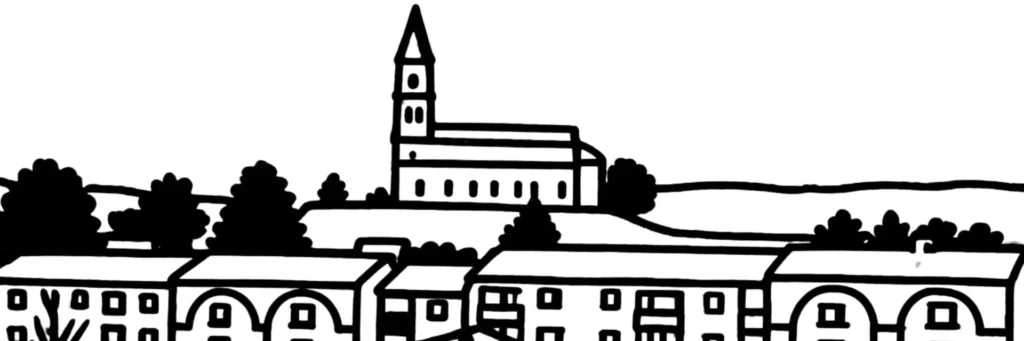
Atmospheric illustration of L'Isle-d'Abeau, a new town of the Nord-Isère between Lyon and Bourgoin-Jallieu.
An apartment in L'Isle-d'Abeau sells on average for around 2 713 €/m², a benchmark calculated on the sales actually completed before notaries and published in DVF data, the French notarised sales database. This figure rests on 88 apartment sales registered in 2025, for a pace of around 90 transactions a year: a sufficient volume to give a reliable trend at the scale of the municipality. The flat stock dates for the most part from the construction of the new town, from the 1970s onwards, since supplemented by more recent residential blocks. Houses, numerous in the housing estates and suburban sectors, sell at a level per square metre very close to that of apartments. The year of construction, the energy label and the distance to the station explain a good share of the differences from one property to another.
Prices from the DVF file (Demandes de valeurs foncières, published by the DGFiP), transactions actually recorded at the notary at municipality level. Cross-referenced with the Notaires de France - INSEE indices. Learn more about our methodology.
The L'Isle-d'Abeau market benefits from its position in the Nord-Isère, halfway between the Lyon metropolis and Bourgoin-Jallieu. Demand comes largely from households who can no longer find housing in Lyon or its inner suburbs and who accept a commute by train or via the A43. In return the town offers larger floor areas and a greener setting, with hillsides and natural areas close by. The local employment area, between the logistics hub of Saint-Quentin-Fallavier, the business parks of the CAPI and the shops of the Sayes, also supports demand.
Supply is abundant but heterogeneous, which widens price gaps from one neighbourhood to another. Renovated, well-insulated properties close to the station sell faster, while the energy-intensive homes of the first phases of the new town often require negotiation. The timetable for the gradual ban on letting energy-inefficient homes is pushing some landlords to sell or to undertake works. For a seller, presenting a recent DPE and a clear maintenance history remains the best way to defend the price.
L'Isle-d'Abeau sits slightly below La Verpillière and Saint-Priest, closer to Lyon, but well above La Tour-du-Pin, further east. It occupies an intermediate position, consistent with its status as a new town served by train and motorway.
The name of the municipality is said to come from Insula Arthas, a village dependent on the priory of Artas, surrounded by marshes to the point of resembling an island. For centuries, L'Isle-d'Abeau remained a small farming village of the Bas-Dauphiné, set on the hillsides overlooking the valley of the Bourbre, a tributary of the Rhône. A fortified house is recorded there as early as 1540 in the inventories of the 16th century. The old bourg retains from that era its église Saint-Pierre-et-Saint-Paul, the chapelle Saint-Germain and the traces of a former Templar commandery.
Everything changed on 8 February 1968, when the State decided by decree to create a new town east of Lyon, intended to absorb part of the growth of the conurbation. A public development body, the EPIDA, was set up on 10 January 1972 and led the urbanisation of several municipalities of the Nord-Isère for decades. Development zones followed one another: Saint-Hubert, Fontbonnière, Pierre-Louve, then the Trois-Vallons. In a few decades the village became a town of more than 17 000 inhabitants, organised in neighbourhoods around the old bourg.
Governance followed the same path: a new town association was created in 1984, replaced on 1 January 2007 by the Communauté d'agglomération Porte de l'Isère, the CAPI, whose headquarters stand on avenue du Bourg, in the municipality. L'Isle-d'Abeau now forms, with Bourgoin-Jallieu, Villefontaine and Saint-Quentin-Fallavier, the heart of this territory. The Sayes shopping area and the neighbouring business parks have anchored jobs there. The town thus keeps a double face, that of an old Dauphiné village and that of a planned town of the second half of the 20th century.
L'Isle-d'Abeau has 17 515 inhabitants, a population that has risen steadily since the creation of the new town. The housing stock mixes blocks of flats built in the development neighbourhoods, grouped town houses typical of the programmes of the 1970s and 1980s, and more recent detached houses on the outskirts. Buyers are often young households and families who work in the Lyon conurbation or in the Nord-Isère and are looking for more space than in Lyon on a contained budget. First-time buyers find family apartments at still affordable prices, while investors target the rental demand linked to the station and the employment zones. The old bourg, with its old stone houses, attracts a different clientele, more attached to the character of the buildings.
The town reads neighbourhood by neighbourhood, inherited from the development zones of the new town. Pierre-Louve is a residential sector appreciated for its calm, with a large share of houses. Saint-Hubert and Fontbonnière, among the most populated neighbourhoods, concentrate more blocks of flats and often offer the lowest entry prices. The old bourg, around the church, offers older buildings that are rarer on the market. The Trois-Vallons, developed later, bring together more recent constructions.
The municipality has a TER regional train station opened in 1985, on the line that links Lyon to the Alpine corridor via Bourgoin-Jallieu. Direct trains serve Lyon, and Grenoble can be reached in a little over an hour. By road, the A43 motorway crosses the territory and three interchanges serve the municipality, which puts Lyon some twenty kilometres away. The RUBAN bus network provides links with Bourgoin-Jallieu, Villefontaine and the business parks. A home close to the station or an interchange is a real selling point for working people.
As a local particularity, the price per square metre of houses is very close to that of apartments, around the benchmark of 2 713 €/m² for flats. The choice therefore depends above all on the floor area sought and the overall budget, a house representing a higher entry ticket. Many houses in the new town are grouped houses on small plots, to be distinguished from detached houses with gardens. For apartments, the condition of the co-ownership and the amount of service charges weigh on value. In both cases, energy performance plays a growing role.
The municipality is crossed by the Bourbre, and some plots in the valley, formerly marshy, may be exposed to a risk of flooding or rising groundwater. The risk disclosure statement (état des risques) provided by the seller and the local urban plan (PLU), available at the town hall or from the CAPI, let you check this plot by plot. In the co-ownership buildings of the 1970s and 1980s, it is useful to consult the latest minutes of general meetings to identify works voted or to come. The energy performance certificate (DPE) also deserves careful reading, as part of the housing stock from this period is poorly insulated.
DVF data records around 90 apartment transactions a year in the municipality, including 88 in 2025. This volume ensures decent liquidity: a property at market price generally finds a buyer without excessive delay. Houses also see a sustained number of sales, driven by the housing estates of the new town. To value your property, the most reliable approach remains to compare it with recent sales in your neighbourhood, for equivalent floor area and condition.
This analysis is published by Immover, an independent observatory founded by Antony Barbier. Data sourced from official sources (DVF, INSEE, Notaries of France).