The average price per m² in La Madeleine is 3 260 €/m² for an apartment, based on actual notarised (DVF) sales. About 243 transactions are recorded each year.

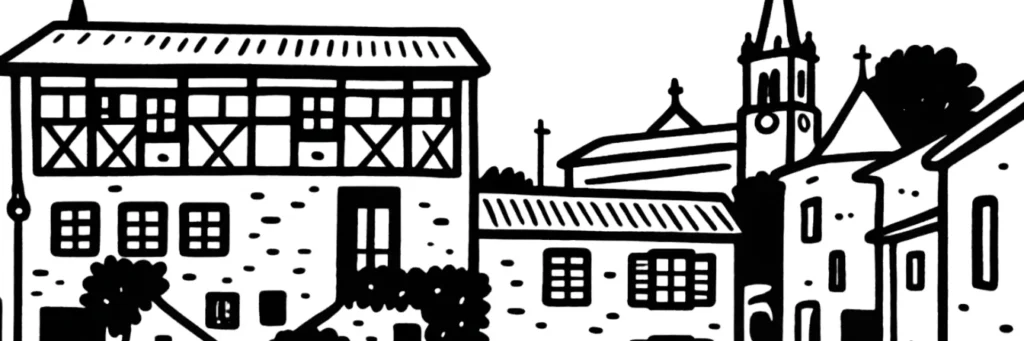
Mood illustration of La Madeleine, in the Nord.
The average price recorded in La Madeleine stands at 3 260 €/m². That average covers a stock that is very largely collective, since close to seven dwellings out of ten are apartments according to INSEE, the French national statistics institute, on a dense territory of 2,84 km² squeezed between Lille, the Deûle and the Grand Boulevard. It mixes the tenement blocks of the avenue de la République, the brick workers' houses inherited from the Berkem spinning mills, the housing blocks built after 1960 and the more recent developments of the Romarin sector. These values come from the DVF database, the French notarised sales database, which lists the transactions actually registered before notaries.
Prices from the DVF file (Demandes de valeurs foncières, published by the DGFiP), transactions actually recorded at the notary at municipality level. Cross-referenced with the Notaires de France - INSEE indices. Learn more about our methodology.
The La Madeleine market depends first of all on Lille. The municipality adjoins the city centre and lies about three kilometres from Lille-Flandres station, served by the two tramway lines of the Grand Boulevard, by a regional train stop and by several Ilévia bus lines. It therefore captures demand from households who work in the metropolitan area and look for a larger dwelling or a house without moving away. The average household size, at 1,9 people per main residence according to INSEE, reflects the presence of many young working people and of couples without children.
Supply, for its part, is very constrained. With 2,84 km² almost entirely built up, the municipality has no land reserves left and its renewal comes through the conversion of former industrial sites and through one-off schemes, such as those carried out in the Romarin sector. The inter-municipal local plan of the Métropole européenne de Lille, in force since June 2020, frames those changes, in particular plot divisions and added storeys on the fabric of workers' houses. The share of tenants, in the majority according to INSEE, also keeps up demand from investors for small floor areas.
La Madeleine sits just below the level of Lille, which it adjoins, but above Villeneuve-d'Ascq and well above Roubaix, further along the line of the Grand Boulevard.
La Madeleine took shape from several hamlets lying outside the walls of Lille: le Vert-Pire, le Riez, Waudringhien and Berkem, the last of these bearing a name of Flemish origin. A parish of Sainte-Marie-Madeleine was established there in 1233, outside the town wall. The area then followed the fate of Flanders, passing from the counts of Flanders to the Burgundian realm and then to the Habsburgs, before the French conquest of 1667. The fortifications built by Vauban brought part of the parish into the enlarged Lille and left the rest as a suburb, outside the ramparts. In 1790, that suburb became a municipality of some six hundred inhabitants.
The nineteenth century turned this farming town into an industrial one. Engineering workshops and chemical works appeared between 1825 and 1850, followed after 1872 by the spinning mills, among them the Agache, Saint-Léger and Huet works, large employers of female labour. The population rose from about two thousand inhabitants in the middle of the century to several thousand on the eve of 1900. Public facilities followed the movement: the church of Saint-Vital was built at Berkem in 1868, the church of Sainte-Marie-Madeleine rebuilt in 1888, the town hall opened in 1892. At the turn of the century, an experimental sewage treatment station was studied in the municipality by the Institut Pasteur in Lille.
The opening of the Grand Boulevard on 4 December 1909, then of Alfred Mongy's tramway on 11 December of the same year, gave the municipality a structuring route towards Roubaix and Tourcoing, along which blocks and middle-class houses rose. After the occupation of 1914-1918 and the rebuilding, the church of Notre-Dame de Lourdes was put up in 1937. The deindustrialisation of the 1970s and 1980s closed Huet, wound up Agache and made the Cotonnière disappear: the freed-up sites and part of the working-class districts gave way to blocks of flats. In the 1990s, opposition from the town council to a metro viaduct on the Grand Boulevard kept the historic tramway in place.
La Madeleine has 21 790 inhabitants over 2,84 km², a density comparable to that of a city centre. According to INSEE, the municipality counts about 13 050 dwellings, of which 87 % are main residences and less than 4 % second homes: the market is residential, with no holiday dimension. Again according to INSEE, close to 71 % of dwellings are apartments and 27 % houses, and 43 % of the households occupying their main residence own it, against 56 % who rent. With 1,9 people per main residence on average, buyers are mainly young working people, couples and families who work in Lille and look for a neighbouring municipality on a better scale than the city centre.
The average price stands at 3 260 €/m². That figure is calculated from the DVF database, which lists the transactions registered by notaries, and not from listings. It covers very different situations depending on the nature of the property: a brick house in the Berkem sector, an older apartment on the avenue de la République or a recent dwelling in the Romarin do not sit at the same level.
The municipality is organised around a few clearly identified sectors. The centre, around the town hall and the church of Sainte-Marie-Madeleine, concentrates the shops. Berkem, a former hamlet turned factory district, borders the Deûle to the south-west. The avenue de la République, which carries the Grand Boulevard and the tramway, lines up more comfortable housing. The Romarin, around the Valentine-Labbé secondary school, and the Nouvelle Madeleine, near the ring road, are the most recent sectors.
The municipality adjoins Lille, about three kilometres from the centre. Tramway lines R and T, which link Lille-Flandres station to Roubaix and Tourcoing, serve the Romarin and Botanique stops on the Grand Boulevard. La Madeleine station takes the regional trains between Lille-Flandres and Hazebrouck. The Ilévia bus network completes the service, with the lianes 5 and 91 and several standard lines. There is no metro station within the municipality.
The two markets coexist, which is uncommon so close to Lille. According to INSEE, about 71 % of dwellings are apartments and 27 % houses, often brick workers' dwellings, sometimes former courtyard housing since refurbished, with modest floor areas and small gardens. The supply of houses is therefore limited and concentrated in the streets born of industrial urbanisation, while flats dominate along the main routes and in the more recent developments.
The municipality is part of the Métropole européenne de Lille, which holds planning powers. The inter-municipal local plan, known as PLU2, was approved by the metropolitan council on 12 December 2019 and came into force on 18 June 2020. It is that document, and not a municipal set of rules, that must be consulted before any extension, added storey or plot division project, in addition to the easements attached to each plot.
This analysis is published by Immover, an independent observatory founded by Antony Barbier. Data sourced from official sources (DVF, INSEE, Notaries of France).