The average price per m² in Lons-le-Saunier is 1 649 €/m² for an apartment, based on actual notarised (DVF) sales. For a house or villa, it is 2 279 €/m². About 168 transactions are recorded each year.

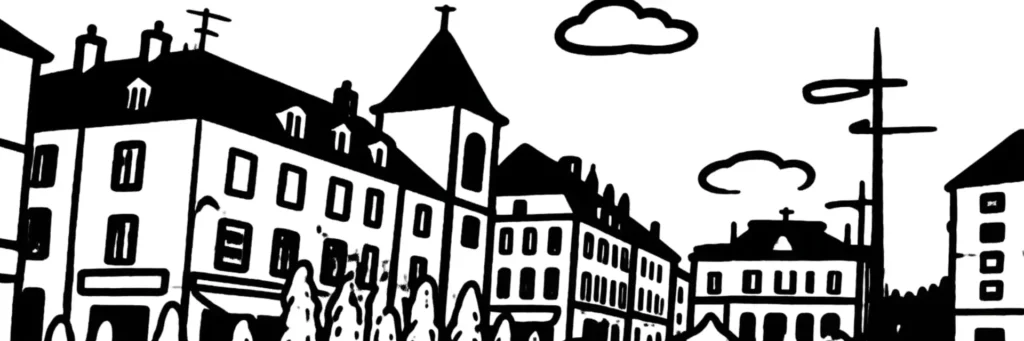
Atmospheric illustration of Lons-le-Saunier, prefecture of the Jura, between the Revermont hills and the Bresse plain.
In Lons-le-Saunier, an apartment sells for around 1 649 €/m², according to sales completed before notaries and published in DVF data, the French notarised sales database. This benchmark rests on 198 apartment sales, a sufficient volume for a town of this size, with around 168 transactions a year across all categories. Flats are concentrated in the old centre, around the rue du Commerce, and in the residential blocks built from the 1960s onwards on the slopes and on the outskirts. Houses, found in the suburban neighbourhoods and on the hillsides, sell for more per square metre, around 2 279 €/m² over 96 sales. That is why the page shows both benchmarks.
House : 2 279 €/m²
Prices from the DVF file (Demandes de valeurs foncières, published by the DGFiP), transactions actually recorded at the notary at municipality level. Cross-referenced with the Notaires de France - INSEE indices. Learn more about our methodology.
The Lons market rests on stable and diversified employment. Its status as prefecture keeps administrations, a hospital and schools in the town, while the dairy industry, with the Bel factory and other processing sites, provides industrial jobs. This base limits sharp price movements: the town experiences neither the pressure of the large cities nor the slump of declining areas. The population has nonetheless fallen slightly in recent years, which moderates demand for the least well-located or most energy-inefficient properties.
To sell in good conditions, the condition of the dwelling counts as much as the location. Renovated apartments in the centre, close to shops and the station, find buyers among working people and retirees, whereas properties rated F or G on the energy performance certificate face tougher negotiation, all the more so as renting them out is being progressively restricted. For houses, demand remains driven by families who want to stay close to the services of the prefecture. With a sufficient volume of sales, the town-wide average gives a reliable benchmark here, which the valuation of your property then refines.
Lons-le-Saunier sits at the level of Dole, the other large town of the Jura, above Chalon-sur-Saône and below Bourg-en-Bresse, the neighbouring prefecture of the Ain.
Lons-le-Saunier takes its name from salt. The salt springs of the site were exploited as early as Roman times, and the qualifier "Saunier", the one who produces salt, was added to the town's name in the Middle Ages. A castle is recorded as early as 1097, and around 1400 the lordship passed under the authority of the house of Chalon-Arlay, whose title later went to the princes of Orange. This salt wealth explains the presence of a market town at the foot of the Revermont, where the Jura plateau meets the Bresse plain.
The 17th century marked a break. In 1637, during the war between France and Spanish Franche-Comté, French troops forced the ramparts and the town was set on fire. The rue du Commerce, until then built of wood, was rebuilt in stone and tile while keeping its medieval curve: its 146 arcades today form the best-known image of the centre. The town passed definitively under French control in 1674, and its fortifications were gradually dismantled. Claude Joseph Rouget de Lisle, author of La Marseillaise, was born there on 10 May 1760, in a house on that same street which is now a museum.
The 19th and 20th centuries gave Lons its dual identity as a spa town and a cheese town. The Lédonia thermal baths have operated since 1892 using the local salt waters, in the parc des Bains neighbourhood. The Bel company set up in Lons in 1897; Léon Bel registered the La Vache qui rit trademark on 16 April 1921, and the Lons factory, inaugurated in 1926, still produces this cheese. Since 2009, the Maison de la Vache qui rit has welcomed the public on the site of the first production. As prefecture of the Jura, the town also concentrates the administrations, the hospital and the services of the department.
Lons-le-Saunier has 16 618 inhabitants and remains the main town of a largely rural department. Its property stock mixes old stone buildings in the centre, post-war apartment blocks and suburban neighbourhoods spreading up the slopes of the Revermont. Buyers are largely local working people, civil servants, employees of the dairy industry or of the hospital sector, as well as households from neighbouring municipalities looking for the services of a prefecture town. The centre also attracts retirees and single people, for whom an apartment close to the shops matters more than a plot of land. For families, a house with a garden on the outskirts remains the usual target.
Allow on average 1 649 €/m² for an apartment in 2026, according to the notarised transactions in DVF data. This level rests on 198 apartment sales, which makes it a solid benchmark for a town of this size. An old apartment under the arcades and a dwelling in a 1970s residential block do not sell at the same price: the floor, the condition of the common areas and the energy performance change the result. The average is a starting point, not a verdict.
In Lons-le-Saunier, houses sell for around 2 279 €/m², well above apartments. The gap comes from the nature of the properties: the houses sold are often recent or renovated detached houses with land, on the hillsides or on the outskirts, whereas part of the apartments belongs to an older stock of blocks. With 96 house sales, this second benchmark is substantial enough to be displayed. For your property, the size of the plot, the orientation and the general condition count as much as the neighbourhood.
Lons-le-Saunier station is on the line from Mouchard to Bourg-en-Bresse, served by TER regional trains towards Besançon and Lyon. The A39 motorway, which links Dijon to Bourg-en-Bresse, passes around ten kilometres west of the town. Lons is also a road junction between the Bresse, the Jura vineyards and the plateaus in the east of the department. For a buyer who works in the town, most journeys are made by car or on foot from the centre.
The old centre, around the rue du Commerce, the theatre and the place de la Liberté, contains most of the stone buildings and old apartments. The parc des Bains neighbourhood, near the Lédonia thermal baths, offers a more open setting with bourgeois houses and small apartment buildings. The apartment-block neighbourhoods built from the 1960s onwards make up another, more affordable market. Finally, the housing developments and houses on the slopes of the Revermont form the segment most sought after by families.
The centre of Lons-le-Saunier has several buildings protected as historic monuments. Around these monuments, work visible from public space, such as a façade, a roof or joinery, requires the opinion of the Architectes des Bâtiments de France, the state heritage architects. Before buying an old apartment to renovate, ask at the town hall about the rules that apply to the address. The energy performance certificate (DPE) also deserves a careful reading, as old stone buildings can show a poor rating.
This analysis is published by Immover, an independent observatory founded by Antony Barbier. Data sourced from official sources (DVF, INSEE, Notaries of France).