The average price per m² in Mèze is 3 880 €/m² for an apartment, based on actual notarised (DVF) sales. About 71 transactions are recorded each year.

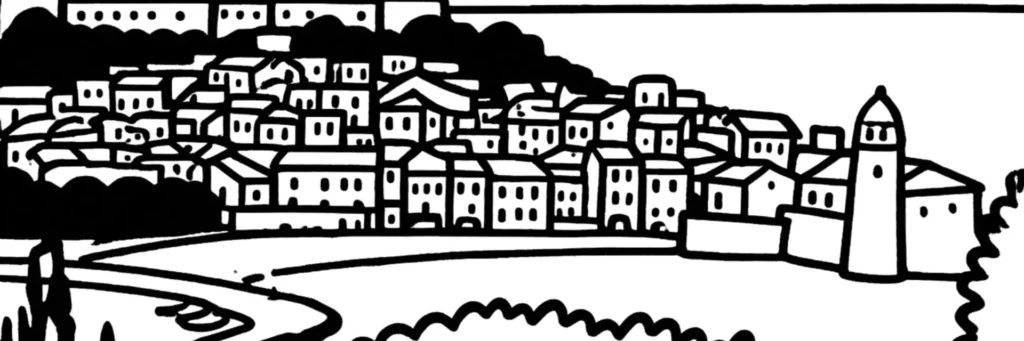
Atmospheric illustration of Mèze, on the north shore of the Thau lagoon, in the Hérault.
The average apartment price in Mèze stands at 3 880 €/m², based on DVF transactions actually registered with notaries (DVF is the French record of notarised property sales). This average covers a contrasted stock: village houses in the old centre packed around the harbour, houses on the estates of the second half of the twentieth century, recent developments close to the Thau lagoon and more modest dwellings on the outskirts. Proximity to the water, the view, the aspect, the condition of the property and its distance from the harbour make values vary noticeably from one dwelling to another. The municipality borders the north shore of the lagoon, between the vines and the water, halfway between Sète and Montpellier.
Prices from the DVF file (Demandes de valeurs foncières, published by the DGFiP), transactions actually recorded at the notary at municipality level. Cross-referenced with the Notaires de France - INSEE indices. Learn more about our methodology.
The Mèze market is steady rather than busy. Recent DVF data record on the order of 140 sales over the period retained, that is around 70 transactions a year, a volume consistent with the size of the municipality and with the predominance of houses, which change hands less often than the small units of the seaside resorts. This moderate liquidity stems from a stock largely occupied year-round and from a contained share of second homes.
Several factors support the price level. The position of Mèze on the Thau basin, between the employment hub of Sète and the Montpellier metropolitan area, attracts households looking for the lagoon setting without the prices of the Sète seafront. Oyster and shellfish farming sustain economic activity and a maritime identity all year, while the appeal of the Hérault coast keeps second-home demand alive. Conversely, the relative distance from the sandy beaches and the absence of a station on the main line keep values below those of municipalities directly on the Mediterranean.
Mèze sits in the lower range of the Thau basin municipalities, behind the resorts that open directly onto the Mediterranean. The price level stays close to that of nearby Sète, but below that of Marseillan.
Mèze is among the oldest inhabited sites of the Thau basin. The Phocaeans settled there in the sixth century BC, around the time nearby Agde was founded, and the site was fully occupied by the Romans from 49 BC. During the first three centuries of the Christian era the town prospered under the Roman peace, with numerous villae established on its land. The name itself is ancient: it derives from a root meaning marsh, attested in the Latinised forms castrum de Mesoae in 844 and villa de Mesoa in 987.
In the Middle Ages, Mèze was taken by the troops of Simon de Montfort in 1209, during the Albigensian Crusade, then attached to the kingdom of France in 1229. The town went through the Black Death of 1347 and the turmoil of the Wars of Religion, before a period of prosperity in the eighteenth century: maritime trade revived on the lagoon and winegrowing established itself as the dominant resource of the land. The first elected municipal council was installed in 1790.
Oyster farming, today associated with the image of the municipality, came later. The first concessions were granted from 1911 and shellfish farming developed slowly after the First World War, before taking off after 1945, when fishermen and above all winegrowers hit by the wine crisis switched to raising oysters and mussels. The Mourre Blanc quarter, west of the town, remains its historic heart and one of the main shellfish harbours of the Thau lagoon.
Mèze has 12 669 inhabitants at the latest INSEE census (INSEE is the French national statistics office). The housing stock is predominantly made up of houses: according to INSEE, houses account for nearly 62 % of dwellings and apartments around 38 %, the reverse of the split in the neighbouring large seaside resorts. Main residences form around 80 % of the stock and second homes nearly 15 %, a moderate share for a municipality on the Hérault coast, the sign of a town that stays lived in year-round. Also according to INSEE, a little over 60 % of households own their home. Buyers are split between families working in Sète or in the Montpellier metropolitan area, local workers and second-home buyers drawn by the lagoon.
The average apartment price in Mèze is 3 880 €/m², based on DVF transactions actually completed before notaries. This average hides gaps depending on proximity to the harbour and the lagoon, the view, the floor level, the presence of outdoor space and the condition of the property. A recent dwelling close to the water and an older apartment set back do not trade at the same level.
Mèze remains above all a town lived in year-round: main residences account for around 80 % of the stock, against nearly 15 % second homes according to INSEE. That is a markedly lower proportion than in the resorts of the coastal sand bar. The Mourre Blanc shellfish harbour and oyster farming sustain a local economy all year, beyond the summer season.
Mèze lies on the north shore of the Thau lagoon, about 7 kilometres from Sète and some thirty kilometres from Montpellier. The municipality is linked by the road that follows the lagoon and by the A9 motorway via the nearby junctions. It has no station on the main line: the closest are Sète and Montpellier, supplemented by the urban-area bus network.
Like many municipalities on the Hérault coast, Mèze may apply tax measures specific to second homes, the terms of which change from one year to the next. The council tax on second homes and the rules governing furnished tourist lettings are decided locally. These points should be checked with the town hall before any purchase of a second home.
The Mèze market is made up mainly of houses: according to INSEE they account for nearly 62 % of the municipality's dwellings, against around 38 % apartments. The old centre around the harbour concentrates village houses, while the estates and recent developments provide most of the supply of houses and flats. The reference price of 3 880 €/m² relates to the apartment segment.
This analysis is published by Immover, an independent observatory founded by Antony Barbier. Data sourced from official sources (DVF, INSEE, Notaries of France).