The average price per m² in Montfort-sur-Meu is 2 527 €/m² for an apartment, based on actual notarised (DVF) sales. About 19 transactions are recorded each year.

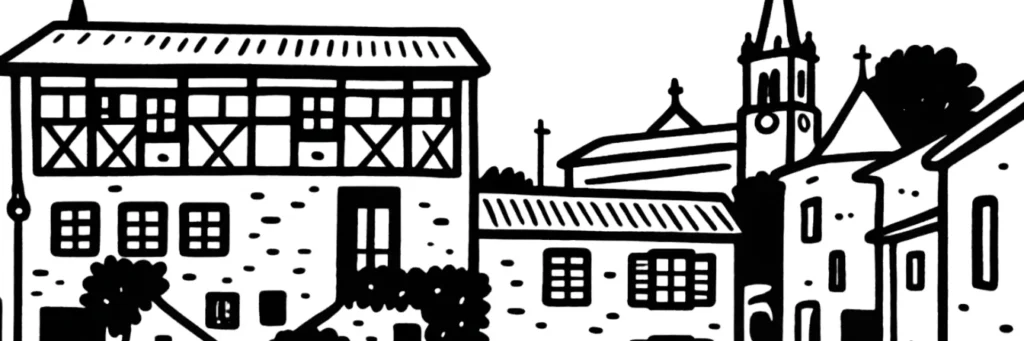
Atmospheric illustration of Montfort-sur-Meu, a small town of character west of Rennes, in Ille-et-Vilaine.
The average price recorded in Montfort-sur-Meu stands at 2 527 €/m². This average covers a housing stock where the house is largely dominant, close to 70 % of the homes according to INSEE, the French national statistics institute, against 30 % of apartments concentrated in the centre and in recent developments. Differences in value come from the location, between the protected old centre and the housing estates on the outskirts, from the condition of the property and from its energy performance. These figures come from the DVF database, which records transactions actually registered with notaries, and not from asking prices displayed by agencies.
Prices from the DVF file (Demandes de valeurs foncières, published by the DGFiP), transactions actually recorded at the notary at municipality level. Cross-referenced with the Notaires de France - INSEE indices. Learn more about our methodology.
The Montfort-sur-Meu market is driven by the growth of the Rennes area. With around twenty sales a year, the municipality offers steady liquidity, without speculative excess. The population, which rose from around 4 300 inhabitants in the early 1980s to 6 810 in 2023 according to INSEE, feeds sustained demand from families and working households. The station on the Rennes to Brest line and the immediate closeness of the Rennes metropolitan area, some twenty kilometres away, are the main engines of this residential momentum.
Prices remain below those of the inner ring around Rennes, which attracts buyers put off by the levels reached in Mordelles, Le Rheu or Bruz. The stock, dominated by the detached house, renews itself through estates and new developments on the outskirts, while the historic village keeps a rarer supply of older buildings. Energy performance weighs more and more heavily in negotiations, particularly on the older houses in the centre and on the estate houses of the 1970s and 1980s.
West of the Rennes metropolitan area, Montfort-sur-Meu shows a price level clearly below that of Rennes and of its neighbour Mordelles, while staying above a more distant municipality such as Ploërmel.
Montfort was born in the 11th century, when Raoul I of Gaël, a companion of William the Conqueror, chose a knoll overlooking the Meu to raise a castle there. A motte was laid out, then a stone keep around 1091. From 1376 to 1389, Raoul VIII rebuilt the fortress and surrounded it with four towers; the town then protected itself with a wall pierced by three gates, Saint-Jean, Coulon and Saint-Nicolas. The stronghold was dismantled in the 17th century. Of that whole, the Papegaut tower survives, a 14th-century keep that today houses the ecomuseum of the Montfort country.
The town grew at the meeting point of the Meu and the Garun, two rivers that shaped its economy. From the Middle Ages, the banks of the Meu were home to tanneries: until the end of the 19th century, some ten works were concentrated in the same quarter, and the last tannery closed its doors in 1966. Montfort is also the birthplace of Louis-Marie Grignion de Montfort, a priest and missionary born in 1673, a leading figure of Marian spirituality. That past earned it the label of small town of character, which marks out its built heritage.
In the 19th century, Montfort became a sub-prefecture of Ille-et-Vilaine, a status that came with a first phase of urban growth and new amenities. The municipality, long close to 4 300 inhabitants in the early 1980s, saw its population climb to 6 810 in 2023 under the effect of the closeness of Rennes, some twenty kilometres away. Served by a station on the Rennes to Brest line, it spread through successive estates around its old core, without that core losing its character as a historic village built on the water.
According to INSEE, the French national statistics institute, Montfort-sur-Meu has 6 810 inhabitants, a population that has risen sharply since the 1980s. The stock is overwhelmingly made up of houses, close to 70 % of the homes, against around 30 % of apartments. Main residences account for more than 91 % of the stock and second homes for less than 2 %, the sign of a municipality lived in all year round rather than geared to tourism. A little more than two households in three own their home according to INSEE. The market serves first and foremost families and working households employed in Rennes or in its wider area, drawn by a small-town setting and prices below those of the inner ring around Rennes.
The average price recorded is 2 527 €/m², calculated from transactions registered with notaries and published in the DVF database. It is a municipality-wide average that mixes the old village house, the estate house and the recent apartment. Location, floor area, condition and the energy rating of a home explain most of the differences. A reliable valuation rests on recent comparable sales, not on the municipal average alone.
The historic centre, around the Papegaut tower and the banks of the Meu, appeals to buyers attached to old buildings and to village life, with its shops and its markets. The housing estates on the outskirts and recent developments close to the station attract families looking for a house with a garden. Closeness to the station and to the routes towards Rennes clearly weighs on demand from one area to another.
Montfort lies some twenty kilometres west of Rennes. The municipality has a station on the Rennes to Brest line, with regional trains reaching the centre of Rennes in about fifteen minutes. By road, the N12 gives quick access to the Rennes metropolitan area. This double link, by rail and by road, explains much of the residential appeal of the town for people working in Rennes.
The stock is clearly geared to the house, which accounts for close to 70 % of the homes according to INSEE. Apartments, around 30 % of the stock, are found mainly in the centre and in recent developments close to the station. A house with a garden will suit a family looking for space, while an apartment may appeal for a first purchase or a rental investment. The gap in price per square metre depends above all on location and on the condition of the property.
The old centre, labelled a small town of character, includes areas around listed monuments where external works may require the opinion of the regional heritage architect. As the town is built where two rivers meet, some plots are exposed to flood risk: the statement of risks should be consulted before any purchase. It is wise to check the local planning document and the easements attached to the plot concerned.
This analysis is published by Immover, an independent observatory founded by Antony Barbier. Data sourced from official sources (DVF, INSEE, Notaries of France).