The immover observatory
Property Prices in Saint-Cyprien, Pyrénées-Orientales2026 property valuation

Updated: January 2026 Sources: DVF · Notaires de France · INSEE · Immover January 2026 · DVF, Notaires de France, INSEE, Immover
In brief

The average price per m² in Saint-Cyprien is 3 681 €/m² for an apartment, based on actual notarised (DVF) sales. About 320 transactions are recorded each year.

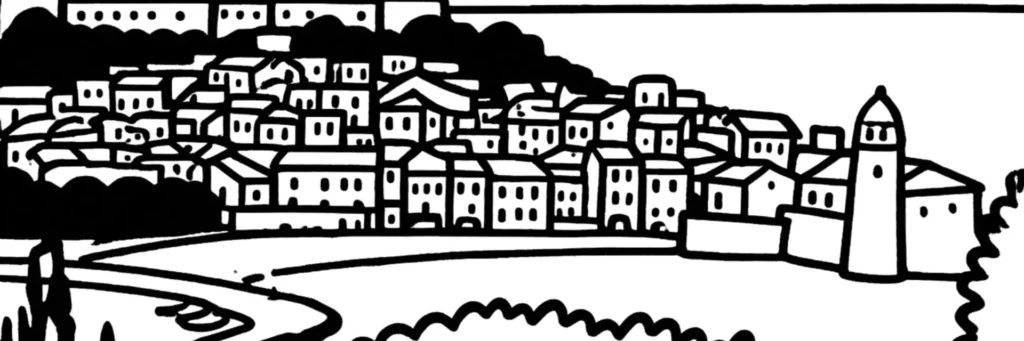
Line drawing of the Saint-Cyprien marina, sailing boats at the quay and a sandy beach

Atmospheric illustration of Saint-Cyprien, between the old village, the marina and the seafront.

Property Prices in Saint-Cyprien

The 2026 figures· Indicative data
3 681€/m²

In Saint-Cyprien, the average price comes out at 3 681 €/m² for an apartment. This average covers an area split in two: on one side the original village, to the west, with its older buildings and its town houses; on the other the resort created in the 1960s, lining up holiday developments, seafront blocks, the marinas of the harbour and the villas of the Golf sector. The stock is around 52 % apartments according to INSEE, the French national statistics office, many of them small units designed for seasonal letting. The figure comes from DVF data, that is from transactions actually registered with notaries, not from listings.

Apartment transactions / year
320
Median price per m²
3 644 €

Prices from the DVF file (Demandes de valeurs foncières, published by the DGFiP), transactions actually recorded at the notary at municipality level. Cross-referenced with the Notaires de France - INSEE indices. Learn more about our methodology.

Market trend in Saint-Cyprien

+13 % over 5 years
Change in the average price per m² in Saint-Cyprien, from 3 260 € in 2021 to 3 681 € in 2026. 4 200 € 3 850 € 3 500 € 3 150 € 3 260 € 3 547 € 3 886 € 3 845 € 3 672 € 3 681 € 2021 2022 2023 2024 2025 2026
Change in the average price per m² in Saint-Cyprien, 2021 to 2026. Source: DVF.

After 3 260 €/m² in 2021, the average price in Saint-Cyprien reaches 3 681 €/m² in 2026, an increase of roughly +13 % over the period.

Market trends and analysis for Saint-Cyprien

The Saint-Cyprien market is driven first by second-home demand along the municipality's six kilometres of beach. The municipal population rose from 1 854 inhabitants in 1962 to 12 068 in 2023, but it multiplies several times over in season, which sustains continuous demand for small units that can be let in summer. That seasonality shapes prices: studios and one-bedroom flats often trade at a higher price per square metre than large dwellings, and the distance to the beach or to the harbour creates clear gaps between two properties of equivalent size.

The second driver lies in the amenities and in the constraint on land. The marina, the golf course opened in 1976 and water sports extend the season beyond the summer and support local jobs, largely oriented towards tourism and retail. On the supply side, the Coastal Act, the nature reserve of the Canet-Saint-Nazaire lagoon and exposure to submersion risk limit buildable land near the sea. Most transactions therefore involve existing property, in a stock largely built between the 1970s and the 1990s.

Saint-Cyprien on the Roussillon coast

average €/m²

Saint-Cyprien sits clearly above the prefecture of the Pyrénées-Orientales, only some twelve kilometres away, but behind the villages of the Côte Vermeille and the most established seaside resorts of the Languedoc coast. The scarcity of buildable land near the sea explains a large part of those gaps.

MunicipalityTierPrice /m²Gap
Collioure5 697 €+55 %
Agde4 219 €+15 %
Saint-Cyprien3 681 €ref.
Perpignan1 616 €-56 %

The history of Saint-Cyprien

The site was occupied from antiquity under the name Villa Salix, where it served as the sea outlet of Illiberis, today's Elne. The name Saint-Cyprien, borrowed from the bishop of Carthage martyred in 258, appears in written records at the beginning of the tenth century. The village then took shape around its church and its farmland, with a Templar presence in the twelfth century. It remained modest throughout the Middle Ages: about 350 inhabitants were recorded at the end of the fourteenth century. Like most municipalities on the Roussillon coast, it was built back from the shore, sheltered from raids from the sea and from marshy ground.

The twentieth century turned abruptly in February 1939. After the fall of Catalonia and the mass arrival of Spanish Republican refugees, the state opened an internment camp on the sand of the beach itself: the first huts were put up from 4 February 1939 and the camp would hold several tens of thousands of internees before being emptied at the start of 1940. The municipality then returned to its farming and maritime calling. Two housing schemes for fishing families were launched in 1947 and then in 1954, but Saint-Cyprien still had only 1 854 inhabitants at the 1962 census.

The turning point came from the Racine mission, the tourist development programme for the Languedoc-Roussillon coast launched in the early 1960s. Saint-Cyprien became one of the resorts created between 1963 and 1983. The marina was built in 1967: it took 300 boats in 1969 and today exceeds 2 000 berths, which makes it one of the largest on the French Mediterranean. The golf course, designed by the British architects Ben Wright and Barry Tomlinson, opened in 1976. The painter François Desnoyer, who lived locally, bequeathed more than 700 works to the municipality in 1972. The population reached 12 068 inhabitants in 2023.

Who buys in Saint-Cyprien

According to INSEE, Saint-Cyprien has 12 068 inhabitants for about 17 700 dwellings, of which nearly 62 % are second or occasional homes and 38 % main residences. The stock is split almost evenly between houses and apartments, the latter accounting for around 52 % of dwellings. Buyers are therefore in large part second-home purchasers, often from Toulouse, the Garonne valley, the Paris region or nearby Spain, looking for a studio or a one-bedroom flat near the beach, sometimes for a dwelling with a mooring at the harbour. Year-round residents are mostly owners: according to INSEE, 62 % of households occupy their main residence as owner-occupiers.

Frequently asked questions

The average price recorded in Saint-Cyprien is 3 681 €/m² for an apartment. It is calculated from sales actually registered in the DVF database, fed by notarial deeds, and not from listings. That level reflects a seaside market where a large share of the properties sold are holiday dwellings. For a specific property, the gap with this average depends above all on the area, the distance to the beach, the floor level, the view and the parking.

The municipality is divided into about a dozen neighbourhoods, spread between two poles some three kilometres apart. To the west, Saint-Cyprien-Village keeps the older buildings, the town hall and the everyday shops. To the east, Saint-Cyprien-Plage and the Port sector concentrate the holiday developments and the marinas. Les Capellans, to the south, form a more residential seaside neighbourhood, while the Golf sector, to the north, mixes villas and small schemes along the course.

The municipality has no railway station. It is reached by road from Perpignan, about 13 kilometres away, by the departmental roads that cross the Roussillon plain, and by the Perpignan Sud junction of the A9 motorway. The nearest stations are Elne and Perpignan, on the Narbonne to Cerbère line. Perpignan-Rivesaltes airport is some twenty kilometres away. This dependence on the car weighs on the value of properties that come with private parking.

Saint-Cyprien was classified as a tight housing market area by the decree of 25 August 2023, which widened the list of municipalities concerned. That classification allows the council to vote an increase in the municipal share of the council tax on second homes, of between 5 % and 60 %. With nearly 62 % second homes in the stock according to INSEE, the measure potentially affects a majority of dwellings. Check the rate actually voted with the town hall before working out your annual budget.

No. The municipality is subject to the Coastal Act, which limits the extension of urban development near the shore and protects a coastal strip where building is prohibited. The north of the area borders the nature reserve of the Canet-Saint-Nazaire lagoon, a protected wetland, and part of the plain is exposed to flooding and marine submersion risk. Consult the local planning scheme and the risk prevention plan applying to the plot before any purchase, extension or additional storey.

Value your property in Saint-Cyprien

Free valuation in under 2 minutes

Value my property

This analysis is published by Immover, an independent observatory founded by . Data sourced from official sources (DVF, INSEE, Notaries of France).

Estimer mon bien