The average price per m² in Valserhône is 2 345 €/m² for an apartment, based on actual notarised (DVF) sales. For a house or villa, it is 3 448 €/m². About 148 transactions are recorded each year.

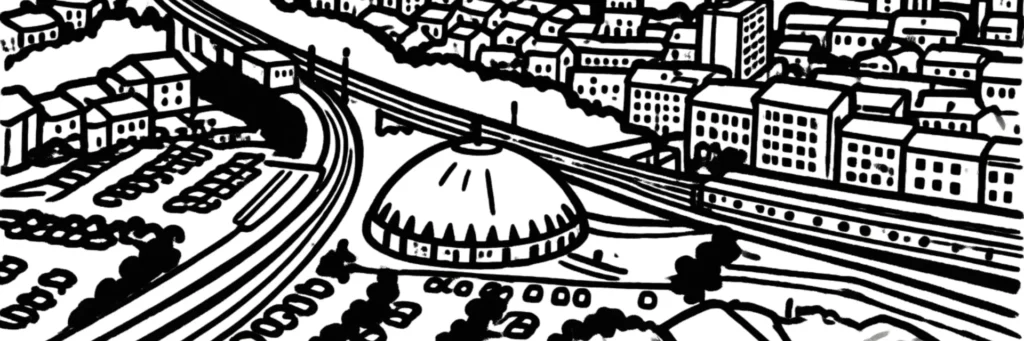
Atmospheric illustration of Valserhône, a town in the Ain department that grew out of Bellegarde-sur-Valserine, at the confluence of the Rhône and the Valserine.
In Valserhône, an apartment changes hands on average for around 2 345 €/m², according to sales registered by notaries in DVF data, the French notarised sales database, and not according to asking prices in listings. This benchmark rests on 162 sales retained for the reference year, and the municipality records around 148 transactions a year: a market active enough for the average to be meaningful. The flat supply is split between the old buildings of the centre of Bellegarde, the residential blocks from the 1960s to the 1980s built during the industrial boom and a few recent developments near the station. Houses, more present on the heights of Châtillon-en-Michaille and Lancrans, sell for markedly more, at around 3 448 €/m², which is why the page also shows this second benchmark.
House : 3 448 €/m²
Prices from the DVF file (Demandes de valeurs foncières, published by the DGFiP), transactions actually recorded at the notary at municipality level. Cross-referenced with the Notaires de France - INSEE indices. Learn more about our methodology.
The Valserhône market moves to the rhythm of the Geneva area, without sharing its price level. The municipality is markedly cheaper than the border municipalities of Haute-Savoie, which attracts households working in Switzerland who are ready to lengthen their commute slightly thanks to the Léman Express. This outside demand adds to that of local workers, in a town that has lost part of its historic industry but remains a centre for services, shops and facilities for the whole Bellegarde area.
In this context, the condition of the home often makes the difference. Apartments in residential blocks built during the Trente Glorieuses, the post-war boom years, are numerous, and their energy performance certificate (DPE) weighs on both the price and the time to sell, as homes rated F or G are gradually being barred from letting. Conversely, a renovated property near the station finds a buyer more easily. For houses, the view, the orientation and winter access on the hillsides remain decisive criteria.
Valserhône sits markedly below the municipalities of the Haute-Savoie Genevois such as Valleiry, Saint-Julien-en-Genevois or Collonges-sous-Salève, closer to the border. This gap reflects the distance to Geneva and the industrial past of the town, but also a more affordable entry price for households in the area.
Valserhône is a new municipality, created on 1 January 2019 by the merger of Bellegarde-sur-Valserine, Châtillon-en-Michaille and Lancrans. Its historic core, Bellegarde, was formerly called Musinens: the town council adopted the name Bellegarde in 1858, confirmed by imperial decree the same year, in reference to the bridge named after Roger de Bellegarde, governor of Burgundy. The suffix sur-Valserine were only added in 1956. In the twentieth century, the town grew by absorbing Le Ponthoud, Coupy and then Arlod.
The destiny of the town stems from its position as a crossing point between Lyon and Geneva. The Lyon-Geneva railway line reached it in 1858, followed by a line towards Évian in 1881 and another towards the Dombes in 1882. Water did the rest: the force of the Valserine and the Rhône attracted industry, and in 1884 the power station of Louis Dumont made Bellegarde the first electrified town in France. Electrometallurgy settled there for the long term, until the closure of the Pechiney site in 2003, whose brownfield land long marked the landscape.
The heritage of Valserhône is above all natural. The town is bordered by the Rhône, whose famous sinks disappeared beneath the reservoir of the Génissiat dam, and crossed by the Valserine, a river that received the Rivières Sauvages wild rivers label in 2014. Its gorges and sinks, where the water plunges between the rocks, draw walkers a few minutes from the centre. The villages of Châtillon-en-Michaille and Lancrans, on the slopes, keep a more rural character that contrasts with the lower town.
Valserhône has 16 712 inhabitants, making it the third most populous municipality of the Ain, behind Bourg-en-Bresse and Oyonnax. Its housing stock mixes blocks of flats in the former Bellegarde, around the station and the centre, and detached houses in the Châtillon-en-Michaille and Lancrans sectors. Some buyers work in Switzerland and look for a more affordable entry price than in the border municipalities of Haute-Savoie, while keeping direct access to Geneva. Households working locally or in the Bellegarde area form the other side of demand, often for a first purchase. Investors look mainly at small homes near the station, easy to let to mobile workers.
Our benchmark for an apartment in Valserhône stands at 2 345 €/m², calculated on sales completed before notaries and published in DVF data. It reflects the prices actually paid, not the amounts displayed by sellers. From one building to another, the gap can be significant: a renovated home near the station does not sell at the price of an apartment needing work in a residential block from the 1970s. For a figure suited to your property, the valuation tool on this page takes into account its size, floor and condition.
The municipality brings together three former municipalities with different profiles. Bellegarde-sur-Valserine concentrates most of the apartments, the shops, the services and the station. Châtillon-en-Michaille and Lancrans, on the hillsides, offer more houses, more land and views of the mountains, at the cost of a heavier reliance on the car. The choice between these sectors is often one between proximity to the train and space.
Yes, it is one of the strengths of the town. Bellegarde station is served by TGV and Lyria trains, by TER regional trains and by a line of the Léman Express, the cross-border rail network, which runs directly to Genève-Cornavin. By road, the A40 motorway interchange lies a few kilometres from the town centre. For someone working in Geneva, the commute often weighs as much as the price per m² in choosing a home.
The gap is marked: houses sell for around 3 448 €/m², against 2 345 €/m² for an apartment. This difference stems from the land, the view and the location of the houses, often on the heights of Châtillon-en-Michaille or Lancrans. It also reflects strong family demand for detached homes in the Geneva area. For a house, the quality of the insulation and the heating system count a great deal, as winters are harsh at the foot of the Jura.
The town is bordered by the Rhône and crossed by the Valserine: consult the risk statement attached to the preliminary sale agreement to find out whether the property is affected by a flood or ground movement risk, common on sloping land. The former industrial brownfield sites, including the Pechiney site closed in 2003, justify looking into the history of neighbouring plots. In a co-ownership building, ask for the latest minutes of the general meetings to anticipate any energy renovation works. Finally, the local urban development plan, available at the town hall, specifies what can be built around you.
This analysis is published by Immover, an independent observatory founded by Antony Barbier. Data sourced from official sources (DVF, INSEE, Notaries of France).