The average price per m² in Baud is 2 334 €/m² for an apartment, based on actual notarised (DVF) sales. About 16 transactions are recorded each year.

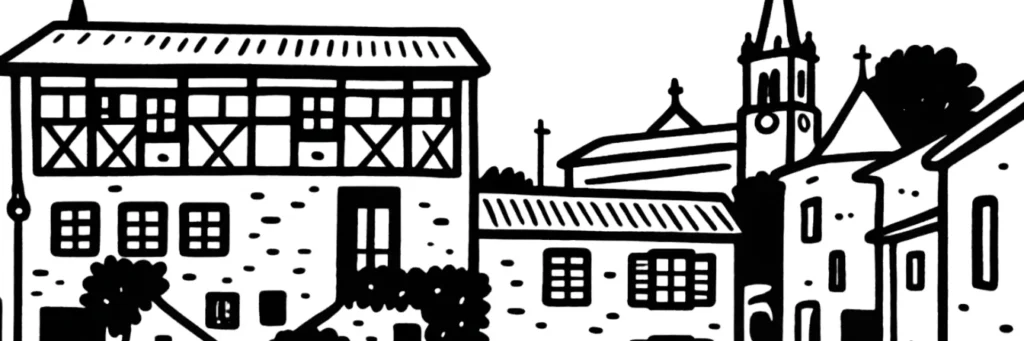
Mood illustration of Baud, a main town of the Blavet valley, between Lorient and Pontivy, in the Morbihan.
The average price recorded in Baud stands at 2 334 €/m². That average brings together a market where individual houses dominate the housing stock by far, alongside a limited share of apartments. The gaps around that average depend on the type of property, the floor area, the general condition, the presence of land and the location, between the town centre and the surrounding hamlets. The town centre, packed around its historic heritage and the Blavet valley, stands apart from the more recent estates on the edges. These figures come from the DVF database, which records sales actually signed before notaries, and give a municipal benchmark to be refined property by property. In a municipality of this size, the number of annual sales remains limited, which makes each transaction sensitive to the features of the property sold.
Prices from the DVF file (Demandes de valeurs foncières, published by the DGFiP), transactions actually recorded at the notary at municipality level. Cross-referenced with the Notaires de France - INSEE indices. Learn more about our methodology.
The Baud market rests on its status as a main town of inland Morbihan, at the crossroads of the RN 24 and of the Auray to Pontivy road. Demand comes above all from families and working people employed in Lorient, Pontivy or Vannes, looking for a house with land at a more affordable price than on the Morbihan coast. The setting of the Blavet valley and the heritage of the municipality, in particular the Vénus de Quinipily, add to its residential appeal without making it a dominant tourist destination like the coastal municipalities.
Supply remains limited by the small volume of annual transactions, typical of a municipality of this size, which makes the market sensitive to the individual features of each property put up for sale. Buyers weigh the old town, close to the shops and to the built heritage, against the more recent estates on the edges, where prices per m² are generally more moderate. The small share of apartments limits the options for tight budgets or small households, steering most of the demand towards the individual house.
A main town of the Blavet valley between Lorient and Pontivy, Baud sits above Pontivy, but below Hennebont and Lorient.
The name of Baud, Baod in Breton, is recorded in the forms Baut in 1259, Bault in 1322, then Baud in 1266 and 1387. According to the linguist Hervé Abalain, it would come from the old Breton baot, bold or daring, itself derived from the Germanic baldo. The inhabitants are called Baudais or Baldiviens. The origins of the parish go back to a priory founded in the 11th century, dependent on the abbey of Saint-Gildas-de-Rhuys, which lastingly shaped the territory. That priory gave Baud an old religious and administrative vocation, at the crossroads of the Blavet valley and the farming land of inland Morbihan. The original parish covered a wider territory than the present municipality, before Saint-Barthélemy separated from it in the 19th century.
The built heritage of Baud carries the mark of several centuries. The château de Quinipily, raised around 1425 by the Langueouez family then taken over by the Lannion family, overlooks the site where the Vénus de Quinipily found refuge in 1695. That ancient statue, long venerated in the neighbouring municipality of Bieuzy before being brought to Baud by the Lannion family, was listed as a historic monument in 1943 and remains one of the best-known landmarks of inland Morbihan. The municipality also keeps the allée couverte du Prieuré, a megalithic monument some ten metres long, as well as the church of Saint-Pierre, which structures the town centre. The war memorial, sculpted by Henri Gouzien in 1924, recalls the 205 victims of the First World War and the 38 of the Second.
Baud became the chief town of a canton in 1790, a status it kept for nearly two centuries before joining the canton of Pontivy at the territorial redrawing. The railway line linking Auray to Pontivy, opened in 1864, long served the municipality before being limited to freight. In 1867, Saint-Barthélemy separated from Baud to form an independent municipality. Today Baud is the seat of Baud Communauté and lies at the crossing of the RN 24, the expressway linking Rennes to Lorient, and of the Auray to Pontivy road. That crossroads position, between the Blavet valley and inland Morbihan, makes it a staging main town between Lorient, Pontivy and Vannes, each some thirty kilometres away.
Baud has 6 367 inhabitants according to INSEE, the French national statistics institute. The housing stock is very largely made up of individual houses, which account for more than eight dwellings out of ten, against a limited share of apartments. Main residences dominate by far, around nine dwellings out of ten, the share of second homes remaining marginal. Nearly three quarters of households own their home. That profile attracts above all families and working people employed in Lorient, Pontivy or Vannes via the RN 24, looking for a house with land in the setting of a main town rather than in a dense urban area. First-time buyers turn to the outlying estates, while buyers sensitive to heritage aim at the old town, close to the church of Saint-Pierre and to the Blavet valley.
The average price recorded in Baud stands at 2 334 €/m², based on sales registered before notaries and published in the DVF database. That figure brings together varied properties, very largely houses. The type of property, the floor area, the condition, the land and the location, between town centre and hamlets, explain the greater part of the gaps around that average. For a reliable valuation, it is better to rely on sales of comparable properties than on the municipal average alone.
Baud is no longer served by rail: the Auray to Pontivy line, which crosses the municipality, is today reserved for freight since passenger traffic ended. Travel therefore rests on the road, via the RN 24, the expressway that links the municipality to Lorient to the south-west and towards Rennes to the north-east, and via the Auray to Pontivy road, upgraded to dual carriageway as far as Pontivy. That crossroads position makes it possible to reach Lorient, Pontivy or Vannes within some thirty kilometres, without depending on a local rail service.
Baud is a main town of inland Morbihan, set on the edge of the Blavet valley. The municipality has kept a marked built heritage, with the church of Saint-Pierre, the allée couverte du Prieuré and above all the Vénus de Quinipily, an ancient statue listed as a historic monument and installed on the site of the château de Quinipily. The setting remains rural, between a packed old town and the surrounding hamlets, away from the land pressure of the Morbihan coast. That setting suits households looking for a quiet living environment while staying close to the roads towards Lorient, Pontivy and Vannes.
The Baud market is very largely dominated by the individual house, which accounts for more than eight dwellings out of ten, against a limited share of apartments concentrated in the town. Buying a house matches the dominant profile of the municipality, with land and the setting of a main town of inland Morbihan. Apartments, few in number, suit more measured budgets or smaller households looking for a home near the shops. Your choice will depend above all on your budget and on your need for outdoor space.
Baud is organised around its old town centre, gathered near the church of Saint-Pierre, then spreads out in more recent low-rise detached housing estates on the edges and in hamlets scattered along the Blavet valley, in particular towards the site of Quinipily. The sectors close to the town offer direct access to shops and services, while the hamlets favour a more rural setting. Closeness to the RN 24 remains a criterion for working people employed outside the municipality. Each sector has its own features of building and environment, to be looked at according to your project.
This analysis is published by Immover, an independent observatory founded by Antony Barbier. Data sourced from official sources (DVF, INSEE, Notaries of France).