The average price per m² in Kerichen (Brest) is 1 925 €/m² for an apartment, within a range of 1,6 to 2,1 k€ per m², based on actual notarised (DVF) sales. Over the period, the market rose 14 % over 5 years and rose 6,3 % over the last 12 months, with about 101 transactions per year.

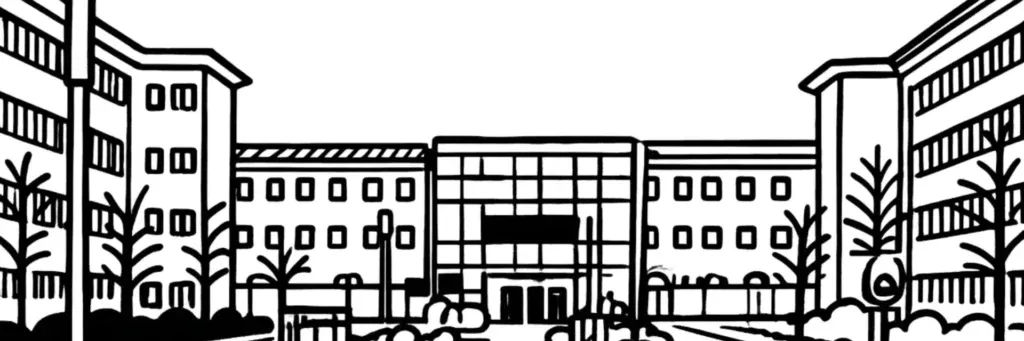
Kerichen, a school and residential district of Brest, around the Kerichen-Montaigne school complex.
Apartments in the Kerichen district of Brest sell at an average price of around 1 925 €/m², based on prices actually recorded in deeds (DVF transactions). A band of 1 643 to 2 115 €/m² covers half of all sales, the spread reflecting the floor, the aspect and the condition of the property. Five-year change: +14 %.
Prices from the DVF file (Demandes de valeurs foncières, published by the DGFiP), transactions actually recorded at the notary, aggregated at district level using the IRIS zoning of INSEE. Cross-referenced with the Notaires de France - INSEE indices. Learn more about our methodology.
After 1 689 €/m² in 2021, the average price in the Kerichen district of Brest reaches 1 925 €/m² in 2026, roughly +14 % over the period.
Local shops answer the daily needs of residents and of the school and student population of the district.
The Kerichen-Montaigne school complex, its colleges and the nearby university give the district a student and sixth-form life.
Schools, local services and educational facilities, in a residential area served by bus and close to the tram.
The Kerichen district, in Brest. Google Maps map.
Kerichen lies in the centre-east of Brest, around the Kerichen-Montaigne school complex and its sixth-form colleges, close to the University of Western Brittany and on the edge of the Bellevue district. A district of the second half of the twentieth century, it combines educational facilities, residential blocks and green space, in an area marked by its schools and its university presence.
The Kerichen-Montaigne school complex and the proximity of the university give the district a student and sixth-form life. The building stock mixes residential blocks and small developments, with green space between them. Neighbourhood life rests on local shops and school facilities. Served by the Bibus bus network and close to the tram, Kerichen stays connected to the centre and to the Bellevue campus.
Valued for its proximity to the colleges and the university, its residential setting and its affordable prices, Kerichen sits in the lower middle of the Brest market. What is on offer here is mainly apartments, popular with families, teaching staff and investors targeting student lettings.
The Kerichen district attracts families, working people and investors drawn by the proximity of the colleges and the university, the residential setting and affordable prices. Demand focuses on apartments close to the school complex and the campus, sought after for student buy-to-let. The school and university presence sustains steady demand.
The average price in Kerichen is 1 925 €/m² for an apartment (actual DVF transactions, notarised sales), within a range of 1 643 to 2 115 €/m² depending on the building, the floor and the condition.
It combines the proximity of the Kerichen-Montaigne school complex and the University of Western Brittany, a residential setting with green space and affordable prices. That combination attracts families, teaching staff and investors targeting student lettings.
Mainly apartments, in residential blocks and small developments close to the school complex and the campus. Studios and one-bedroom flats, popular for student buy-to-let, and family apartments are the most in demand.
No. Kerichen sits in the lower middle of the Brest market, at affordable levels. The district offers a residential setting close to the schools and the university, in a city that is already affordable by national standards.
Yes. The Bibus bus network serves the district and connects it to the centre and the Bellevue campus, and the tram passes nearby. The centre of Brest and the university remain reachable from the district.
This analysis is published by Immover, an independent observatory founded by Antony Barbier. Data sourced from official sources (DVF, INSEE, Notaries of France).