The average price per m² in Châteaubourg is 2 786 €/m² for an apartment, based on actual notarised (DVF) sales. About 31 transactions are recorded each year.

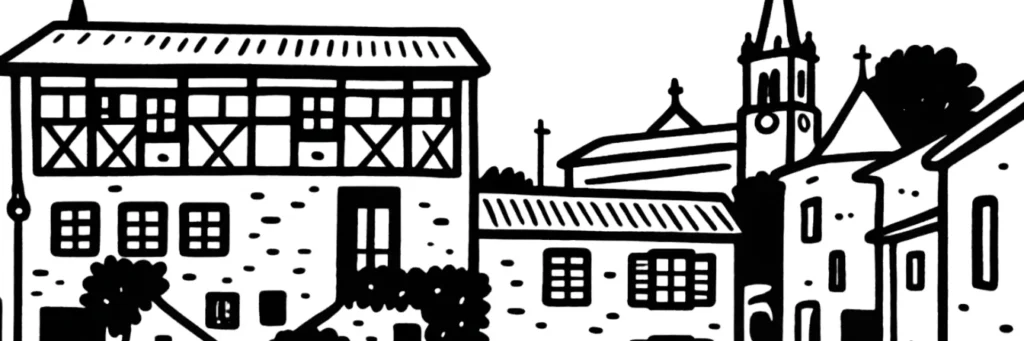
Mood illustration of Châteaubourg, on the Vilaine, in the Ille-et-Vilaine.
The average price for apartments in Châteaubourg stands at 2 786 €/m², based on the DVF transactions actually registered before notaries. Houses, which make up the bulk of the stock, trade on average at 2 537 €/m². That average covers a mainly low-rise fabric, marked by a large share of dwellings built after 1990. Closeness to the station and to the roads towards Rennes, the year of construction, the plot size and the condition of the property make value vary from one address to another. New build, still active in the housing estates of the municipality, pulls part of the benchmarks upwards. The source remains DVF, that is to say completed sales, not agency estimates.
Prices from the DVF file (Demandes de valeurs foncières, published by the DGFiP), transactions actually recorded at the notary at municipality level. Cross-referenced with the Notaires de France - INSEE indices. Learn more about our methodology.
The Châteaubourg market is carried above all by demography. The population has more than tripled since 1962 and continues to grow, fed by the arrival of working households employed in Rennes or in its ring. The low rate of vacant dwellings, on the order of 4,5 % according to INSEE, reflects sustained demand against a supply that renews itself mainly through new build. Transactions remain steady, carried by resales of detached houses in the estates of the 1990s and 2000s and by deliveries of recent developments.
Several factors structure the price level. The direct rail service to Rennes in a quarter of an hour and the N157 express road place the municipality within the range of the workers of the metropolitan area, while offering budgets below those of the first ring around Rennes. The local food-processing fabric, including the Tendriade abattoir, anchors a share of jobs on site. Conversely, competition from other municipalities of the pays de Vitré and of the Rennes ring, and the pace of building starts, contain the rise in values.
Châteaubourg sits mid-table east of Rennes, noticeably below the metropolitan area and the municipalities of its first ring, but above the more distant villages of the pays de Vitré. Closeness to the station explains a good part of that gap.
Châteaubourg takes its name from the village born around a castle commanding the crossing of the Vilaine. The first known mention, in the form Castelburg, goes back to 1084. A Benedictine priory dependent on the abbey of Redon is recorded as early as the 11th century, and the seigneury passed over the centuries between several noble families. In 1677, Louis XIV raised four local seigneuries into a county. In the 18th century, the village worked as a posting stage on the royal road from Paris to Brest, a crossroads position that explains part of its later development.
The arrival of the railway marked a turning point. The station was brought into service in 1858 on the line from Paris-Montparnasse to Brest, and is still served today by the TER regional trains of the Rennes-Vitré axis. That service, later doubled by the N157 express road between Rennes and Paris, gradually brought the municipality closer to the Rennes employment area. The population has been multiplied by more than three since 1962, moving from a large farming village to a peri-urban municipality, without the old centre and the Saint-Pierre church, rebuilt in 1893, losing their role as a landmark.
The municipality has also built an identity around contemporary art. Along the Vilaine, the former moulin Ar Milin', now a hotel and restaurant, presents in its park and along the banks a set of open-air sculptures. Works are also installed in the streets of the centre, which makes Châteaubourg a municipality where a walk regularly crosses a contemporary piece. That cultural choice, long-standing for a town of this size, is part of its image and completes an economic fabric turned towards food processing, of which the Tendriade abattoir is one of the notable employers.
Châteaubourg has 7 533 inhabitants. According to INSEE, the French national statistics institute, the municipality counts on the order of 2 650 dwellings, of which around 95 % are main residences and barely 4,5 % vacant dwellings, a sign of a market tightened by peri-urban demand. The stock is very largely made up of detached houses, a good half of them built after 1990 in successive housing estates. Buyers are for the most part young households and families working in Rennes or in its ring and looking for a larger home at a reasonable distance from the metropolitan area, with the support of the station. First-time buyers weigh heavily in sales, alongside working people already settled in the pays de Vitré.
The average price for apartments in Châteaubourg is 2 786 €/m², and that of houses 2 537 €/m², based on the DVF transactions actually completed before notaries. These averages cover gaps depending on the year of construction, closeness to the station and to the roads towards Rennes, the plot size and the condition of the property. A recent detached house in an estate and an older house to renovate do not sit at the same price level.
The market is clearly dominated by the detached house, typical of a peri-urban municipality built by successive estates. Apartments exist above all in the new developments of the centre and around the station, and appeal to first-time buyers and investors. For a family looking for a plot, the supply of houses remains the widest, but also the most contested given the low rate of vacant dwellings.
The station of Châteaubourg, opened in 1858 on the Paris-Brest line, is linked to Rennes by direct TER trains in about fifteen minutes, with connections towards Vitré and Laval in the other direction. By car, the N157 express road joins the Rennes ring road to the west. That double service, rail and road, is one of the main drivers of local property demand.
Yes. The municipality has gone through sustained low-rise development, and more than half of its stock was built after 1990. Housing estates and new developments continue to come out of the ground to answer demand coming from Rennes. That recent supply keeps up a steady volume of transactions and weighs on the average price, new properties selling above older ones needing renovation.
Its crossroads position between Rennes and Vitré, on the Vilaine, earned it a station and a fast road link very early. The municipality also stands out through its contemporary art policy, with the open-air sculptures of the Ar Milin' park and of the centre, rare for a town of this size. Lastly, its food-processing fabric, including the Tendriade abattoir, makes it a local employment hub and not merely a commuter town.
This analysis is published by Immover, an independent observatory founded by Antony Barbier. Data sourced from official sources (DVF, INSEE, Notaries of France).