The average price per m² in Cormeilles-en-Parisis is 4 232 €/m² for an apartment, based on actual notarised (DVF) sales. About 125 transactions are recorded each year.

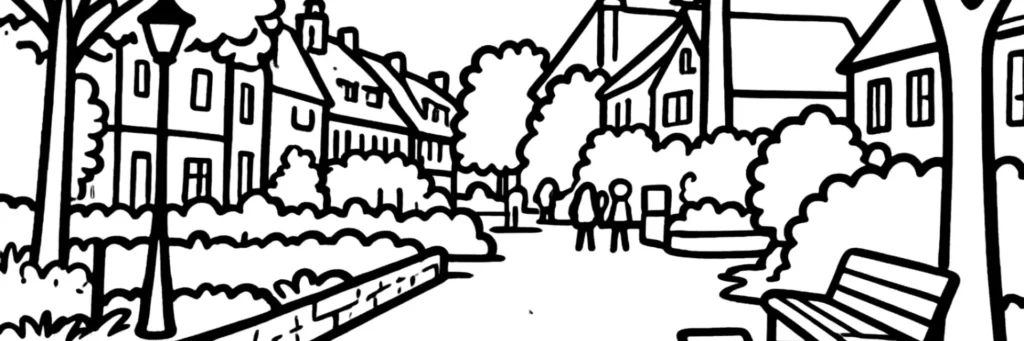
Ambience illustration of Cormeilles-en-Parisis, between the Parisis hill and the Seine plain, in the Val-d'Oise.
In Cormeilles-en-Parisis, the average price of an apartment stands at 4 232 €/m². That figure covers a contrasting stock, in the image of the commune's relief: apartment blocks and older developments around the town centre and the station, new schemes built in the plain along the Seine, and a dense fabric of detached houses on the plateau and the slopes of the hill. Houses, well represented here, trade at a nearby level, around 4 430 €/m², the gap with flats staying contained. These values come from the DVF database, which lists sales actually registered before notaries.
Prices from the DVF file (Demandes de valeurs foncières, published by the DGFiP), transactions actually recorded at the notary at municipality level. Cross-referenced with the Notaires de France - INSEE indices. Learn more about our methodology.
The market in Cormeilles-en-Parisis rests on a pivotal position between Paris, La Défense and the countryside of the Vexin. The commune captures demand from households looking for more floor space and greenery without moving away from the heart of the conurbation, with line J as an asset. Well-placed homes near the station and the family houses of the plateau remain the most closely followed properties, while the view over the valley stays a distinguishing criterion on the heights.
On the supply side, the Seine plain concentrates most of the new building and feeds the segment of recent apartments, while the older fabric of detached houses changes more slowly. The energy performance certificate has become a real lever in negotiations, in particular on houses and older blocks in the centre, where works are sometimes needed. The commune sits in an intermediate band of the Val-d'Oise, more affordable than the riverside towns on the Yvelines side, but above the most working-class sectors of the Montmorency valley.
Backing onto its hill, Cormeilles-en-Parisis sits in the middle of its band of the Val-d'Oise: above Franconville and Sartrouville, and at a level close to that of Houilles, on the other bank of the Seine.
Cormeilles-en-Parisis occupies a slope of the Parisis hill, on the right bank of the Seine, some fifteen kilometres north-west of Paris. Its territory reads on two levels: a low plain running down to the river and a perched plateau opening onto a wide panorama. The commune is also the birthplace of Louis-Jacques-Mandé Daguerre, born here in 1787, whose work on the daguerreotype in 1837 makes him one of the fathers of photography. His name remains attached to the town, which has given his surname to several local places.
The identity of Cormeilles was built on gypsum. The rock of the hill, fired to make plaster, had been worked since antiquity, but it was at the start of the 1820s that Pierre-Étienne Lambert opened the quarry that would make the reputation of plaster of Paris. His grandson truly industrialised production from the 1880s. Two centuries later, the site is still working and supplies a notable share of French gypsum. That memory of plaster can be visited at the Plaster Museum, housed in the commune.
At the top of the hill, the fort of Cormeilles recalls another chapter. Built between 1874 and 1877 after the war of 1870, it forms part of the belt of forts designed by General Séré de Rivières to protect Paris and served as a model for the works that followed. Counted among the best preserved in France, it is today maintained and opened to the public by the Friends of the Fort association, which runs guided visits there. Around it, the regional natural area of the Buttes du Parisis preserves hundreds of hectares of woods and meadows from which the view reaches as far as the capital.
Cormeilles-en-Parisis has 27 292 inhabitants, a medium-sized commune, which explains the variety of its housing supply. The stock mixes apartments, concentrated around the town centre, the station and the recent schemes in the plain, with an extensive fabric of detached houses on the plateau and the hillsides. Buyers are largely families and first-time buyers looking for a residential setting close to Paris, along with working households employed at La Défense or in the capital, drawn by line J and by the green spaces of the hills. Town centre, Seine plain and the heights of the plateau do not speak to exactly the same budgets or the same plans. That variety makes the town-wide average insufficient on its own to place a given property.
The average stands at 4 232 €/m² for an apartment, based on sales registered before notaries and published in the DVF database. That marker covers very different situations, from an older studio in the centre to a new home in the Seine plain. The address, the floor level, the view, the aspect, the year of construction and the energy rating explain most of the gaps. For a fair valuation, comparable sales are a better guide than the average alone.
The commune is split between several settings. The town centre and the station district bring together shops, schools and apartment blocks, within walking distance. The plain, towards the Seine, takes in the most recent schemes. The plateau and the slopes of the hill, more residential, are mainly given over to detached houses, with sectors such as Bois Rochefort or Les Champs Guillaume. These situations do not sell at the same level, the view and closeness to the station weighing a great deal.
Cormeilles-en-Parisis station is served by Transilien line J, which reaches Paris Saint-Lazare in around twenty minutes. La Défense is about twelve kilometres away, and a bus network serves the commune and the neighbouring towns of the Val Parisis. That direct access to central Paris and to the region's leading employment hub is one of the drivers of local demand, notably around the station.
The two markets sit side by side, which sets Cormeilles apart from communes more densely built with flats. Houses, numerous on the plateau and the hillsides, sell at around 4 430 €/m², a level close to that of apartments. Flats dominate in the centre and in the plain, where new developments are more present. The choice depends above all on your plans for living and on the sector, the value of a house owing a great deal to its plot and its condition.
The subsoil of the hill was long dug out to extract gypsum, which can expose some sectors to ground movements linked to the former workings. It is wise to consult the planning documents and the statement of risks before any purchase. As elsewhere in the Paris region, letting a furnished tourist rental means complying with local rules, and the tax treatment of a second home is worth anticipating depending on your situation.
This analysis is published by Immover, an independent observatory founded by Antony Barbier. Data sourced from official sources (DVF, INSEE, Notaries of France).