The average price per m² in Coudekerque-Branche is 1 880 €/m² for an apartment, based on actual notarised (DVF) sales. About 28 transactions are recorded each year.

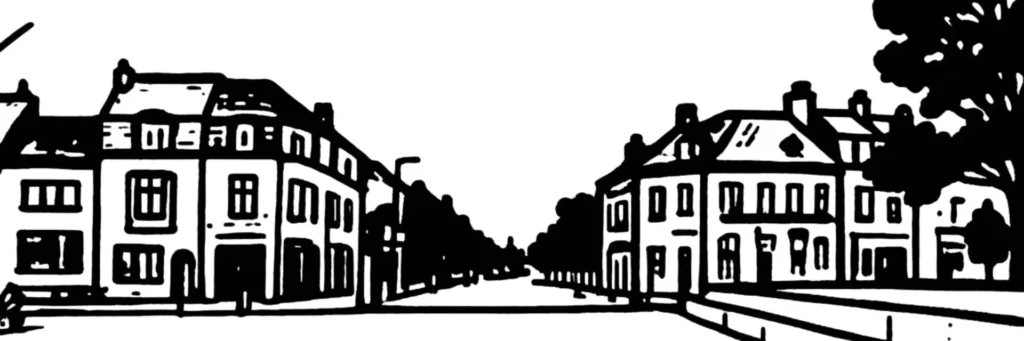
Atmospheric illustration of Coudekerque-Branche, a municipality of the Dunkerque conurbation, in the Nord department.
The price shown for Coudekerque-Branche, 1 880 €/m², is an apartment price, calculated on single-lot sales actually registered before notaries in DVF data, the French notarised sales database. The flat market here remains narrow: 122 sales in five years, or around twenty-five a year, concentrated for the most part around the town centre. The dominant market of the municipality is the house, with 1 117 sales over the same period. Unusually, the two sell at the same level per square metre: apartments here do not carry the usual discount against houses.
Prices from the DVF file (Demandes de valeurs foncières, published by the DGFiP), transactions actually recorded at the notary at municipality level. Cross-referenced with the Notaires de France - INSEE indices. Learn more about our methodology.
After 1 678 €/m² in 2021, the average price in Coudekerque-Branche reaches 1 880 €/m² in 2026, roughly +12 % over the period.
Coudekerque-Branche reached its population maximum in 1968, with 23 039 inhabitants; it has 20 787 in 2023 according to INSEE, a decline of around 1,6 % since 2017. That demographic erosion, shared by much of the Dunkerque area, describes a market without tension: sales remain regular, but demand does not push prices upwards. The flat segment remains marginal, with twenty-five sales a year, while houses account for more than two hundred. On volumes as low as these, a single unusual transaction would be enough to distort an average calculated neighbourhood by neighbourhood.
The local driver remains industrial and port employment. The port of Dunkerque, close by, and the steel industry of the coast have structured the basin since the 1960s; the opening at the end of 2025 of the first Verkor battery cell plant, at Bourbourg within the port district, is expected to add around 1 200 direct jobs. On transport, the complete free travel on the buses of the urban community authority since 1 September 2018 and the TER service towards Lille and Calais bring the municipality closer to the rest of the conurbation. These factors support first of all the demand for family houses, rather than creating a market for apartments.
Coudekerque-Branche shows the lowest price level in this comparison: its immediate neighbour Dunkerque, Calais on the same coast and Lille, the regional metropolis, all sit above it. The gap with Dunkerque remains contained, the one with Lille is wide.
The parish of Coudekerque is mentioned as early as 1067 in the abbey archives. Coudekerque-Branche, the branch detached from the original village, became an autonomous municipality on 14 December 1789, when the French communes were created. The territory belongs to the Blootland, the Flemish maritime plain, entirely flat and criss-crossed by waterways: the canal de Bergues, dug in 1634, and the canal de Bourbourg, opened in 1846, run through it. The municipality has lost ground twice: the Jeu-de-Mail neighbourhood was attached to Dunkerque in 1850, and the Rosendaël section gained its independence in 1860. A little over nine square kilometres remain.
Industrialisation began in 1836 with the Dickson textile works, followed by the Weill spinning mill in 1897, the Boudenoot brewery in 1908, then the Lesieur oil mill and several chemical plants. The station opened on 16 September 1888, and the installation of a locomotive depot and a repair workshop made the municipality a leading railway centre until the end of the 1960s. The population followed: 1 265 inhabitants in 1800, 5 440 in 1901. Under the mandate of mayor Gustave Fontaine, from 1904 to 1937, the town acquired its public facilities, among them the town hall inaugurated in 1907.
Spared by the First World War, the municipality paid a heavy price in the second: nearly 500 houses were destroyed from 1940 onwards, and the town was only liberated on 9 May 1945, with the surrender of the Dunkerque pocket. The reconstruction plan for the conurbation, adopted in 1947 under the direction of the architect Théodore Leveau, covered six municipalities including Coudekerque-Branche; work opened on 4 September 1949 and finished in 1963. The housing estates of the 1950s and 1960s then extended the town eastwards, around the Vieux Coudekerque, the Petit and the Grand Steendam and the Sainte-Germaine neighbourhood, whose church was built in 1903. The population peaked at 23 039 inhabitants in 1968, the very year the municipality became one of the twelve founding members of the Dunkerque urban community authority.
Coudekerque-Branche has 20 787 inhabitants according to INSEE, the French statistics institute, over a little more than nine square kilometres that are entirely built up. The housing stock is dominated by houses, which account for around seven dwellings in ten, against three in ten for apartments. More than nine dwellings in ten are main residences and close to six households in ten own theirs, still according to INSEE: the second-home market is non-existent here. You will find mainly families and employees of the port and of the Dunkerque industrial area, as well as first-time buyers looking for a house with a garden a few kilometres from the centre of Dunkerque. Two points deserve to be checked before buying: the energy performance of a brick housing stock that is often old, and the exposure of some streets to road and rail routes.
The average apartment price stands at 1 880 €/m², based on single-lot sales actually registered before notaries in DVF data. That average rests on a narrow market, 122 transactions in five years, and covers variations depending on the sector, the floor, the condition of the property and its energy performance rating. Houses, very much in the majority in the municipality, sell at the same level per square metre.
Because the volumes do not allow it. The municipality has nine statistical sectors, and only one reaches the reliability threshold we apply, thirty apartment sales over five years. The Vieux Coudekerque falls well below it, and the suburban sectors of Saint-Pierre and Steendam record almost no flat sales at all. We prefer a single page backed by all the transactions of the municipality to a series of fragile neighbourhood prices.
The real market of the municipality is the house: 1 117 sales over five years, or around 223 a year, against twenty-five apartment sales a year. The housing stock is made up of Flemish brick town houses, often terraced, and of detached houses from the 1950s to the 1970s. In a rare particularity, houses and apartments trade here at the same price per square metre: the choice therefore turns on the plot, upkeep and service charges, not on a gap in value.
The town is organised around its centre, where the town hall of 1907 stands, and around four sectors: the Vieux Coudekerque, the Petit and the Grand Steendam to the east, and Sainte-Germaine, whose church dates from 1903. Apartments are concentrated for the most part around the centre, while the east of the municipality is markedly more suburban in character. These differences in urban form weigh on prices, but flat sales are too rare to put a figure on them sector by sector.
The municipality borders Dunkerque, whose centre lies around four kilometres away. Coudekerque-Branche station, opened on 16 September 1888, receives TER regional trains towards Dunkerque, Calais and Lille. The bus network of the urban community authority, free for all passengers since 1 September 2018, serves the town on several lines. Finally, the A16 and A25 motorways offer four exits spread between the different neighbourhoods.
This analysis is published by Immover, an independent observatory founded by Antony Barbier. Data sourced from official sources (DVF, INSEE, Notaries of France).