The average price per m² in Deuil-la-Barre is 3 492 €/m² for an apartment, based on actual notarised (DVF) sales. For a house or villa, it is 4 637 €/m². About 157 transactions are recorded each year.

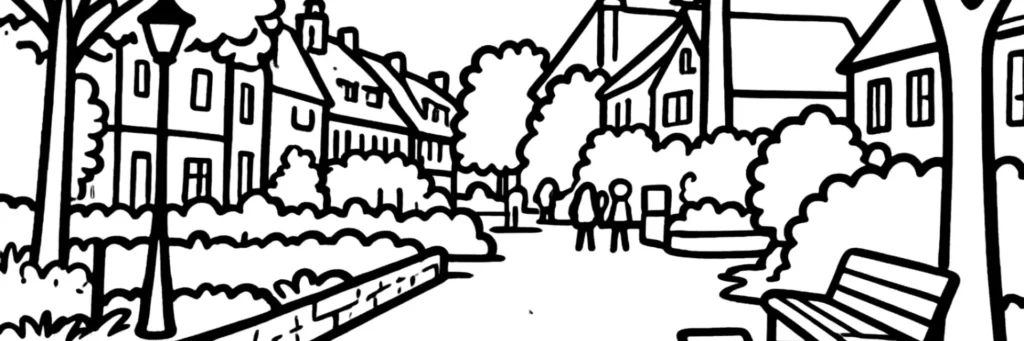
Ambience illustration of Deuil-la-Barre, in the Montmorency valley, in the Val-d'Oise.
The average price recorded in Deuil-la-Barre stands at 3 492 €/m². That average covers a stock split between two realities: according to INSEE, the French national statistics institute, the commune counts 63,1 % apartments and 36,1 % houses. Flats dominate around the two stations and the centre, while detached and town houses, rarer and more expensive, pull the average price of houses and villas to 4 637 €/m². Closeness to a station, the condition of the property and its year of construction explain most of the gaps, in a town where more than half the stock was built after 1970. The figures come from the DVF database, which lists sales actually registered before notaries.
House : 4 637 €/m²
Prices from the DVF file (Demandes de valeurs foncières, published by the DGFiP), transactions actually recorded at the notary at municipality level. Cross-referenced with the Notaires de France - INSEE indices. Learn more about our methodology.
The market in Deuil-la-Barre owes to its role as a residential suburb of the northern Paris region, carried by a double rail service towards Paris and by the setting of the Montmorency valley. Demand comes above all from households buying their main residence, second homes being almost non-existent (1,0 % of the stock according to INSEE). The population, up 3,56 % since 2017, keeps steady pressure on a constrained stock, where flats dominate around the stations and single-family homes are becoming scarcer on the hillsides.
Two dynamics shape prices. On one side, closeness to a line H station and quick access to Paris strongly add value to well-placed properties, which explains the gap between the dense centre and the residential sectors. On the other, energy performance now weighs in negotiations, in particular on the older houses of the slopes whose energy rating is becoming a reason for discount. The vacancy rate, at around 9,4 %, also leaves room for renovated properties to come back onto the market.
A residential town of the Montmorency valley, Deuil-la-Barre sits a notch above its immediate neighbours in the northern Paris region shown here. The gap owes to its double rail service and to the weight of hillside housing.
The place is mentioned as early as 862 in the form Diogilum, a name linked to Celtic roots evoking a consecrated clearing. The estate first belonged to the abbey of Saint-Denis, then passed to the Montmorency family from the 11th century. The commune only took its present name of Deuil-la-Barre on 7 December 1952, the addition of la Barre setting apart the district built around the former station. The Notre-Dame-et-Saint-Eugène church, whose oldest parts go back to the 11th and 12th centuries, was listed as a historic monument in 1962; badly damaged by the fall of a V2 flying bomb on 4 October 1944, it was restored between 1949 and 1955.
In the 18th century, the commune took in the château de La Chevrette, home of Madame d'Épinay, where a salon was held frequented by Denis Diderot and Jean-Jacques Rousseau, Grimm and other figures of the Enlightenment. The château was demolished in 1786; all that survives is a 17th-century pavilion and a gateway, today in a public park. Long a village of farming and vines on the slopes of the Montmorency valley, Deuil moved into the orbit of Paris with the arrival of the railway in the 19th century, which began the spread of detached housing on the hillsides.
Attached to the canton of Montmorency from 1793 to 1964, the commune joined the new department of the Val-d'Oise and the Sarcelles district on 1 January 1968, as part of the reorganisation of the Paris region. Residential growth in the second half of the 20th century took the population from a few thousand inhabitants to more than 23 000 today, with a densification of flats around the stations without erasing the fabric of detached houses on the hillsides.
According to INSEE, Deuil-la-Barre has 23 099 inhabitants (2023 census) for 11 115 dwellings, of which 89,6 % are main residences; second homes weigh only 1,0 % of the stock and vacant homes 9,4 %. The stock is mainly made up of flats, with 63,1 % apartments against 36,1 % houses. Among households in main residences, 58,5 % are owners and 40,1 % tenants. Buyers are above all those of a residential suburb of the northern Paris region: first-time buyers and families looking for an apartment or a town house within reasonable reach of Paris, drawn by the two stations on line H and by the setting of the Montmorency valley, rather than second-home demand, almost absent here.
The average price recorded is 3 492 €/m², calculated from sales registered before notaries and published in the DVF database. It is a town-wide average, mixing the apartment near a station and the town house on the hillsides. The average price recorded on houses and villas reaches 4 637 €/m². Closeness to a line H station, the condition of the property, the floor level and the year of construction explain most of the gaps. A serious valuation is set on comparable sales, not on the average.
The commune is divided into several sectors: La Côte and the town centre, Blancport-Lac Marchais, Mortefontaines, Le Moutier and its stadium district, Presles-Hirondelles, and Galathée-Trois Communes. The centre and the surroundings of the stations concentrate the flats and the shops, with a covered market at Mortefontaines. The hillsides and the residential streets offer more scattered single-family housing. These kinds of housing do not sell at the same level, single-family homes and immediate closeness to a station being among the most highly valued criteria.
The commune is served by two stations on Transilien line H. Deuil-Montmagny station reaches Paris-Gare du Nord in around fifteen minutes, and La Barre-Ormesson in a comparable time. This double service, rare for a town of this size, puts Deuil-la-Barre a short distance from the capital and weighs on the value of properties a few minutes' walk from a station. The road network completes access towards Enghien-les-Bains and the rest of the Montmorency valley.
Houses account for 36,1 % of dwellings according to INSEE, against 63,1 % apartments. Single-family supply therefore genuinely exists, but it is concentrated on the hillsides and in the residential streets, often as town houses or interwar and post-1970 detached homes. Floor areas and plots vary there, and the price per square metre of houses sits above the town-wide average, which makes valuing a house more dependent on its condition, its plot and its closeness to a station than on the town's average figure.
As everywhere, a sale means providing the set of technical surveys (energy rating, asbestos, lead, electricity depending on the age of the property), which today strongly governs negotiation, in particular on the older homes of the hillsides. For a short-term letting of a furnished tourist rental, a declaration at the town hall is required. The tax treatment of a second home or a buy-to-let property is worth anticipating, even if second homes are very much in the minority here (1,0 % of the stock).
This analysis is published by Immover, an independent observatory founded by Antony Barbier. Data sourced from official sources (DVF, INSEE, Notaries of France).