The average price per m² in Les Clayes-sous-Bois is 3 098 €/m² for an apartment, based on actual notarised (DVF) sales. About 100 transactions are recorded each year.

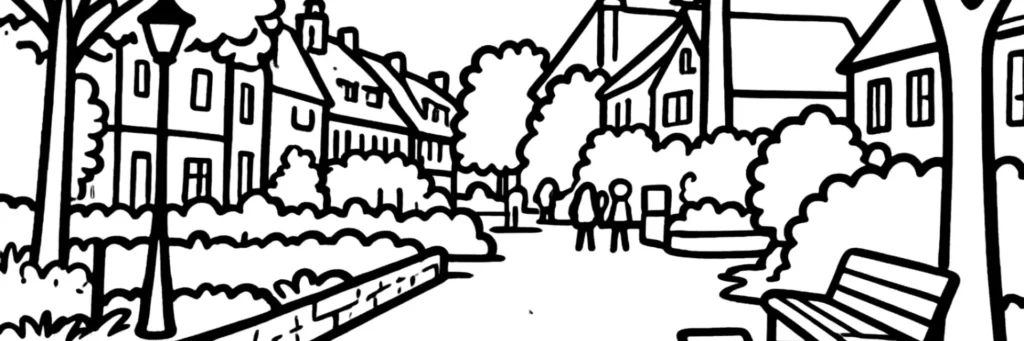
Mood illustration of Les Clayes-sous-Bois, in the west of the Yvelines.
In Les Clayes-sous-Bois, the average price recorded stands at 3 098 €/m². The municipality, set in the west of the Yvelines at the gates of Saint-Quentin-en-Yvelines, has a balanced housing stock inherited from the strong post-war growth: town houses and detached houses in the residential districts, and blocks of flats, in particular around the centre and the sectors built in the 1960 to 1980 decades. Detached houses and apartments sit side by side there, with marked gaps depending on the sector, the age of the fabric and the closeness of the stations and of the routes towards Paris. The figures come from the DVF database, which records the transactions actually registered before notaries, and not the prices displayed by agencies. It is a municipal average, to be refined according to the district and the condition of the property.
Prices from the DVF file (Demandes de valeurs foncières, published by the DGFiP), transactions actually recorded at the notary at municipality level. Cross-referenced with the Notaires de France - INSEE indices. Learn more about our methodology.
The Les Clayes-sous-Bois market is a main-residence market, carried by demand from working households of the Paris region. The municipality plays a fallback role for buyers looking for housing more affordable than in the most highly rated sectors of the western Paris region, while staying connected to Paris and to the employment hubs of Saint-Quentin-en-Yvelines. The presence of a fabric of service and technology activities in the municipality and nearby supports steady local demand, carried by first-time buyers and families.
Supply is that of an already largely built-up municipality, where free land is scarce: most transactions bear on the existing stock, suburban houses and apartments in the blocks of flats. The energy performance of dwellings from the 1960 to 1980 decades is becoming a bargaining criterion, properties with the best certificate ratings holding their value better than energy-hungry homes, which draw discounts and renovation projects. Membership of Saint-Quentin-en-Yvelines and changes in the transport service remain factors to watch for the development of the market.
In the west of the Yvelines, Les Clayes-sous-Bois shows a price close to that of its immediate neighbours such as Plaisir or Bois-d'Arcy, and a little below the municipalities of the Saint-Quentin-en-Yvelines hub such as Montigny-le-Bretonneux.
The history of Les Clayes-sous-Bois goes back to the Middle Ages. The name is thought to come from the Old French claie, the fence or the trellis, in reference to the woods that surrounded the village. The church of Saint-Martin was built around 1100, and a castle is mentioned as early as the beginning of the 12th century. The village long remained a small farming community on the edge of the forest, away from the main routes.
In the 16th century, the estate passed into the hands of Diane de Poitiers, favourite of king Henri II, who made it a hunting lodge; local tradition credits her with the planting of a tree that has remained famous in the municipality. A neoclassical castle was rebuilt between 1800 and 1816. Destroyed in 1944 during the Second World War, it was never raised again, but its park and its memory still mark the geography of the town. The arrival of the railway in 1861 began the end of rural isolation.
The real change came after 1945. The village of around 2 100 inhabitants in 1946 saw rapid growth and passed 17 000 inhabitants in the 1980s, with the building of numerous suburban districts and blocks of flats. The setting up of a large electronics plant, long attached to Thomson then to Bull, fixed a lasting service and technology activity in the municipality. On 1 January 2016, Les Clayes-sous-Bois joined the Saint-Quentin-en-Yvelines agglomeration authority.
Les Clayes-sous-Bois has 16 804 inhabitants, in a residential municipality of the western Paris region far more populated than the neighbouring villages. The stock mixes detached houses in the suburban districts and apartments in the blocks of flats built during the post-war growth. Buyers are for the most part working households of the Paris region: first-time buyers and families drawn by prices more affordable than in the municipalities close to Versailles or to Paris, and by the closeness of the employment hubs of Saint-Quentin-en-Yvelines. The rail service and the road routes towards the western Paris region make the municipality a fallback address for buyers looking for a compromise between budget, transport and a residential setting.
The average price recorded is 3 098 €/m², calculated from the sales registered before notaries and published in the DVF database. It is a municipal average that brings together houses and apartments, across all sectors. The age of the fabric, the district, the closeness of a station and the condition of the property create gaps around that average. For a reliable value, it is better to start from comparable properties in the same sector of the municipality.
The municipality is served by train, on the western suburban lines linking the Yvelines to Paris Montparnasse, with connections towards the regional network. It also benefits from the closeness of Saint-Quentin-en-Yvelines, a major employment and transport hub. The road completes the links towards the western Paris region and the A12. That accessibility, at a price below that of the municipalities closer to Versailles, explains part of the appeal of the local market.
The two markets sit side by side, a legacy of the post-war growth. Detached houses are numerous in the suburban districts and speak above all to families, with gardens and larger floor areas. Apartments are concentrated in the blocks of flats, often more affordable to buy and close to services. The choice depends on the budget, on the make-up of the household and on how close to the stations and the shops you want to be.
The municipality is organised between a shopping town centre, residential suburban districts and sectors of flats built in the 1960 to 1980 decades. The surroundings of the former castle park and the areas close to the green spaces are sought after for their setting. Prices vary with the closeness of a station, the quality of the fabric and the immediate surroundings. Each sector has its own profile, which justifies a targeted valuation rather than a single municipal figure.
On the whole, yes. The average price there remains below that of the more highly rated municipalities of the western Paris region, such as those close to Versailles or to Saint-Germain-en-Laye. That position makes it a fallback address for first-time buyers and families looking for housing in the Yvelines without reaching the price levels of the most sought-after sectors. The closeness of the employment hubs of Saint-Quentin-en-Yvelines strengthens that balance between budget and accessibility.
This analysis is published by Immover, an independent observatory founded by Antony Barbier. Data sourced from official sources (DVF, INSEE, Notaries of France).