The average price per m² in Lorient is 2 669 €/m² for an apartment, within a range of 2,1 to 3,0 k€ per m², based on actual notarised (DVF) sales. Over the period, the market rose 17 % over 5 years and rose 2,1 % over the last 12 months, with about 607 transactions per year.

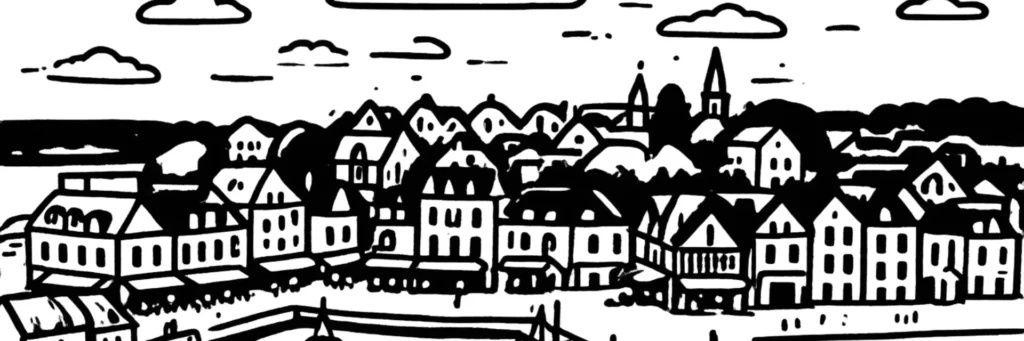
Illustration of Lorient, sub-prefecture of the Morbihan, around its harbour and its port.
Apartments in Lorient sell at an average price of around 2 669 €/m², based on prices actually recorded (DVF data, the French notarised sales database). A sub-prefecture of the Morbihan, at the mouth of the Scorff and the Blavet, Lorient is a port town rebuilt after the bombing of 1943, marked by the Keroman fishing port and the former submarine base. Prices run from around 1 781 €/m² in Saint-Armel, to the north, the most affordable area, to nearly 3 016 €/m² in the rebuilt town centre. The residential districts of the centre and the south make up the top of the market.
Prices from the DVF file (Demandes de valeurs foncières, published by the DGFiP), transactions actually recorded at the notary at municipality level. Cross-referenced with the Notaires de France - INSEE indices. Learn more about our methodology.
After 2 288 €/m² in 2021, the average price in Lorient reaches 2 669 €/m² in 2026, around +17 % over the period.
Change in the average price per m² over twelve months, district by district, based on the most recent DVF sales.
The average price per m² for an apartment in each district of Lorient covered by Immover, ranked from the most expensive to the most affordable.
The Lorient market is that of a sub-prefecture port town on the southern coast of Brittany. With an average price of around 2 669 €/m² for an apartment and about 3 107 €/m² for a house, Lorient sits above the inland towns of Brittany, without reaching the levels of the most sought-after parts of the Morbihan coast such as Vannes or the gulf.
Geography draws the price map. The rebuilt town centre and the residential districts of the south, such as Lanveur, hold the highest prices. The housing areas of the west and north, such as Kervénanec, Kerletu and Saint-Armel, remain the most affordable in the town, carried by a steady volume of sales.
With an average price of around 2 669 €/m², Lorient sits at the level of a mid-sized port town on the Breton coast, more affordable than the major cities. Its harbour, its Keroman fishing port and its maritime setting make it a sought-after town for buyers and families who want to be close to the sea.
Lorient is a sub-prefecture of the Morbihan, born in 1666 with the arrival of the French East India Company, which gave it its name, drawn from L'Orient. The town grew around its port, at the mouth of the Scorff and the Blavet, facing the harbour and the Gâvres peninsula.
During the Second World War, Lorient housed a major submarine base at Keroman and suffered bombing that destroyed much of the town. The centre was entirely rebuilt after 1945, which explains its post-war urban fabric, around the church of Saint-Louis and the town hall.
Today Lorient remains a port town, with the Keroman fishing port, the Cité de la Voile sailing centre and the Festival Interceltique. The geography of prices follows that history: the rebuilt centre and the residential districts of the south are gaining value, while the housing areas of the west and north remain more affordable.
The Lorient market attracts first-time buyers, families, working people from the local employment basin and investors. Demand focuses on apartments in the rebuilt centre and the residential districts, and on houses in the former villages of the west such as Keryado. Prices, measured for a port town of this size, are sought after for the maritime setting, the proximity of the coast and the life of the town.
The average price in Lorient is 2 669 €/m² for an apartment (actual DVF transactions, notarised sales), within a range of 2 126 to 3 040 €/m² depending on the district. Property portals show asking prices, 10 to 20 % above the prices actually recorded.
No. The rebuilt town centre sits at the upper end of the range, at around 3 016 €/m², while Saint-Armel, to the north, remains the most affordable area, at around 1 781 €/m². The residential districts of the south and the centre make up the core of the market.
Lorient combines a measured market, around 2 669 €/m² for an apartment, a maritime setting with the harbour and the nearby coast, and a port and service-sector employment basin. The town attracts buyers and families looking for access to the sea at a price below that of the most sought-after parts of the Morbihan coast.
The Lorient market has risen by around 17 % over five years for apartments, in a context of strong demand along the Breton coast. Changes vary by district, with the centre and the residential areas well positioned.
The town-wide average price is not enough: you have to start from the price in your own district, then adjust for the type of property, the floor, the condition, the aspect and how close you are to the sea and to the centre. The Immover valuation tool draws on the actual sales closest to your address.
This analysis is published by Immover, an independent observatory founded by Antony Barbier. Data sourced from official sources (DVF, INSEE, Notaries of France).