The average price per m² in Loudéac is 1 690 €/m² for an apartment, based on actual notarised (DVF) sales. About 23 transactions are recorded each year.

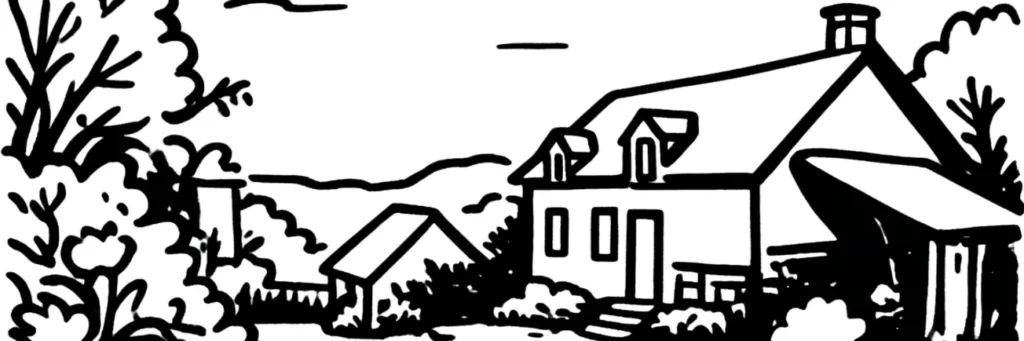
Atmospheric illustration of Loudéac, a market town in central Brittany, between the Oust valley and the Loudéac forest, in Côtes-d'Armor.
The average price recorded in Loudéac stands at 1 690 €/m². This average covers a housing stock where the detached house largely dominates, spread between the old town centre, the outlying districts and the suburban housing developments on the edge of town. Apartments, fewer in number, are concentrated mainly in the centre and in a few small residences. The gaps around this average come down to the type of property, the floor area, the condition, the plot and the proximity to the shops and services of the town centre. In a market where transactions remain few each year, a single atypical sale can weigh on the average. These figures come from DVF data, the French notarised sales database, which lists the sales actually signed with notaries, and give a municipal benchmark to be refined property by property.
Prices from the DVF file (Demandes de valeurs foncières, published by the DGFiP), transactions actually recorded at the notary at municipality level. Cross-referenced with the Notaires de France - INSEE indices. Learn more about our methodology.
The Loudéac market rests on its status as the main town of central Brittany, a hub for shops, services and food-processing jobs serving a wide rural catchment area. Demand comes mainly from local families and workers looking for a house with a plot on an affordable budget, as well as from households drawn by property costs more measured than in Pontivy or Saint-Brieuc. The inland setting, between the Oust valley and the Loudéac forest, and its role as a local centre support this demand for main residences. Transactions therefore mostly involve houses, which make up most of the available stock.
Supply remains marked by a large stock of older buildings in the centre and by suburban housing developments on the edge of town, with a limited volume of sales each year. In the resale market, the energy performance of houses has become a negotiating point, particularly for properties built in past decades. Buyers weigh up proximity to the centre and its services, the size of the plot and the condition of the property. The small number of annual transactions makes the municipal average sensitive to atypical sales, which calls for reasoning on comparable properties rather than on the average price alone.
The main town of inland Brittany, Loudéac shows a price level below that of Pontivy, its neighbour to the south, as well as Saint-Brieuc, the prefecture town of Côtes-d'Armor, and Ploërmel to the east, all more expensive.
Loudéac appears in written records as Locduiac in 1059, the modern form being attested from 1271. In the Middle Ages the place came under the viscounts of Rohan, one of the great seigneurial houses of Brittany, whose presence shaped this part of central Brittany, the Argoat, for a long time. The town developed as a centre for fairs and markets, a commercial role that remains one of the defining features of its identity. In the 17th and 18th centuries, Loudéac drew its prosperity from the toiles de Bretagne, a linen cloth woven in winter by peasants and exported to Spain, the Americas and as far as the Indies.
During the Revolution, Loudéac became the chief town of a district from 1790 to 1800, then the seat of an arrondissement from 1801 to 1926, before being attached to the arrondissement of Saint-Brieuc. The Saint-Nicolas parish church, whose choir bears the date 1759 and which was completed in its current form in the 20th century, overlooks the central square; the municipality also preserves several chapels and protected religious furnishings. The arrival of the railway in 1872, supplemented in the early 20th century by metre-gauge branch lines, connected the town to the regional network and supported its role as a local centre.
In the 20th century, Loudéac established itself as a food-processing hub for central Brittany, with the arrival of industries in cured meats, salting and dairy and pork processing, activities still present today. The town remains known for its racecourse, where races have been run since 1880, and for the Passion de Loudéac, a religious play performed since 1914. The Oust valley and the Loudéac forest, a woodland of more than 2 000 hectares to the north, shape the natural setting of the municipality.
Loudéac has around 9 987 inhabitants and acts as the main town for a wide rural catchment area in central Brittany. The housing stock consists overwhelmingly of detached houses, spread between the old centre, the outlying districts and the suburban housing developments on the edge of town, while apartments remain a minority and are concentrated in the centre. Main residences make up most of the stock, the share of second homes being low in this inland municipality, away from the coast. Owner-occupation dominates, with a majority of households owning their home. This profile mainly attracts families, workers employed in the local job market and households who find here a house with a plot on a measured budget. First-time buyers turn to detached houses, while apartments in the centre suit smaller budgets or single people.
The average price recorded in Loudéac stands at 1 690 €/m², based on sales registered with notaries and published in the DVF database. This figure brings together a variety of properties, overwhelmingly houses. The type of property, the floor area, the condition, the plot, the energy performance and the location explain most of the gaps around this average. In a market where sales are few each year, it is better to rely on comparable properties than on the municipal average alone.
Loudéac holds a central position in Brittany, about twenty kilometres from Pontivy and around 37 kilometres south of Saint-Brieuc. The town is served by the roads crossing the centre of the region, notably the dual carriageway between Rennes and western Brittany. It has a railway station opened in 1872, on the regional rail network. This position as an inland crossroads explains its role as a market town for a wide rural hinterland.
Loudéac is organised around its central square and the Saint-Nicolas church, whose choir bears the date 1759, surrounded by several chapels and protected religious furnishings. The town is known for its racecourse, active since 1880, and for the Passion de Loudéac, a play performed since 1914. The Oust valley and the Loudéac forest, a vast woodland to the north, offer a much appreciated natural setting. Fairs and markets, inherited from a long commercial tradition, still bring life to the town centre.
The Loudéac market consists overwhelmingly of houses, from the old centre to the housing developments on the edge of town. Buying a house therefore matches the dominant profile of the municipality, with a plot and the proximity of the services of this local centre. Apartments, rarer, are found mainly in the town centre and suit smaller budgets or single people. Your choice will depend above all on your budget, your need for outdoor space and your wish to be close to shops.
Loudéac is made up of an old town centre around the church square and the shopping streets, extended by outlying districts and then by suburban housing developments on the edge of town. The areas close to the centre offer proximity to shops, services and amenities, while the suburban neighbourhoods favour the house with a plot. The surroundings of the Oust valley and the forest provide a greener environment. Each area has its own characteristics in terms of buildings and age, to be examined closely according to your project.
This analysis is published by Immover, an independent observatory founded by Antony Barbier. Data sourced from official sources (DVF, INSEE, Notaries of France).