The average price per m² in Marseillan is 4 356 €/m² for an apartment, based on actual notarised (DVF) sales. About 161 transactions are recorded each year.

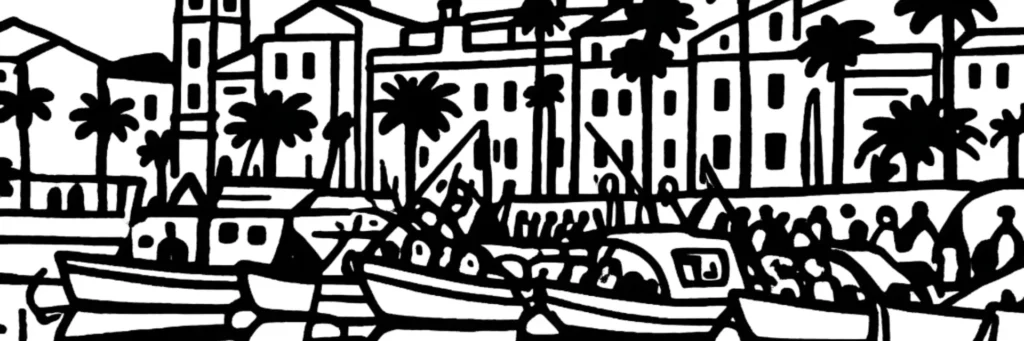
Mood illustration of Marseillan, a harbour on the étang de Thau in the Hérault.
The average price recorded in Marseillan stands at 4 356 €/m². That average covers a coastal housing stock where houses and apartments are split almost equally: according to INSEE, France's national statistics institute, houses account for 51,1 % of dwellings and apartments for 46,5 %, between the old town, the districts of detached houses and the developments of Marseillan-Plage. The weight of holiday housing pulls the average upwards, since close to six dwellings in ten are second homes. Location, proximity to the lagoon or to the beach, the year of construction and the energy rating open up wide gaps from one property to another. The figures come from the DVF database, which records the transactions actually registered with notaries.
Prices from the DVF file (Demandes de valeurs foncières, published by the DGFiP), transactions actually recorded at the notary at municipality level. Cross-referenced with the Notaires de France - INSEE indices. Learn more about our methodology.
The local market rests on a double function: a village of the étang de Thau turned towards shellfish farming and the harbour, and a Mediterranean seaside resort with Marseillan-Plage. The population is growing, driven by new households settling in and by the appeal of the Hérault coast, which sustains demand for main residences alongside holiday demand. With close to six dwellings in ten being second homes according to INSEE, most of the supply remains geared to holiday housing, a segment sensitive to the season and to the economic situation of non-resident buyers.
New supply exists but is constrained by the loi Littoral, France's coastal planning act, and by the exposure of part of the territory to natural hazards, which limits sprawl and concentrates a share of activity on older property and renovation. Energy performance weighs more and more in negotiations, particularly on the detached homes and beach developments of past decades. Between the town around the harbour, the housing estates and the seafront, price levels remain uneven, and the value of a property depends above all on its sector, its view and its condition.
A village of the étang de Thau between Sète and Agde, Marseillan sits above the neighbouring municipalities shown here, driven by its double frontage onto lagoon and sea and by the weight of second homes.
Marseillan is a municipality of the Hérault set on the southern shore of the étang de Thau, not to be confused with the two other Marseillans in the Gers and the Hautes-Pyrénées. Its history begins early: its foundation is attributed to merchants from Marseille and Agde, who set up trading posts for the wine trade around the sixth century BC. Its position between sea and lagoon very quickly made the site a place of exchange. In the twelfth century the community came under the Trencavel family, viscounts of Agde and Béziers, who worked the salt of the lagoon and levied taxes on shipping, before Marseillan became a fief of the bishop of Agde in 1187.
The harbour shaped the town for centuries. At the place known as Les Onglous, the Canal du Midi built by Pierre-Paul Riquet, today a UNESCO World Heritage site, joins the étang de Thau: Marseillan is its final stop. The nineteenth century marked the golden age, driven by winegrowing and the spirits trade. It was in that period that the Noilly Prat house settled here, its vermouth born of the business launched by Joseph Noilly in 1813; his son chose to establish himself on the shore of the lagoon at Marseillan around the middle of the century, and the historic cellar was founded in 1870. From that prosperity a distinctive architecture remains, with tall merchant houses built of the black basalt of Agde.
The étang de Thau is still at the heart of activity and landscape. Its oyster and shellfish tables can be seen from the quays, and the municipality has grown a second face as a seaside resort, Marseillan-Plage, open to the Mediterranean along the lido. Tourism, shellfish farming, winegrowing and boating today shape a seasonal economy, on which a good part of the housing market depends.
According to INSEE, France's national statistics institute, Marseillan has 8 414 inhabitants for 10 881 dwellings, of which only 4 346 are main residences, that is 39,9 % of the stock: second homes and occasional dwellings account for 59,7 %. The stock splits almost evenly between houses (51,1 %) and apartments (46,5 %). Among the households settled year-round, 59,7 % are owners and 36,8 % tenants. Two kinds of buyer therefore meet on this market. On one side holiday buyers, often from Montpellier, the Toulouse region or further north, looking for a beach apartment or a house near the lagoon. On the other, households who live here year-round, working in tourism, shellfish farming, winegrowing and services, leaning rather towards a town house or a detached home.
The average price recorded is 4 356 €/m², calculated from the transactions registered with notaries and published in the DVF database. It is a municipal average, which blends the apartment in Marseillan-Plage, the town house and the recent detached home. Proximity to the lagoon or the sea, the view, the year of construction and the energy certificate explain most of the gaps. A serious valuation is based on comparable sales in the same sector, not on the municipal average.
The municipality lives on two hubs a few kilometres apart. Marseillan town is organised around the harbour, the old centre and the étang de Thau, with stone merchant houses, narrow streets and year-round life. Marseillan-Plage is a seaside resort set on the lido, between lagoon and Mediterranean, strongly marked by the summer season and holiday developments. The two sectors do not answer the same demand and do not sell at the same level, the beach apartment and the town house belonging to different logics.
Yes, very largely. According to INSEE, second homes and occasional dwellings account for 59,7 % of the stock, against 39,9 % main residences. A large share of transactions therefore concerns dwellings that will not be occupied year-round, with demand sensitive to the tourist season and to the circumstances of holiday buyers. That weight of holiday housing supports prices but makes the market more dependent on summer visitor numbers and on the purchasing power of non-resident households.
The étang de Thau is the signature of the place. It hosts oyster and shellfish farming, whose tables dot the water, and it opens onto boating and water sports. Marseillan is also the final stop of the Canal du Midi, which meets the lagoon at Les Onglous. That double frontage, lagoon on one side and Mediterranean on the other at Marseillan-Plage, explains part of the property demand, in particular for homes offering a view or quick access to the water.
As a coastal municipality, Marseillan falls under the loi Littoral, the coastal planning act that governs development near the shore and the lagoon, and part of the territory is exposed to natural hazards, notably flooding from the sea. Letting a furnished tourist property requires a declaration at the town hall, in a municipality where that market is active. The taxation applying to second homes, on which the municipality may increase the residence tax, is worth anticipating before buying, given the weight of that kind of dwelling.
This analysis is published by Immover, an independent observatory founded by Antony Barbier. Data sourced from official sources (DVF, INSEE, Notaries of France).