The average price per m² in Saint-Cyr-sur-Mer is 6 227 €/m² for an apartment, based on actual notarised (DVF) sales. About 190 transactions are recorded each year.

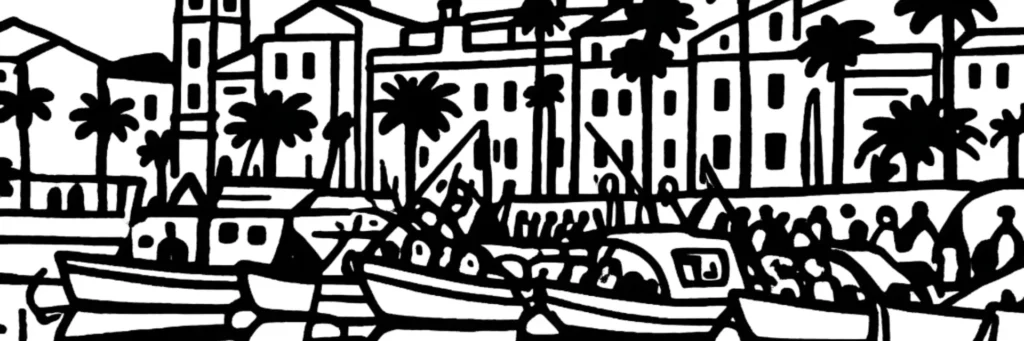
Atmospheric illustration of the bay of Les Lecques at Saint-Cyr-sur-Mer.
The average apartment price in Saint-Cyr-sur-Mer stands at 6 227 €/m², based on DVF transactions actually registered with notaries (DVF is the French record of notarised property sales). The municipality has no single centre: it is organised around three poles, the village set back inland, the seaside resort of Les Lecques and the small harbour of La Madrague. This average therefore covers very different situations, between the developments open onto the bay and the apartments of the village, about two kilometres from the shore. The view, the floor level, the presence of outdoor space and the distance to the beach explain most of the gaps observed from one sale to the next.
Prices from the DVF file (Demandes de valeurs foncières, published by the DGFiP), transactions actually recorded at the notary at municipality level. Cross-referenced with the Notaires de France - INSEE indices. Learn more about our methodology.
The Saint-Cyr-sur-Mer market is steady: around 190 apartment sales a year, and 379 transactions retained in the 2024-2025 calculation base. For a municipality of fewer than 12 000 inhabitants, that volume reflects a turnover fed by the dual use of the stock, main residence on one side, holiday home on the other. The average therefore rests on a solid sample, but it aggregates heterogeneous segments: small seafront units at Les Lecques, family apartments in the developments of the 1970s and 1980s, and village houses that come to market far more rarely.
Several drivers support this price level. The area is hemmed in between the sea, the vines of the Bandol appellation and the slopes of the Sainte-Baume, which leaves little buildable land and limits new schemes. Tourism rests on the bay of Les Lecques, the coastal path towards the Port d'Alon inlet and the Tauroentum museum, with a season running from spring to autumn. Finally, the regional railway station and the A50 junction put the municipality within reach of the employment areas of Marseille and Toulon, which widens demand beyond second-home buyers alone.
Saint-Cyr-sur-Mer sits in the upper middle of this coastline, a notch below its immediate neighbour Bandol, above La Ciotat and clearly below Cassis. The gaps reflect the scarcity of seafront land and the weight of second homes in each municipality.
The coast of Saint-Cyr-sur-Mer was occupied from antiquity. At the place known as Tauroentum, on the seafront at Les Lecques, excavations uncovered the remains of a Roman villa maritima occupied from the first to the third century, with its mosaics and its retaining walls facing the bay. The site was laid out as a museum in 1969 and remains one of the rare surviving examples of this type of coastal residence in France. After antiquity the population withdrew inland, onto the promontory of La Cadière, a defensive position commanding the whole plain. The shore was then no more than a place for fishing and huts, with no structured permanent settlement.
The municipality was created late: on 6 July 1825 the hamlets of San-Céri, Les Lecques and La Madrague split from La Cadière to form an independent council. At that date the whole had about 1 300 inhabitants spread over nearly 2 100 hectares, with only 33 houses at Les Lecques and 6 at La Madrague. The economy was then agricultural, turned towards the vine, the olive and the caper. The cooperative winery La Saint-Cyrienne was founded in 1926, and the wines of Bandol obtained their controlled designation of origin by the decree of 11 November 1941. The municipality now has more than 350 hectares classified under that appellation.
One episode explains the village's most visible curiosity: in 1913, when the first municipal water supply was commissioned, the landowner Anatole Ducros gave Saint-Cyr a scale model of the Statue of Liberty, signed by Bartholdi, 2,50 metres high. It has stood on Place Portalis ever since. The shift towards tourism came from the railway and the road: the station of Saint-Cyr-Les Lecques-La Cadière, on the line from Marseille-Saint-Charles to Ventimiglia, then the A50 motorway junction, brought the municipality closer to Marseille and Toulon. The Nouveau Port des Lecques, built in the 1970s, completed the resort as it is seen today.
Saint-Cyr-sur-Mer has 11 658 inhabitants for a stock of about 11 300 dwellings. According to INSEE, the French national statistics office, main residences account for a little over half of that stock, around 51 %, against 46 % second and occasional homes: the municipality therefore attracts holiday buyers as much as year-round households. Also according to INSEE, apartments make up nearly 60 % of dwellings and houses a little over 40 %, which leaves real room for villas and village houses. Among main residences, around 63 % of households are owner-occupiers, a high proportion that restricts the year-round rental supply.
The average apartment price in Saint-Cyr-sur-Mer is 6 227 €/m², calculated on DVF transactions actually completed before notaries. It is a municipal average, mixing the seafront developments of Les Lecques and the apartments of the village, set back inland. For a specific property, the view, the floor level, the outdoor space and the distance to the beach make value vary noticeably around that reference.
Les Lecques concentrates demand, with the blocks and developments looking onto the curved beach of the bay and onto the Nouveau Port. La Madrague, a former tuna port turned marina and fishing harbour, forms a quieter second pole, valued for its calm. The village, about two kilometres from the shore, offers more affordable properties, with shops and schools nearby but without a sea view.
The municipality has its own station, Saint-Cyr-Les Lecques-La Cadière, in the village about two kilometres from the beaches, on the line from Marseille-Saint-Charles to Ventimiglia served by regional trains. An A50 motorway junction completes that link between the two cities. This dual connection makes commuting to Marseille and Toulon possible, which supports main-residence demand alongside seasonal buyers.
It is evenly split. According to INSEE, around 46 % of dwellings are second or occasional homes, against 51 % main residences: the balance leans more towards permanent housing than in several neighbouring resorts of the Var coast. In practice the municipality keeps year-round life, with its schools and its village shops, while seeing a sharp swing in population between winter and summer.
Yes, and it weighs on land supply. More than 350 hectares of the municipal area are planted with vines classified under the Bandol controlled designation of origin, worked notably by the cooperative winery founded in 1926. These plots, protected by their agricultural classification, cannot be built on. Together with the coastal protection rules, they limit the space available for new schemes and keep pressure on existing properties.
This analysis is published by Immover, an independent observatory founded by Antony Barbier. Data sourced from official sources (DVF, INSEE, Notaries of France).