The average price per m² in Valbenoîte (Saint-Étienne) is 1 156 €/m² for an apartment, within a range of 0,9 to 1,3 k€ per m², based on actual notarised (DVF) sales. Over the period, the market rose 1 % over 5 years and fell 1,5 % over the last 12 months, with about 110 transactions per year.

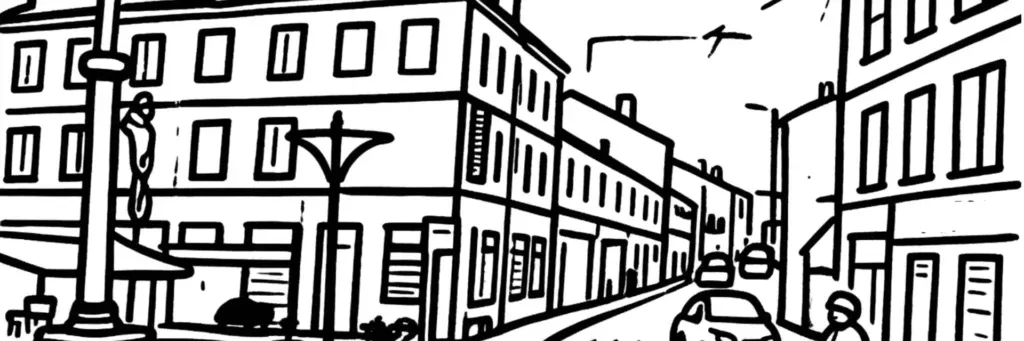
Valbenoîte, a former suburb south of Saint-Étienne, around its church.
Apartments in the Valbenoîte district, in Saint-Étienne, sell at an average price of around 1 156 €/m², based on actual recorded prices (DVF transactions). Between 877 and 1 327 €/m² covers half of the sales, the gap depending on the floor, the aspect and the condition of the property. Five-year change: +1 %.
Prices from the DVF file (Demandes de valeurs foncières, published by the DGFiP), transactions actually recorded at the notary, aggregated at district level using the IRIS zoning of INSEE. Cross-referenced with the Notaires de France - INSEE indices. Learn more about our methodology.
After 1 149 €/m² in 2021, the average price in the Valbenoîte district of Saint-Étienne reaches 1 156 €/m² in 2026, roughly +1 % over the period.
Local shops of the district, complemented by what the neighbouring centre of Saint-Étienne offers.
The church of Notre-Dame de Valbenoîte and the old suburban building stock along the Furan give the district its character.
Schools and local services, in a residential area steeped in history in the south of the city.
The Valbenoîte district, in Saint-Étienne. Google Maps map.
The Valbenoîte district stretches south of Saint-Étienne and brings together the Valbenoîte, La Rivière and Valfuret areas, along the course of the Furan towards the south. It is arranged around the church of Notre-Dame de Valbenoîte, which keeps the traces of a former Cistercian abbey. It is an old suburb, residential today, marked by its history and its position along the river.
Valbenoîte is an old village, fortified well before the centre of Saint-Étienne, which stayed independent until it was merged into the city in 1855. Its abbey, whose church was begun in the early thirteenth century, was tested several times over the centuries. The district was also a suburb of gunsmiths, who found in the waters of the Furan a source of power for their workshops, hence a building stock mixing religious heritage and industrial legacy.
Valued for its heritage, its suburban identity and its position in the south of the city, Valbenoîte sits among the affordable areas of the Saint-Étienne market. Supply mixes period apartments and houses, sought after by families and by buyers drawn to the character and history of the district.
The Valbenoîte district attracts families and buyers drawn to heritage and to the identity of an old suburb, south of Saint-Étienne. Demand mixes period apartments and houses in the Valbenoîte, La Rivière and Valfuret areas. The historic character, the church and the closeness of the Furan sustain interest in this affordable district.
The average price in Valbenoîte is 1 156 €/m² for an apartment (actual DVF transactions, notarised sales), within a range of 877 to 1 327 €/m² depending on the building, the floor and the condition.
It combines striking heritage around the church of Notre-Dame de Valbenoîte and its former abbey, the identity of an old suburb along the Furan, and a position in the south of the city. That historic character and its affordable prices make it an attractive area.
Mainly period apartments and houses, in an old suburban building stock mixing religious heritage and industrial legacy. Properties close to the church and the La Rivière area are sought after for their character.
No. Valbenoîte is among the affordable areas of the Saint-Étienne market, which remains one of the most accessible among the large French cities. The district offers a heritage setting in the south of the city at attractive price levels.
Yes. The area is linked to the centre of Saint-Étienne by the public transport network of the conurbation, which serves the south of the city along the Furan. Local shops and services complete the picture.
This analysis is published by Immover, an independent observatory founded by Antony Barbier. Data sourced from official sources (DVF, INSEE, Notaries of France).