The average price per m² in Stains is 2 787 €/m² for an apartment, based on actual notarised (DVF) sales. For a house or villa, it is 3 906 €/m². About 76 transactions are recorded each year.

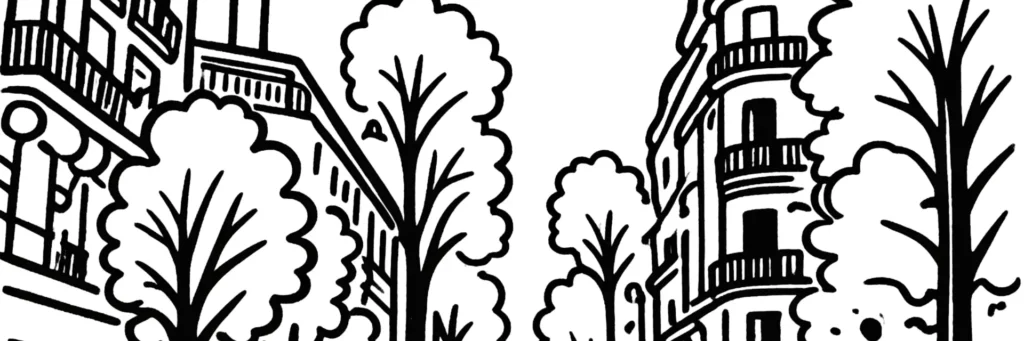
Mood illustration of Stains, its listed garden city, in the Seine-Saint-Denis, north of Paris.
The average price of apartments in Stains stands at 2 787 €/m², based on the DVF transactions actually registered before notaries. That average covers a highly contrasted stock: homes of the listed garden city, the post-war housing estates of Le Clos-Saint-Lazare and Maxime Gorki, more recent developments and the houses of Le Vieux-Stains and Stains Village. Location, the condition of the property, the storey, the presence of outside space and closeness to the stations move the value of a home a great deal. The municipality, in the northern suburbs of Paris some fifteen kilometres from the centre of the capital, is served by the RER and has a setting marked by the tree-lined avenues of the garden city. The market remains more affordable than that of several neighbouring municipalities of the Seine-Saint-Denis and the Val-d'Oise.
House : 3 906 €/m²
Prices from the DVF file (Demandes de valeurs foncières, published by the DGFiP), transactions actually recorded at the notary at municipality level. Cross-referenced with the Notaires de France - INSEE indices. Learn more about our methodology.
The Stains market remains active, carried by demand from households of the northern inner suburbs of Paris and from first-time buyers looking for prices more affordable than those of Paris and of several bordering municipalities. The variety of the stock, between social housing, condominiums, garden city and low-rise detached housing, feeds a steady supply and contrasting price levels from one sector to another. Closeness to the capital and the RER service support the residential appeal of the municipality.
Several factors weigh on how prices move. Urban renewal and refurbishment schemes, notably around the large estates and the garden city, are gradually transforming certain sectors and may change their value. Conversely, the large share of social housing, the condition of part of the stock and competition from better-served neighbouring municipalities cap the rise in prices and keep Stains among the most affordable markets of this part of the Seine-Saint-Denis.
Stains sits above its neighbour Sarcelles, in the nearby Val-d'Oise, and at a level close to Épinay-sur-Seine. The municipality remains below Le Bourget, better linked to Paris by metro and RER, a few kilometres away.
The land of Stains has been settled for a very long time and appears in medieval sources as a lordship of the plain north of Paris. In January 1240, Gervais de Chaumont sold to the Templars of Paris the rights of fealty and homage attached to the fief of Stains. A leper house is mentioned there at the beginning of the 14th century, and the place came for a time under the castellany of Gonesse. The municipality then lived off a farming economy geared to supplying the capital.
In 1714, the lordship of Stains passed to Toussaint Bellanger, who had a château and its park built by Armand-Claude Mollet, architect to the king, in the course of the 18th century. The estate was badly damaged during the war of 1870 and the château disappeared. Some outbuildings survive, among them the stables, bought by the municipality in 1883, which have housed the town hall ever since. These remains recall the old rural and seigneurial past of the municipality before its industrialisation and its urban growth.
The identity of Stains today rests on its garden city, built between 1921 and 1933 by the architects Eugène Gonnot and Georges Albenque for the Seine public office for low-cost housing. Inspired by the English garden cities of Letchworth and Hampstead Garden, it was raised on the grounds of the former château estate, whose layout of paths was partly reused. It brings together blocks of flats and individual brick houses, set along tree-lined avenues. The garden city was listed as a site in 1976 and was among the winners of the European Heritage Award in 2015; it is the subject of a refurbishment programme run by Seine-Saint-Denis Habitat and its partners.
Stains has 41 388 inhabitants, known as the Stanois and Stanoises. The Seine-Saint-Denis municipality has a very varied housing stock, between the listed garden city, large post-war estates such as Le Clos-Saint-Lazare and Maxime Gorki, more recent developments and the low-rise sectors on the Vieux-Stains and Stains Village side. Social housing holds an important place in the municipality, alongside private condominiums and individual houses. Buyers are mainly households of the northern inner suburbs of Paris and first-time buyers drawn by prices below those of Paris and of several bordering towns, within reasonable reach of the capital by RER. Renovated properties, with outside space or close to the stations, remain the most sought after.
The average price of apartments in Stains is 2 787 €/m², based on the DVF transactions actually completed before notaries. That average covers wide gaps depending on the sector, the condition of the property, the storey, the presence of outside space and closeness to the stations. A renovated home in the garden city and an apartment in a large estate awaiting refurbishment do not trade at the same level.
The Stains stock is heterogeneous. The listed garden city, the large estates of Le Clos-Saint-Lazare and Maxime Gorki, the recent developments and the low-rise districts of Le Vieux-Stains and Stains Village do not answer to the same building standards nor to the same setting. The condition of the property, its energy performance, the presence of a garden or a balcony and the distance to the stations explain noticeable differences from one home to another.
Stains lies in the northern suburbs of Paris, some fifteen kilometres from the centre of the capital. The Pierrefitte-Stains station, on the edge of Pierrefitte-sur-Seine, is served by the RER D and links Paris and the north of the region. By car, the Paris-region motorway network, notably the A1 and A86 motorways, runs close by. Paris-Charles-de-Gaulle airport is some fifteen kilometres away.
The market is largely made up of flats, and the benchmark price of 2 787 €/m² bears on apartments. Houses are concentrated in the low-rise sectors of Le Vieux-Stains and Stains Village, as well as in the individual houses of the garden city, which come to the market more rarely. They generally trade above the level of apartments. The choice depends above all on the budget, the floor area sought and the need for outside space.
The garden city, built between 1921 and 1933 and listed as a site in 1976, forms a remarkable urban ensemble, with its brick blocks and houses aligned along tree-lined avenues. It is a sought-after sector of the municipality, distinct from the neighbouring large estates. Its homes are covered by a refurbishment programme, and their value depends on condition, on the type of property and on the presence of a garden.
This analysis is published by Immover, an independent observatory founded by Antony Barbier. Data sourced from official sources (DVF, INSEE, Notaries of France).