The average price per m² in Verdun is 1 402 €/m² for an apartment, based on actual notarised (DVF) sales. About 98 transactions are recorded each year.

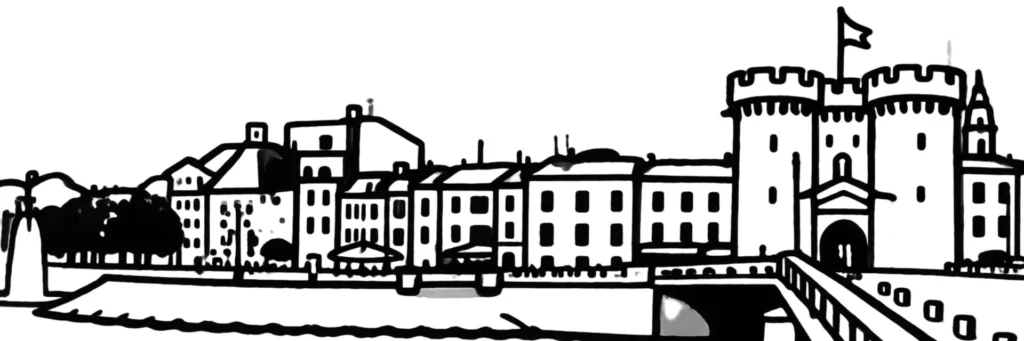
Atmospheric illustration of Verdun, a sub-prefecture of the Meuse department, between the upper town and the quays of the Meuse.
In Verdun, the average apartment price stands at 1 402 €/m², calculated on sales signed before notaries and published in DVF data, the French notarised sales database, for 2024 and 2025. The benchmark rests on 196 apartment sales, or close to a hundred a year, a sufficient volume for a town of this size. The flat supply combines old buildings in the upper town, interwar buildings rebuilt in the lower town after 1916 and more recent residential blocks on the outskirts. Houses carry a comparable weight in number of sales, mainly in the outer districts. From one address to another, the condition of the building, the floor and the energy performance create significant gaps around this average.
Prices from the DVF file (Demandes de valeurs foncières, published by the DGFiP), transactions actually recorded at the notary at municipality level. Cross-referenced with the Notaires de France - INSEE indices. Learn more about our methodology.
The Verdun market rests on an employment area dominated by public services, healthcare, defence and remembrance tourism, which draws visitors every year to the battlefields and the underground citadel. These activities ensure stable underlying demand, particularly for rentals, without creating strong pressure on prices. The population decline observed over several decades keeps supply abundant, which leaves buyers real room for negotiation. The links to the Meuse TGV station and the A4 nonetheless widen the circle of potential buyers beyond the Verdun area alone.
In this context, the quality of the property makes more of a difference than the economic climate. Homes rated F or G under the energy performance certificate, numerous in pre-war buildings, sell at a discount, all the more so since homes rated G can no longer be offered for a new lease since 2025. Conversely, a renovated apartment in the lower town or a house in good condition in the outer districts finds a buyer more quickly. The annual volume of around a hundred apartment sales makes it possible to follow these changes at the scale of the municipality.
Verdun sits at a level close to Jarny and slightly above Écrouves, while Val de Briey shows somewhat higher prices.
Verdun occupies a meander of the Meuse, on a site already inhabited in Gallo-Roman times under the name of Verodunum. Seat of a bishopric from late Antiquity, the town gave its name to the treaty of 843, which divided Charlemagne's empire between his three grandsons and shaped the map of Western Europe for centuries. It then belonged to the Holy Roman Empire, under the authority of its bishops. In 1552, King Henri II took control of it together with Metz and Toul: the Trois-Évêchés were born, and the treaty of Münster attached them definitively to France in 1648.
A stronghold on the eastern frontier, the town received in the seventeenth century a citadel built on the site of the abbey of Saint-Vanne. It endured the Prussian siege of 1792, then that of 1870. After 1871, the new border placed it on the front line, and a ring of forts was built on the surrounding heights. In 1916, the battle of Verdun pitted the French and German armies against each other from 21 February to 18 December on these hills, at the cost of immense losses on both sides. The town, evacuated and shelled, came out of the conflict largely destroyed.
Interwar reconstruction gave the lower town most of its present appearance, with its aligned facades along the quays. The upper town retains the cathedral of Notre-Dame, of Romanesque foundation, the bishop's palace that now houses the Centre mondial de la paix, and the Victory monument. The Porte Chaussée, a fortified gateway from the fourteenth century, still guards the bridge over the Meuse. Beneath the upper citadel, the underground galleries that sheltered soldiers and services during the war are open to visitors, and remembrance tourism is part of the local economy, as is the making of sugared almonds, a long-standing Verdun speciality.
With 16 890 inhabitants, Verdun is the most populous municipality of the Meuse, ahead of Bar-le-Duc, the prefecture, even though it is only a sub-prefecture. Its population has declined since the 1970s, which explains a calm market where properties for sale are not in short supply. Buyers are mostly households from the Verdun area, public servants and healthcare staff linked to the services of the sub-prefecture, as well as military personnel of the garrison stationed at Thierville-sur-Meuse, on the other bank, whose postings feed a steady rental market. Investors also look for small apartments in the centre to let. The housing stock combines dense older flats in the centre with detached housing that is more present in the outer districts and on the heights.
In 2026, the immover benchmark for an apartment in Verdun stands at 1 402 €/m². This level comes from sales actually completed before notaries in 2024 and 2025, and not from asking prices in listings. With close to a hundred apartment sales a year, the average is solid, but a renovated home with a lift and an apartment needing work in an old building can differ from it markedly. Our online valuation tool lets you refine the figure according to the size, floor and condition of your property.
The upper town, around the cathedral and the citadel, concentrates old stone buildings and quiet streets, sought after for their character. The lower town, rebuilt after the First World War, gathers the shops, the quays and most of the apartments in blocks. On the right bank, the faubourg Pavé and the more recent residential neighbourhoods offer more houses with land. Price differences between these sectors owe as much to the type of property as to the address itself.
Verdun station, place Maurice-Genevoix, is served by TER Grand Est regional trains towards Metz and Nancy, directly or via Conflans-Jarny. A shuttle bus connects in around thirty minutes to the Meuse TGV station, located about 25 km to the south, from which TGV trains run to Paris and Strasbourg. The A4 motorway passes north of the town, with two exits nearby. Within the town, an urban bus network completes the service.
The two markets carry a similar weight: 196 apartment sales and 183 house sales were used for the calculation. Per square metre, houses sell for slightly more, at around 1 694 €/m², a moderate gap that reflects often older houses and generous floor areas. The price shown at the top of the page remains the apartment price. For a house, a garden, a garage and the condition of the roof count as much as the sector.
Part of the lower town and the banks of the Meuse is covered by the flood risk prevention plan (PPRI) of the Meuse valley, Verdun sector, which regulates works and extensions according to the level of hazard. Around the cathedral, the Porte Chaussée and the other historic monuments, works visible from outside are subject to the opinion of the Architectes des Bâtiments de France, the state heritage architects. In a largely old housing stock, the energy performance certificate (DPE) also deserves particular attention, especially if you plan to let the property.
This analysis is published by Immover, an independent observatory founded by Antony Barbier. Data sourced from official sources (DVF, INSEE, Notaries of France).