The average price per m² in Saint-Jacques (Amiens) is 2 153 €/m² for an apartment, within a range of 1,6 to 2,6 k€ per m², based on actual notarised (DVF) sales. Over the period, the market rose 9 % over 5 years and fell 1,8 % over the last 12 months, with about 72 transactions per year.

Saint-Jacques, a district in the west of Amiens, around the Saint-Roch station.
Apartments in the Saint-Jacques district, in Amiens, sell at an average price of around 2 153 €/m², based on actual recorded prices (DVF transactions, the French database of notarised property sales). Between 1 578 and 2 607 €/m² covers half of the sales, the gap depending on the floor, the aspect and the condition of the property. Five-year change: +9 %.
Prices from the DVF file (Demandes de valeurs foncières, published by the DGFiP), transactions actually recorded at the notary, aggregated at district level using the IRIS zoning of INSEE. Cross-referenced with the Notaires de France - INSEE indices. Learn more about our methodology.
After 1 972 €/m² in 2021, the average price in the Saint-Jacques district of Amiens reaches 2 153 €/m² in 2026, roughly +9 % over the period.
Local shops and everyday services are dotted through the district, with the town centre and its retail brands still within a few minutes.
The Saint-Roch station, the work of Pierre Dufau, and the heritage of Amiens houses give the district its identity, a stone's throw from the centre.
Schools, services and health facilities are present in the district and close to the centre.
The Saint-Jacques district, in Amiens. Google Maps.
Saint-Jacques, often linked with the neighbouring Saint-Roch area, is a district in the west of Amiens. The historic Saint-Jacques stretched, inside the fifteenth-century ramparts, as far as the Somme; before that, it was an outer district on the west side of the city. Very badly damaged during the Second World War, it was largely rebuilt in the years that followed.
The neighbouring Saint-Roch area was, in the eighteenth century, open countryside beyond the ramparts. In the late nineteenth and early twentieth centuries it filled with Amiens brick houses built for the workforce of the textile mills. The construction of a second Amiens station, the Saint-Roch station, in the middle of the 1870s, brought new life to the district. Bombed several times, it was rebuilt after the war by the architect Pierre Dufau.
Sought after for its closeness to the centre, its rail service and its brick houses, Saint-Jacques sees demand carried by families, working people and first-time buyers. Supply mixes reconstruction buildings, apartments and Amiens houses, which makes it an affordable residential area, close to the heart of the city.
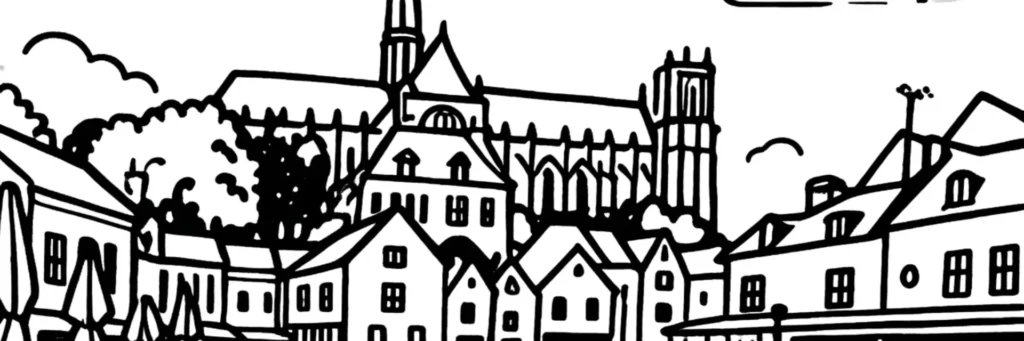
Saint-Jacques attracts families, working people and first-time buyers looking for a district close to the centre and well connected by rail. Demand focuses on the Amiens brick houses of the Saint-Roch area, the apartments and the reconstruction buildings. The closeness of the centre and the Saint-Roch station, along with measured prices, sustain an affordable residential market.
The average price in Saint-Jacques is 2 153 €/m² for an apartment (actual DVF transactions, notarised sales), within a range of 1 578 to 2 607 €/m² depending on the building, the floor and the condition.
Saint-Jacques lies west of the centre of Amiens, linked with the Saint-Roch area and its station. It is a district partly rebuilt after the Second World War, close to the heart of the city.
The district mixes post-war reconstruction buildings, apartments and Amiens brick houses, above all in the Saint-Roch area. The supply suits both families and first-time buyers.
Saint-Jacques remains an affordable area of the Amiens market, among the most accessible close to the centre. Its rail service and its closeness to the heart of the city nevertheless sustain steady demand.
Yes, it is one of the best-connected areas of Amiens. The Saint-Roch station serves the district, the centre is quickly reached, and the Ametis bus network completes the service.
This analysis is published by Immover, an independent observatory founded by Antony Barbier. Data sourced from official sources (DVF, INSEE, Notaries of France).