The average price per m² in Centre-ville (Dole) is 1 556 €/m² for an apartment, within a range of 1,1 to 1,8 k€ per m², based on actual notarised (DVF) sales. Over the period, the market rose 16 % over 5 years and rose 13,4 % over the last 12 months, with about 70 transactions per year.

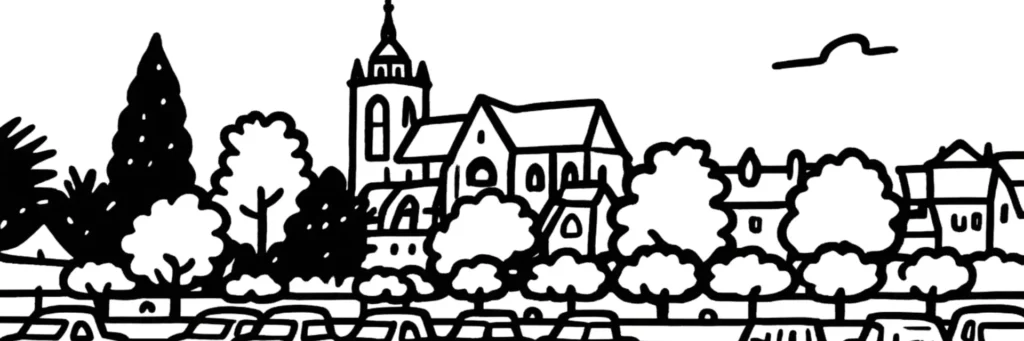
The centre of Dole, the collégiale Notre-Dame above the canal des Tanneurs.
Apartments in the Centre-ville district, in Dole, sell at an average price of around 1 556 €/m², based on prices actually recorded (DVF transactions, notarised sales). Between 1 124 and 1 773 €/m² covers half of all sales, the gap depending on the condition of the property, its energy rating, its floor area and heritage constraints. Five-year change: +16 %.
Prices from the DVF file (Demandes de valeurs foncières, published by the DGFiP), transactions actually recorded at the notary, aggregated at district level using the IRIS zoning of INSEE. Cross-referenced with the Notaires de France - INSEE indices. Learn more about our methodology.
After 1 338 €/m² in 2021, the average price in the Centre-ville district in Dole reaches 1 556 €/m² in 2026, around +16 % over the period.
Town-centre retail in the pedestrian streets, markets, restaurants and tourism along the canal des Tanneurs.
Collégiale Notre-Dame, the birthplace of Louis Pasteur, municipal services and the sub-prefecture, primary and secondary schools of the centre.
An old Franche-Comté town on its promontory, the canal des Tanneurs and houses standing over the water, a protected area, a 73 metre bell tower.
The old centre of Dole, around the collégiale Notre-Dame. Google Maps.
The centre of Dole is the Franche-Comté town proper. The one that was capital of the county of Burgundy, that received its parliament at the start of the fifteenth century and then its university, and that became French only in 1678 with the conquest by Louis XIV. The density of its built fabric and the quality of its façades come from those two centuries as a capital.
The collégiale Notre-Dame is its central monument. Built between 1509 and 1588, it combines late flamboyant Gothic with the Renaissance, and its seventy-three metre bell tower can be seen from across the plain. Around it, the Grande Rue, the rue des Arènes, the rue Granvelle, the rue du Prélot and the rue Marcel-Aymé trace a tight fabric of private mansions and town houses.
Below, the canal des Tanneurs and its houses standing over the water give Dole its best-known image. It was there that Louis Pasteur was born in 1822, in a tannery; his birthplace, on the quay that carries his name, is open to visitors.
The district is the largest market in the town: 354 apartment sales in five years, seventy a year, or 35 % of the Dole total. And it is also the cheapest, at 1 556 €/m², level with Wilson. It gains 16 % over five years and 13,4 % over the last twelve months, the strongest annual rise in the town.
The centre of Dole is the most paradoxical district in the town: it is the largest market, with 35 % of sales, and it is also the cheapest, at 1 556 €/m². This is not a sign of decline. It is an effect of the housing stock. The old Franche-Comté fabric is dense here, often divided into small units, and a large share still needs renovation, which pulls the lower quartile of the market down to 1 124 €/m², the lowest in Dole. A renovated home reaches far higher levels, and the range of the district, from 1 124 to 1 773 €/m², shows it. There are two buyer profiles: first-time buyers and investors who find here the best entry point in the town, and heritage-minded purchasers taking on a property to renovate. Three practical points. The area is protected, and work on façades, joinery and roofing is regulated: check with the planning department before any project, particularly an energy refurbishment. Parking is difficult in the fabric of a walled town. And the rise of 13,4 % over twelve months, the strongest in Dole, rests on seventy annual sales: it is solid, and it indicates that the market of the centre is being repriced.
The average price in Centre-ville is 1 556 €/m² for an apartment (actual DVF transactions, notarised sales), within a range of 1 124 to 1 773 €/m² depending on the building, the floor and the condition.
This is a peculiarity of the town, and it comes from the housing stock rather than from how attractive the area is. The old centre concentrates 35 % of sales in the town, on a dense Franche-Comté built fabric made up of many small units and a large share of properties in need of renovation. Its lower quartile falls to 1 124 €/m², the lowest in Dole. A renovated home reaches far higher levels there: here it is the condition of the property that sets the price, not the address.
No. The area is protected and the old fabric is regulated: work on façades, joinery and roofing is subject to requirements. Check with the planning department before buying, especially if your project involves external wall insulation or a change of window frames, since not all the usual solutions are permitted here. The point matters all the more because many properties in the centre are sold in need of renovation.
Yes, more so than in the other districts of the town. It covers seventy annual sales, the largest volume in Dole, which shields it from small-sample effects. It is consistent with the rise of 16 % over five years. The most likely reading is that the market of the centre is being repriced, particularly on renovated properties.
In a tannery in the old centre, beside the canal des Tanneurs, in 1822. His birthplace, on the quay that now carries his name, is open to visitors. The canal and its houses standing over the water form the best-known image of the town, below the historic centre and the collégiale Notre-Dame.
This analysis is published by Immover, an independent observatory founded by Antony Barbier. Data sourced from official sources (DVF, INSEE, Notaries of France).