The average price per m² in Lens is 1 742 €/m² for an apartment, within a range of 1,4 to 2,0 k€ per m², based on actual notarised (DVF) sales. Over the period, the market fell 3 % over 5 years and rose 3,9 % over the last 12 months, with about 91 transactions per year.

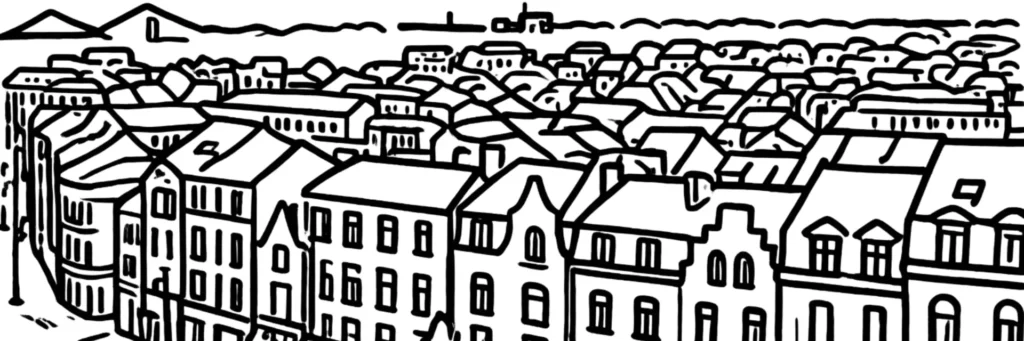
Illustration of Lens, a town of the Pas-de-Calais coal basin, between its miners' housing estates, the Louvre-Lens and its rebuilt centre.
Apartments in Lens sell at an average price of around 1 742 €/m², based on transactions actually recorded (DVF data, the French database of notarised property sales). At the heart of the Pas-de-Calais coal basin, Lens is shaped by its mining history, by the miners' housing estates listed as UNESCO World Heritage, by the Louvre-Lens and by the Bollaert-Delelis stadium. Prices run from around 1 557 €/m² at Cité 4, to the west, to nearly 1 851 €/m² in the town centre. Houses, at around 1 646 €/m², trade close to apartment levels and even slightly below: that is a feature of former mining towns, whose housing stock is largely made up of miners' cottages. Sales volume remains moderate, at around 90 apartment transactions a year.
Prices from the DVF file (Demandes de valeurs foncières, published by the DGFiP), transactions actually recorded at the notary at municipality level. Cross-referenced with the Notaires de France - INSEE indices. Learn more about our methodology.
After 1 801 €/m² in 2021, the average price in Lens reaches 1 742 €/m² in 2026, roughly -3 % over the period.
Change in the average price per m² over twelve months, district by district, based on the most recent DVF sales.
The average price per m² for an apartment in each district of Lens covered by Immover, ranked from the most expensive to the most affordable.
The Lens market is that of a post-mining town in the Pas-de-Calais, at the centre of the Lens-Liévin conurbation. With an average price of around 1 742 €/m² for an apartment, Lens is among the most affordable markets in the Hauts-de-France. That level reflects the conversion of the former coal basin and a housing stock largely made up of miners' cottages. Houses, at around 1 646 €/m², trade close to apartment levels and even slightly below, which is rare and specific to former mining towns.
The price map sets the centre against the estates. The rebuilt town centre, around the station and boulevard Émile Basly, holds the top of the market. The miners' estates, to the east around Saint-Édouard and to the west around Cité 9 and Cité 4, remain more affordable. With around 90 apartment sales a year across the whole town, district averages rest on small numbers and move irregularly from one year to the next: the northern sector, around the Grande Résidence, is too quiet to produce a reliable average.
With an average price of around 1 742 €/m², Lens is one of the most affordable markets in the Hauts-de-France, far from the levels seen in Lille. Its rebuilt centre, its rail links, the Louvre-Lens and the Bollaert-Delelis stadium make it a town sought after by owner-occupiers and investors.
Lens sits at the centre of the former Nord-Pas-de-Calais coal basin, on a plateau crossed by the coal seams that made its history. A simple farming town until the nineteenth century, it changed scale with the mining of coal by the Société des mines de Lens, which covered the area with pits, slag heaps and workers' estates. That mining landscape, handed down over several generations, is now listed as UNESCO World Heritage.
The town also carries the memory of war. Lying on the front line, Lens was almost 90 % destroyed during the First World War, then rebuilt in the 1920s, which explains the unity of its centre and of its art deco station. After the mines closed, the last pit ceasing activity in the 1980s, the town turned to other landmarks: the Louvre-Lens, opened in 2012 on the former yard of pit 9, and the Bollaert-Delelis stadium, home of Racing Club de Lens, have become its two emblems.
The geography of prices follows that history. The rebuilt, commercial town centre, around the station and boulevard Émile Basly, forms the top of the market. The miners' estates, to the east around Saint-Édouard and to the west around Cité 9 and Cité 4, make up a fabric of miners' cottages and small blocks at more measured prices. The northern sector, around the Grande Résidence, remains marked by social housing.
The Lens market attracts first-time buyers, families and working households from the Lens-Liévin conurbation, along with investors looking for some of the most affordable prices in the region. Demand focuses as much on town houses and former miners' cottages, very present in the housing stock, as on apartments in the centre. Prices, kept measured, reflect the post-mining context of the town and an urban fabric inherited from the coal industry.
The average price in Lens is 1 742 €/m² for an apartment (actual DVF transactions, notarised sales), within a range of 1 409 to 2 008 €/m² depending on the district. Listing portals show asking prices, 10 to 20 % above the prices actually recorded at signing.
No. The town centre, around the station and boulevard Émile Basly, has the highest prices, at around 1 851 €/m². The miners' estates to the east and to the west are more affordable: Saint-Édouard sits at around 1 700 €/m², Cité 9 at around 1 600 €/m² and Cité 4, to the west, at around 1 557 €/m².
Lens combines some of the most affordable prices in the Hauts-de-France region, a rebuilt centre served by rail, and a renewed cultural setting around the Louvre-Lens and the Bollaert-Delelis stadium. The average price, at around 1 742 €/m² for an apartment, makes ownership projects possible that are hard to put together in neighbouring cities such as Lille.
The Lens market has stayed close to flat over five years for apartments, with a slight decline of around 3 %. Volume, at around 90 apartment sales a year, remains moderate, which makes district averages sensitive to recent transactions.
The town-wide average is not enough: you have to start from the price in your district, then adjust for the type of property, the floor, the condition, the energy performance and the kind of home, since a miner's cottage and a recent apartment are not valued in the same way. The Immover estimator draws on the actual sales closest to your address.
This analysis is published by Immover, an independent observatory founded by Antony Barbier. Data sourced from official sources (DVF, INSEE, Notaries of France).