The average price per m² in Orange is 1 919 €/m² for an apartment, within a range of 1,3 to 2,4 k€ per m², based on actual notarised (DVF) sales. Over the period, the market rose 9 % over 5 years and fell 2,3 % over the last 12 months, with about 157 transactions per year.

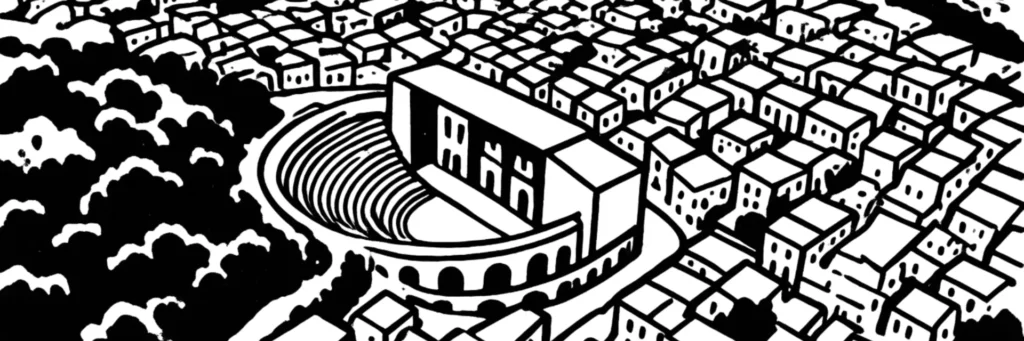
Illustration of Orange, a Roman city of the Vaucluse, between the Rhône and the hill of Saint-Eutrope.
Apartments in Orange sell at an average price of around 1 919 €/m², based on transactions actually recorded (DVF data). Once the Roman Arausio, the city keeps an ancient theatre and a triumphal arch listed as UNESCO World Heritage since 1981. Prices range from around 1 311 €/m² in Argensol, to the east, near the station, to nearly 2 583 €/m² in La Deymarde, to the north, the most expensive residential area of the municipality. The Centre-ville, the old core and the most active district, sits around 2 026 €/m². Houses, at around 2 672 €/m², trade clearly above apartments: Orange remains a city where detached housing dominates.
Prices from the DVF file (Demandes de valeurs foncières, published by the DGFiP), transactions actually recorded at the notary at municipality level. Cross-referenced with the Notaires de France - INSEE indices. Learn more about our methodology.
After 1 755 €/m² in 2021, the average price in Orange reaches 1 919 €/m² in 2026, an increase of roughly +9 % over the period.
Change in the average price per m² over twelve months, district by district, based on the most recent DVF sales.
The average price per m² for an apartment in each district of Orange covered by Immover, ranked from the most expensive to the most affordable.
The Orange market is that of a mid-sized town in the Rhône valley, sub-prefecture of the Vaucluse, carried by its Roman heritage and its motorway and rail position. With an average price around 1 919 €/m² for an apartment, Orange sits well below Avignon and the towns of the south of the department, while staying above the small rural municipalities of the Haut-Vaucluse. Houses, around 2 672 €/m², weigh heavily on this market: detached housing dominates demand here.
The gap between districts reflects the structure of the town. The residential areas of the north and west, La Deymarde, Le Jonquier and Russamp, form the top of the market. The Centre-ville concentrates most of the apartment sales, with the oldest housing stock. The large estates of Fourchevieilles, to the north, and the station area, in Argensol, form the bottom of the range. With about 157 apartment sales per year across the town, the municipal average is solid, but that of the least active districts, in particular Les Sables and Le Jonquier, rests on very few transactions and varies from one year to the next.
With an average price around 1 919 €/m², Orange is more affordable than Avignon and than most cities of Provence. Its Roman heritage, its rail and motorway links and its setting in the Rhône valley make it a sought-after town for families and first-time buyers of the Haut-Vaucluse.
Orange lies on the left bank of the Rhône, in the north of the Vaucluse, about thirty kilometres north of Avignon. The city grew out of the Roman colony of Arausio, founded in the first century BC on the via Agrippa. From it the city keeps two major monuments, the ancient theatre and its stage wall, set against the hill of Saint-Eutrope, and the arch of Orange, which marked the northern entrance to the city. Both ensembles have been listed as UNESCO World Heritage since 1981.
Capital of a principality that gave its name to the House of Orange-Nassau, the town was attached to France in the early eighteenth century. The old centre is still organised around the place Georges Clemenceau, the town hall and the cours Aristide Briand, where the Thursday morning market is held. Every summer the Chorégies d'Orange, an opera festival founded in 1869, take place in the ancient theatre. In the twentieth century the municipality spread through residential districts to the north and west, and through large housing estates to the north, around Fourchevieilles.
The geography of prices follows this history. The residential areas of the north and west, La Deymarde, Le Jonquier and Russamp, form the top of the market. The Centre-ville concentrates the volume of apartment sales, in a largely older housing stock. The large estates of the north and the station area, in Fourchevieilles and Argensol, remain the most affordable. The Rhône to the west, the Aygues to the north and the Meyne, which runs through the town, frame this market.
The Orange market attracts first-time buyers, families and working people from the Rhône valley, along with buyers looking for measured prices about thirty kilometres from Avignon. Demand focuses above all on the houses of the residential districts to the north and west, and on the apartments of the old centre. The station, served by the Paris-Miramas TGV, the motorway interchange towards the A7 and the A9, the Orange-Caritat air base 115 and the jobs of the Rhône valley support an active market.
The average price in Orange is 1 919 €/m² for an apartment (actual DVF transactions, notarised sales), within a range of 1 344 to 2 381 €/m² depending on the district. Listing portals show asking prices, 10 to 20 % above the prices actually recorded at signing.
No. La Deymarde, to the north, shows the highest prices, around 2 583 €/m², on a recent residential fabric, while Argensol, to the east near the station, remains the most affordable area, around 1 311 €/m². The Centre-ville, the old core and the most active district in the town, sits around 2 026 €/m².
Orange combines Roman heritage listed by UNESCO, a location in the Rhône valley about thirty kilometres from Avignon, and measured prices compared with the cities of Provence. The station is served by the Paris-Miramas TGV and the interchange gives access to the A7 and the A9. The average price, around 1 919 €/m² for an apartment, stays well below that of Avignon or Aix-en-Provence.
Over five years the Orange market has risen by roughly 9 % for apartments, with a slight dip over the last twelve months. The volume, around 157 apartment sales per year, makes the city average reliable, even if that of some districts rests on few transactions and varies from one year to the next.
The city average is not enough: you have to start from your district's price, then adjust for the type of property, the floor, the condition, the aspect and proximity to the centre. The gap between apartment and house is also wide, with houses trading well above in Orange. The Immover estimator draws on the actual sales closest to your address.
This analysis is published by Immover, an independent observatory founded by Antony Barbier. Data sourced from official sources (DVF, INSEE, Notaries of France).