The average price per m² in Dunois (Orléans) is 2 731 €/m² for an apartment, within a range of 2,3 to 3,1 k€ per m², based on actual notarised (DVF) sales. Over the period, the market rose 5 % over 5 years and fell 1,2 % over the last 12 months, with about 45 transactions per year.

Dunois, a residential district between the centre and the station in Orléans.
Apartments in the Dunois district, in Orléans, sell at an average price of around 2 731 €/m², based on prices actually recorded (DVF transactions). Between 2 266 and 3 093 €/m² covers half of the sales, the gap depending on the floor, the aspect and the condition of the property. Five-year change: +5 %.
Prices from the DVF file (Demandes de valeurs foncières, published by the DGFiP), transactions actually recorded at the notary, aggregated at district level using the IRIS zoning of INSEE. Cross-referenced with the Notaires de France - INSEE indices. Learn more about our methodology.
After 2 600 €/m² in 2021, the average price in the Dunois district of Orléans reaches 2 731 €/m² in 2026, roughly +5 % over the period.
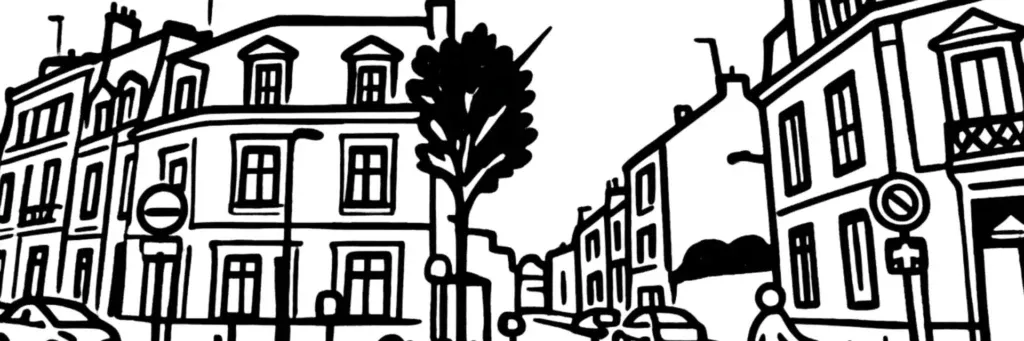
Local shops along rue Dunois and the neighbouring Bannier faubourg.
Quiet streets lined with bourgeois houses and character buildings give the district its charm.
Schools, local services and the shops of the centre within reach, in a central residential area.
The Dunois district, in Orléans. Google Maps map.
The Dunois district stretches between the centre of Orléans and the station, on the north bank of the Loire, around rue Dunois and rue de Châteaudun. It is one of the most valued residential districts of the city, in the centre-west, at the transition between the inner centre and the outer suburbs.
Its quiet streets are lined with bourgeois houses and character buildings, with local shops, in particular towards the neighbouring Bannier faubourg. The district keeps the charm of its older buildings while benefiting from the immediate closeness of the centre, the schools and services.
Sought after for its residential setting, its quality building stock and its central position, Dunois sits in the upper part of the Orléans market, below the historic centre. What is on offer mixes town houses and older apartments, favoured by families and working households looking for a quiet setting a step from the centre and the station.
The Dunois district attracts families, senior professionals and working households looking for a quiet, good-quality residential setting close to the centre and the station. Demand focuses on bourgeois town houses and older character apartments. The well-kept building stock and the centre-west position, between the inner centre and the outer suburbs, sustain prices in the upper part of the Orléans market.
The average price at Dunois is 2 731 €/m² for an apartment (actual DVF transactions, notarised sales), within a range of 2 266 to 3 093 €/m² depending on the building, the floor and the condition.
It combines quiet streets lined with bourgeois houses, local shops and a position between the centre and Orléans station. That good-quality residential setting, a step from the inner centre, makes it one of the most valued districts of the city.
Mostly bourgeois town houses and older character apartments, in a well-kept building stock. Houses with a garden and renovated apartments close to the centre and the station are the most sought after.
Dunois sits in the upper part of the Orléans market, below the historic centre, thanks to its residential setting and its central position. It remains affordable compared with the residential districts of the large French metropolitan areas.
Yes. Orléans station, towards Paris and the regional network, is immediately nearby. The town centre, its two tram lines and its shops are reachable on foot, and the bus network serves the area.
This analysis is published by Immover, an independent observatory founded by Antony Barbier. Data sourced from official sources (DVF, INSEE, Notaries of France).