The average price per m² in Brunoy is 3 077 €/m² for an apartment, within a range of 2,5 to 3,6 k€ per m², based on actual notarised (DVF) sales. Over the period, the market fell 1 % over 5 years and rose 1,2 % over the last 12 months, with about 131 transactions per year.

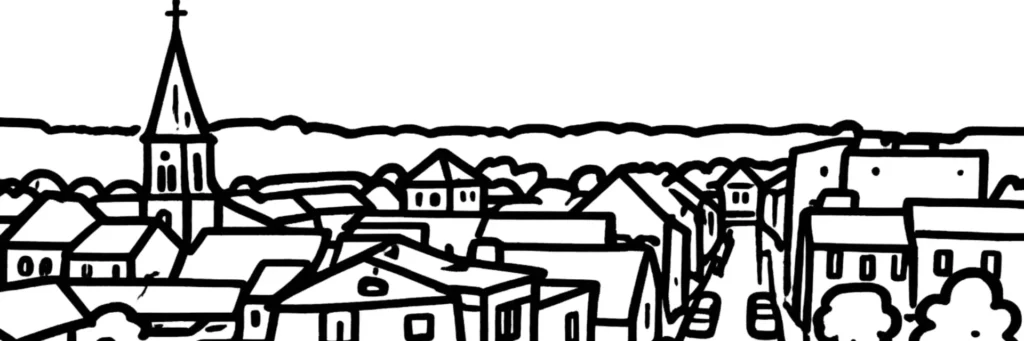
Illustration of Brunoy, in the Yerres valley, on the edge of the Sénart forest.
Apartments in Brunoy sell at an average price of around 3 077 €/m², based on actual recorded transactions (DVF data, the French database of notarised property sales). 21 km south-east of Paris, on the RER D line and on the edge of the Sénart forest, the town has a housing stock split almost evenly between houses and apartments. Prices run from about 2 864 €/m² on the Bords de l'Yerres to 3 330 €/m² in the Centre-ville, a gap of only 16 %. Houses, at 3 975 €/m², trade 29 % above apartments.
Prices from the DVF file (Demandes de valeurs foncières, published by the DGFiP), transactions actually recorded at the notary at municipality level. Cross-referenced with the Notaires de France - INSEE indices. Learn more about our methodology.
After 3 110 €/m² in 2021, the average price in Brunoy reaches 3 077 €/m² in 2026, roughly -1 % over the period.
Change in the average price per m² over twelve months, district by district, based on the most recent DVF sales.
The average price per m² for an apartment in each district of Brunoy covered by Immover, ranked from the most expensive to the most affordable.
The Brunoy market is that of a residential outer-suburban town well connected to Paris. With an average price of 3 077 €/m² for an apartment and 131 sales a year, Brunoy sits in the middle of the RER D part of the Essonne. The price loses 1 % over five years, with a high point in 2022 at 3 279 €/m² and a steady slide since, and regains 1,2 % over the last twelve months.
Two features set this town apart. The first is the narrowness of the gap between districts, 16 % from the most expensive to the most affordable, where a comparable town in the Essonne sits closer to 30 %. The second is that this tight spread hides a divergence of trajectory: La Pyramide, the suburban housing of the south-west, the furthest from the station, loses 19 % over five years while the Centre-ville gains 1 and the Bords de l'Yerres 0. In Brunoy, the station does not decide the level of prices, it decides their direction. A third point is worth making: the housing stock is split almost evenly between houses and apartments, yet a house trades 29 % higher per square metre here, where a town such as Brétigny-sur-Orge, twenty kilometres away, puts the two at exactly the same level.
Brunoy compared with the major French cities, on the average price per m² for an apartment.
Brunoy owes its appearance to two men of the eighteenth century. Jean Pâris de Monmartel, banker to the Court, embellished the estate and made it a place renowned for its gardens and its water displays, where Louis XV came to visit. The estate then passed to the Count of Provence, brother of Louis XVI, who was known as Monsieur: hence the name of the district and that of the avenue de Monsieur. The Grand Château is gone, but the plot pattern of the town centre has stayed very close to its configuration of that time. The pyramid, raised in 1779 to designs by Soufflot at the request of the king and his brother, who hunted in the forest, is the visual landmark of the town.
The arrival of the railway, between 1849 and 1852, changed everything. Parisian families built second homes there, then the town turned into a residential suburb at the beginning of the twentieth century. The Belle Époque left the memory of the guinguettes and the amusement parks in the south of the town, the Chat Noir, the Moulin de la Galette opened in 1914, and the Louis Gervaise park created in 1924 with its dance hall and its velodrome.
The town today covers 6,62 square kilometres, from one end to the other of a plateau cut by two valleys, in a bend of the Yerres and on the edge of the Sénart forest. It reads from west to east: La Pyramide and its estate housing to the south-west, the Bords de l'Yerres and their large properties to the west, the old centre and the RER D station in the middle, the Deux Vallées towards the Brie to the east, and the Hautes-Mardelles to the north-east, a plateau built between 1967 and 1969 with the Provinciales programme, whose walkways carry the names of French provinces. This last sector, entirely social rented housing and classified as a priority neighbourhood, records no apartment sale at all: it has no page of its own on Immover, for lack of a market to describe.
The Brunoy market turns on the RER D station, but not in the way one would expect. On price levels, the three districts sit within 16 % of each other and the ranking does not follow the distance to the station: La Pyramide, the furthest sector, comes second. It is on the trajectory that the station shows. Over five years, the Centre-ville gains 1 %, the Bords de l'Yerres post 0 %, and La Pyramide loses 19 %. The town attracts three profiles, all fed by the RER: first-time buyers and young families looking for suburban houses less than forty-five minutes from Paris, households paying more for the centre because of the daily commute, and investors in small units, which hold their value far better here than elsewhere, at 3 913 €/m² for a studio against 2 759 for a T4 and larger.
The average price in Brunoy is 3 077 €/m² for an apartment (actual DVF transactions, notarised sales), within a range of 2 500 to 3 559 €/m² depending on the district. Property portals show asking prices, 10 to 20 % above the prices actually recorded.
The Centre-ville, around the place Saint-Médard, the Grande Rue and the RER D station, at 3 330 €/m², 8 % above the town average. The gap with the Bords de l'Yerres, the most affordable at 2 864 €/m², is only 16 %: the Brunoy market is very tightly grouped in price terms.
The town is stable: it loses 1 % over five years, with a high point in 2022 at 3 279 €/m² and a slide since, and regains 1,2 % over twelve months. But the average hides a real break: La Pyramide, the sector furthest from the station, loses 19 % over five years while the two other districts post 0 and +1 %.
The two markets are of comparable size, with 131 apartment sales a year and 119 houses, but a house trades 29 % higher per square metre, 3 975 against 3 077. Watch the calculation convention: the price per square metre of a house covers the built floor area whereas the value paid includes the land, which mechanically inflates the figure.
Clearly. The studio and the T1 come out at 3 913 €/m² while the T4 and larger falls to 2 759, a gap of 42 %. This is a gradient typical of tight Paris-region markets on small units, and it makes Brunoy an interesting town for buy-to-let investment in studios, carried by the RER service.
Start with the walking time to the RER D station, which is the number one factor here, on value as much as on resale. Then look at the layout type, whose effect is strong, 42 % between a studio and a large apartment. Finally adjust for condition, energy rating, parking and, in the suburban house sectors, for the plot. The Immover estimator draws on the actually recorded sales closest to your address.
This analysis is published by Immover, an independent observatory founded by Antony Barbier. Data sourced from official sources (DVF, INSEE, Notaries of France).