The average price per m² in Gros Tilleul (Limoges) is 1 601 €/m² for an apartment, within a range of 1,2 to 2,0 k€ per m², based on actual notarised (DVF) sales. Over the period, the market fell 8 % over 5 years and rose 0,1 % over the last 12 months, with about 68 transactions per year.

The Gros Tilleul district, in northern Limoges, around the Dupuytren teaching hospital.
Apartments in the Gros Tilleul district of Limoges sell at an average price of around 1 601 €/m², based on prices actually recorded (DVF transactions, notarised sales). Between 1 182 and 1 965 €/m² covers half of all sales, the gap reflecting the floor, the aspect and the condition of the property. Five-year trend: -8 %.
Prices from the DVF file (Demandes de valeurs foncières, published by the DGFiP), transactions actually recorded at the notary, aggregated at district level using the IRIS zoning of INSEE. Cross-referenced with the Notaires de France - INSEE indices. Learn more about our methodology.
After 1 731 €/m² in 2021, the average price in the Gros Tilleul district of Limoges reaches 1 601 €/m² in 2026, a change of roughly -8 % over the period.
Local shops and services in the district, complemented by the retail hubs of the north of the conurbation.
The Dupuytren teaching hospital and its sites make the district one of the main health hubs in the city.
Schools, local amenities and facilities linked to the university and the hospital shape life in the district.
The Gros Tilleul district, in Limoges. Google Maps.
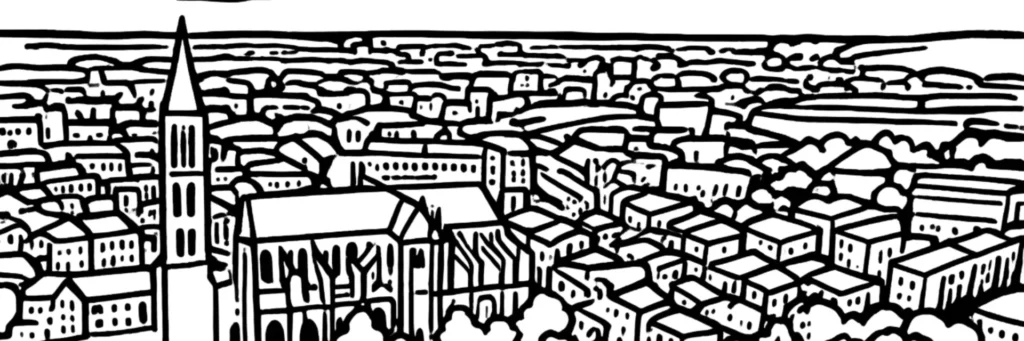
The Gros Tilleul district extends to the north of Limoges, immediately next to the Dupuytren teaching hospital. A residential area still developing, it combines housing, local services and fast access to the main routes. The hospital hub, one of the city's most important facilities, strongly shapes life in the district and draws healthcare staff, students and families.
The Limoges teaching hospital brings together several sites, including the Dupuytren 2 building, opened in 2019. That hospital presence, combined with the proximity of the university and the routes to the north, makes Gros Tilleul a functional area, where recent housing sits alongside older developments. The district benefits from effective access via the city network and the expressways.
Sought after for its proximity to the teaching hospital, the university and the main routes, Gros Tilleul offers supply made up of apartments in developments and houses. The areas of Gros Tilleul and the teaching hospital form a functional market, popular with hospital staff, students and buy-to-let investors.
The Gros Tilleul district attracts healthcare staff, students, families and investors looking for an address close to the teaching hospital and the main routes. Demand focuses on apartments in developments and houses. The presence of the hospital hub and the proximity of the university sustain a functional market, sought after for buy-to-let.
The average price in Gros Tilleul is 1 601 €/m² for an apartment (actual DVF transactions, notarised sales), within a range of 1 182 to 1 965 €/m² depending on the building, the floor and the condition.
It combines the immediate proximity of the Dupuytren teaching hospital, one of the city's main facilities, fast access to the northern routes and a range of services. That functional position attracts healthcare staff, students and investors.
Mainly apartments in developments and houses, between recent housing and older developments, in the areas of Gros Tilleul and the teaching hospital. Units suited to letting, favoured by hospital staff and students, are sought after.
Gros Tilleul shows prices close to the city average, supported by rental demand linked to the teaching hospital and the university. The area offers a good balance between affordability and practicality.
Yes. The city bus network serves the district and the teaching hospital, and the northern expressways link the area to the A20 and to the rest of the conurbation. The university and the centre remain within reach.
This analysis is published by Immover, an independent observatory founded by Antony Barbier. Data sourced from official sources (DVF, INSEE, Notaries of France).