The average price per m² in Carnot (Limoges) is 1 534 €/m² for an apartment, within a range of 1,3 to 1,7 k€ per m², based on actual notarised (DVF) sales. Over the period, the market fell 6 % over 5 years and rose 3,8 % over the last 12 months, with about 216 transactions per year.

The Carnot district, around the place Carnot, north of the centre of Limoges, between Montjovis and Bénédictins stations.
Apartments in the Carnot district of Limoges sell at an average price of around 1 534 €/m², based on prices actually recorded (DVF transactions, notarised sales). Between 1 306 and 1 660 €/m² covers half of all sales, the gap reflecting the floor, the aspect and the condition of the property. Five-year trend: -6 %.
Prices from the DVF file (Demandes de valeurs foncières, published by the DGFiP), transactions actually recorded at the notary, aggregated at district level using the IRIS zoning of INSEE. Cross-referenced with the Notaires de France - INSEE indices. Learn more about our methodology.
After 1 624 €/m² in 2021, the average price in the Carnot district of Limoges reaches 1 534 €/m² in 2026, a change of roughly -6 % over the period.
Local shops, agencies and services line the place Carnot and its streets, extended by the shops of the nearby centre.
The proximity of the centre, its market halls, its squares and the Champ de Juillet offers a lively neighbourhood life.
Schools, administrative services and healthcare professionals are present in the district and immediately next to the centre.
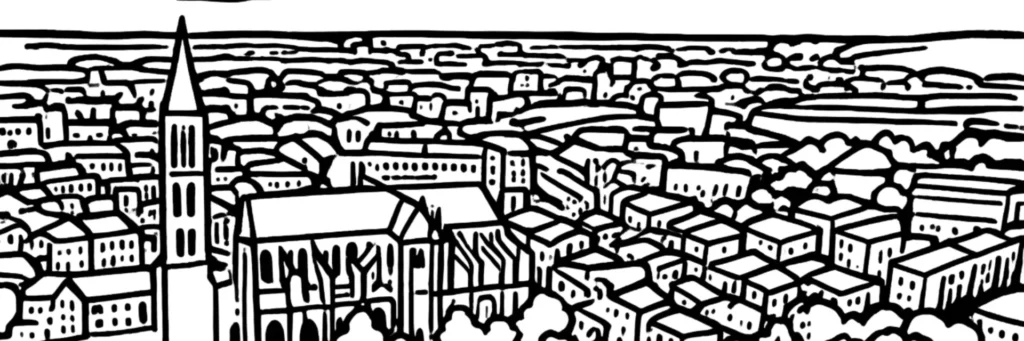
The Carnot district, in Limoges. Google Maps.
The Carnot district is arranged around the place Carnot, one of the large squares of Limoges, north of the centre, at the junction of several streets. Since 1897 the square has borne the name of President Sadi Carnot, born in Limoges in 1837. It lies at the heart of a formerly industrial area where, between Montjovis and Bénédictins stations, many porcelain manufactories and shoe factories were established in the late nineteenth century.
Once a working-class hub with its brasseries and small shops, the place Carnot has gradually changed, with agencies and services taking over. The district keeps the character of a dense urban faubourg, extended by the Charentes and Visitation areas. Its position at the northern gateway to the centre and its proximity to the stations give it a transition role between the city centre and the northern districts.
Sought after for its central position and its transport links, Carnot offers supply made up of period apartments and tenement blocks, prized both for buy-to-let and as main homes. The areas of Les Charentes, Carnot and La Visitation form an affordable urban market, close to shops and transport.
The Carnot district attracts first-time buyers, investors and working buyers looking for a central, well-connected address, close to the stations and the shops. Demand focuses on period apartments and tenement blocks, prized for buy-to-let. The proximity of the place Carnot, of Montjovis and Bénédictins stations and of the town centre sustains an affordable urban market.
The average price in Carnot is 1 534 €/m² for an apartment (actual DVF transactions, notarised sales), within a range of 1 306 to 1 660 €/m² depending on the building, the floor and the condition.
It combines a position at the northern gateway to the centre, the central place Carnot, shops and strong rail access at Montjovis and Bénédictins stations. That accessibility makes it an area sought after by working buyers and investors alike.
Mainly period apartments and tenement blocks, a legacy of the district's industrial and faubourg past, in the areas of Les Charentes, Carnot and La Visitation. Small and medium-sized units, prized for buy-to-let, are the most in demand.
Carnot shows prices close to the city average, driven by its central position and its transport links. The period building stock leaves room for properties needing renovation, which offer scope for appreciation in a well-placed urban area.
Yes. The city bus and trolleybus network serves the place Carnot and its surroundings. Limoges-Montjovis and Limoges-Bénédictins stations are immediately nearby, and the town centre is reached on foot.
This analysis is published by Immover, an independent observatory founded by Antony Barbier. Data sourced from official sources (DVF, INSEE, Notaries of France).