The average price per m² in Centre-ville (Poitiers) is 2 493 €/m² for an apartment, within a range of 2,0 to 2,9 k€ per m², based on actual notarised (DVF) sales. Over the period, the market fell 1 % over 5 years and fell 2,2 % over the last 12 months, with about 298 transactions per year.

The town-centre plateau, around Notre-Dame-la-Grande, the town hall and the pedestrian shopping streets.
Apartments in the town centre of Poitiers sell at an average price of around 2 493 €/m², based on prices actually recorded (DVF transactions, notarised sales). Between 2 030 and 2 858 €/m² covers half of all sales, the gap reflecting the position on the plateau, the heritage character of the building, the floor and the condition. Five-year trend: -1 %.
Prices from the DVF file (Demandes de valeurs foncières, published by the DGFiP), transactions actually recorded at the notary, aggregated at district level using the IRIS zoning of INSEE. Cross-referenced with the Notaires de France - INSEE indices. Learn more about our methodology.
After 2 513 €/m² in 2021, the average price in the town centre of Poitiers reaches 2 493 €/m² in 2026, a change of roughly -1 % over the period.
The pedestrian streets of the plateau, the rue Carnot and the rue des Cordeliers foremost among them, concentrate independent shops, chain stores and the covered market of Notre-Dame-la-Grande.
The centre brings together major Romanesque heritage, terraces, bars and restaurants around the place Leclerc and the place Charles-de-Gaulle.
The town hall, the prefecture and the administrative offices of the Vienne are based in the centre, alongside local services.
The town centre of Poitiers around Notre-Dame-la-Grande. Google Maps.
The town centre of Poitiers, known as Le Plateau, occupies the limestone summit above the valleys of the Clain and the Boivre. It is the historic heart of the city, organised around the place du Maréchal Leclerc, seat of the town hall, and the place Charles-de-Gaulle. The paved pedestrian streets, such as the rue Carnot and the rue des Cordeliers, link the two squares and concentrate the shops, terraces and restaurants.
The district holds outstanding Romanesque heritage: the sculpted facade of Notre-Dame-la-Grande, whose covered market occupies the neighbouring square, the cathedral of Saint-Pierre and the Saint-Jean baptistery. The palace of the counts of Poitou and dukes of Aquitaine, formerly the law courts, bears witness to the city's medieval past. North of the plateau lies the Trois-Quartiers area.
The building stock is mostly period, in limestone, with buildings of character that make the value of the area. The station, below to the west, links the centre directly to Paris on the high-speed line. That combination of heritage, shops and accessibility keeps demand strong and price levels among the highest in the city.
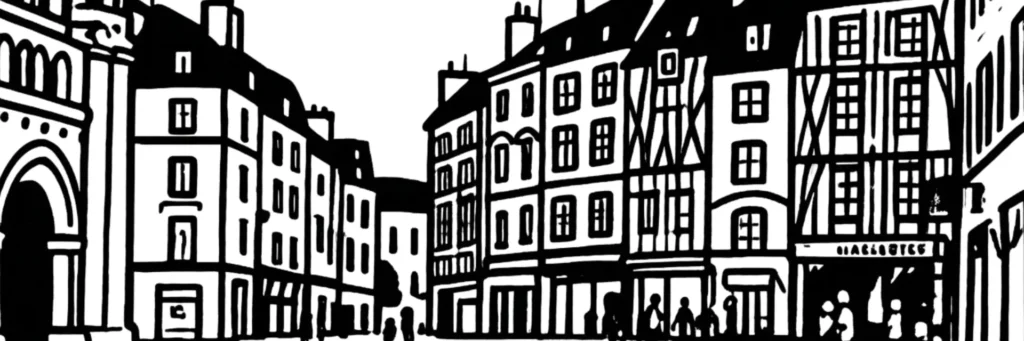
The town centre attracts buyers drawn to the charm of period property and to neighbourhood life: working buyers looking for immediate proximity to the shops and the station, first-time buyers of mid-sized units, and investors targeting the rental market, student or professional. The stone-built stock, often without a lift or parking, steers demand towards buyers ready to put location and heritage character first.
The average price in the town centre is 2 493 €/m² for an apartment (actual DVF transactions, notarised sales), within a range of 2 030 to 2 858 €/m² depending on the building, the floor and the condition.
The town centre, on the plateau, is among the most sought-after areas of Poitiers, with prices above the city average. The level depends a great deal on the position, the floor and the condition of the period property.
The town centre occupies the historic plateau, the limestone summit overlooking the valleys of the Clain and the Boivre. It is organised around the place du Maréchal Leclerc and the place Charles-de-Gaulle, with the station below to the west.
Yes: the concentration of shops and the proximity of the station and the university support steady rental demand. The period stock, often without parking, points towards a clientele of students and working tenants.
This analysis is published by Immover, an independent observatory founded by Antony Barbier. Data sourced from official sources (DVF, INSEE, Notaries of France).