The average price per m² in Centre-ville (Troyes) is 2 563 €/m² for an apartment, within a range of 1,6 to 2,7 k€ per m², based on actual notarised (DVF) sales. Over the period, the market rose 34 % over 5 years and fell 30,3 % over the last 12 months, with about 94 transactions per year.

The Centre-ville of Troyes, the heart of the lower town within the champagne cork.
Apartments in the Centre-ville district, in Troyes, sell at an average price of around 2 563 €/m², based on prices actually recorded (DVF transactions). Between 1 634 and 2 706 €/m² covers half of the sales, the gap depending on the type of property, the condition, the floor and how close it is to the shopping streets. Five-year change: +34 %.
Prices from the DVF file (Demandes de valeurs foncières, published by the DGFiP), transactions actually recorded at the notary, aggregated at district level using the IRIS zoning of INSEE. Cross-referenced with the Notaires de France - INSEE indices. Learn more about our methodology.
After 1 914 €/m² in 2021, the average price in the Centre-ville district of Troyes reaches 2 563 €/m² in 2026, roughly +34 % over the period.
The district concentrates the shops of Troyes, with rue Émile Zola and the covered market hall on rue Claude Huez.
The half-timbered houses of rue Champeaux, the Ruelle des Chats, the Saint-Urbain basilica and the town hall give the district its structure.
Town hall, public services and cultural venues are gathered in the centre or immediately around it.
The Centre-ville of Troyes, around the town hall and rue Émile Zola. Google Maps map.
The Centre-ville occupies the lower town within the champagne cork, on this side of the canal. It was the quarter of the merchants and craftsmen, that of the Champagne fairs. Destroyed by the fire of 1524, it was rebuilt in half-timbering, which left it one of the largest preserved ensembles in France, around rue Champeaux, the Ruelle des Chats and the Cour du Mortier d'Or.
The district brings together the institutions and the shops of the town: the town hall on Place Maréchal Foch, Place Jean Jaurès, rue Émile Zola and the covered market hall on rue Claude Huez. It keeps three major buildings, the Saint-Urbain basilica on Place Vernier, the Sainte-Madeleine church and its rood screen, and the Saint-Jean-au-Marché church. The canal quays, Quai Dampierre and Place Audiffred, mark its northern boundary.
On the market, the Centre-ville shows the highest prices in Troyes, at around 2 563 €/m² for an apartment, on a volume of around 94 sales a year. The annual average for the area varies sharply, between 1 914 and 3 181 €/m² depending on the year: the district mixes older homes needing renovation and refurbished or new units sold well above the local market.
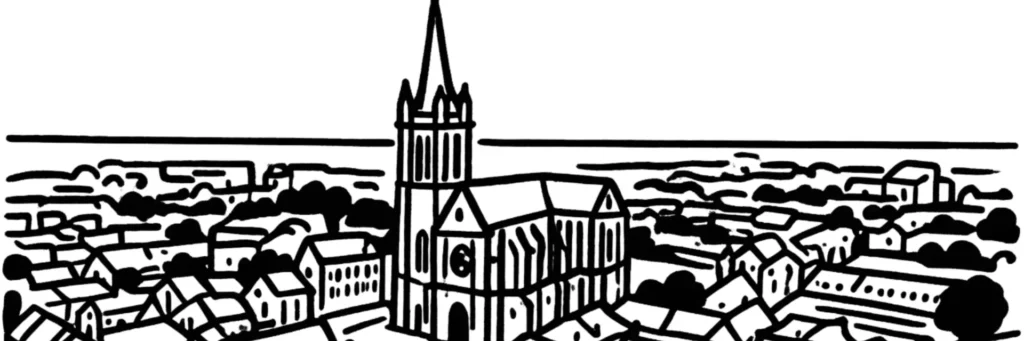
The Centre-ville attracts investors, first-time buyers and buyers looking for immediate proximity to the shops, the market hall and the heritage. Demand focuses almost entirely on apartments, from studios to large flats, in a largely older housing stock. The condition of the property, its energy performance and the presence of a lift or a parking space produce very wide price gaps from one unit to the next.
The average price in the Centre-ville is 2 563 €/m² for an apartment (actual DVF transactions, notarised sales), within a range of 1 634 to 2 706 €/m² depending on the building, the floor and the condition.
The Centre-ville, in the lower town within the champagne cork, sits at around 2 563 €/m² for an apartment, the highest level in the municipality, on a volume of around 94 sales a year. The gap between an older home needing renovation and a refurbished unit is very wide there.
The district brings together one of the largest ensembles of half-timbered houses in France, rebuilt after the fire of 1524, with rue Champeaux, the Ruelle des Chats and the Cour du Mortier d'Or. It also concentrates the town hall, the covered market hall on rue Claude Huez, the Saint-Urbain basilica and the Sainte-Madeleine and Saint-Jean-au-Marché churches.
The area is made up above all of apartments, in older buildings and half-timbered houses divided into units. There are also a few recent refurbishment schemes, sold well above the district average.
This analysis is published by Immover, an independent observatory founded by Antony Barbier. Data sourced from official sources (DVF, INSEE, Notaries of France).