The average price per m² in Vienne is 2 378 €/m² for an apartment, within a range of 1,9 to 2,8 k€ per m², based on actual notarised (DVF) sales. Over the period, the market rose 7 % over 5 years and rose 2,5 % over the last 12 months, with about 269 transactions per year.

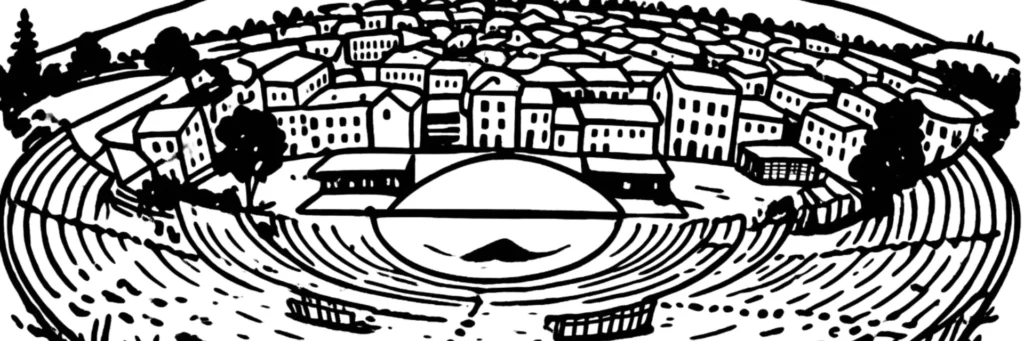
Illustration of Vienne, the former Roman capital on the left bank of the Rhône, in the Isère department.
Apartments in Vienne sell at an average price of around 2 378 €/m², based on transactions actually recorded (DVF data, the French notarised sales database). A sub-prefecture town of the Isère department set on the left bank of the Rhône, some thirty kilometres south of Lyon, Vienne combines outstanding Roman heritage with the urban fabric of a valley town. Prices run from around 1 760 €/m² at Mont Salomon, on the heights of the north-east, to nearly 2 684 €/m² at L'Isle, at the southern tip of the municipality, on a limited volume of sales. The Centre-ville, the historic core and the most active district, sits at around 2 442 €/m². Houses, at around 3 131 €/m², change hands well above apartments: the detached housing of the hillsides remains the most sought-after segment.
Prices from the DVF file (Demandes de valeurs foncières, published by the DGFiP), transactions actually recorded at the notary at municipality level. Cross-referenced with the Notaires de France - INSEE indices. Learn more about our methodology.
After 2 215 €/m² in 2021, the average price in Vienne reaches 2 378 €/m² in 2026, roughly +7 % over the period.
Change in the average price per m² over twelve months, district by district, based on the most recent DVF sales.
The average price per m² for an apartment in each district of Vienne covered by Immover, ranked from the most expensive to the most affordable.
The Vienne market is that of a sub-prefecture town of the Isère department set within the sphere of influence of Lyon. With an average price of around 2 378 €/m² for an apartment, Vienne sits well below the Lyon metropolitan area while staying above the average of the mid-sized towns of the Rhône corridor. Houses, at around 3 131 €/m², weigh heavily on this market: the detached housing of the hillsides accounts for a large share of demand.
The gap between districts reflects the topography of the town. The residential areas of the south and of the hillsides, at L'Isle, at Coupe-Jarret and around La Pyramide, form the top of the market. The Centre-ville holds most of the apartment sales, in the oldest housing stock, and eases slightly over five years. The industrial valleys and the heights of the north-east, at Vallée de Gère and Mont Salomon, form the bottom of the range, with real growth over five years. With around 269 apartment sales a year, the town-wide average is solid, but that of the least active districts varies from one year to the next.
With an average price of around 2 378 €/m², Vienne is far more affordable than Lyon and than the inner Lyon suburbs, while remaining well served by rail and by the Rhône corridor. Its Roman heritage, its setting on the banks of the Rhône and its residential hillsides make it a town sought after by families and by working people from the urban area.
Vienne occupies a crossing point on the left bank of the Rhône, where the Gère valley opens out. Capital of the Allobroges and later a major city of Roman Gaul, it retains a monumental ensemble that is rare for its size: the Théâtre antique, the Roman theatre set against the mont Pipet, the Temple d'Auguste et de Livie, the temple of Augustus and Livia, on the place Charles de Gaulle, and the pyramid of the Roman circus, to the south, which has given its name to a whole district.
The town then became an important episcopal seat, as the cathédrale Saint-Maurice, overlooking the quays, and the church and cloister of Saint-André-le-Bas bear witness. In the nineteenth century, the textile industry settled in the Gère valley and at Estressin, along the watercourses and the river, shaping districts of factories and workers' housing whose heritage is today studied and promoted. In the twentieth century, the town spread onto the plateaux of the east, at Charlemagne and Malissol, and onto the hillsides of the south-east.
The geography of prices follows this history. The residential areas of the south and of the hillsides, at L'Isle, at Coupe-Jarret and around La Pyramide, form the top of the market. The Centre-ville holds the bulk of the sales volume, in a largely period housing stock. The valleys and the heights of the north-east, at Vallée de Gère and Mont Salomon, remain the most affordable. The closeness of Lyon, the rail service and the heritage shape demand.
The Vienne market attracts first-time buyers, families and people working in the Lyon urban area, some twenty minutes away by train. Demand covers both the houses of the hillsides and of the residential districts and the apartments of the centre and of the areas close to the station. The heritage, the services of a sub-prefecture town and the setting of the Rhône sustain an active market, with around 269 apartment sales a year.
The average price in Vienne is 2 378 €/m² for an apartment (actual DVF transactions, notarised sales), within a range of 1 869 to 2 821 €/m² depending on the district. Listing portals show asking prices, 10 to 20 % above the prices actually recorded at signing.
No. L'Isle, at the southern tip of the municipality, and Coupe-Jarret, on the hillsides of the south-east, show the highest prices, at around 2 684 €/m² and 2 681 €/m², on limited volumes that make these averages sensitive. Mont Salomon and Vallée de Gère, to the north-east and the east, remain the most affordable areas, at around 1 760 €/m² and 1 766 €/m². The Centre-ville, the most active district in the town, sits at around 2 442 €/m².
Vienne brings together outstanding Roman and medieval heritage, a setting on the banks of the Rhône and a position some thirty kilometres south of Lyon, with a station that places the metropolis around twenty minutes away. Prices, at around 2 378 €/m² for an apartment, stay well below those of Lyon and of the inner Lyon suburbs, which explains part of the demand.
Over five years, the Vienne market has risen by around 7 % for apartments, with marked gaps between districts: Estressin gains around 18 % over the period while the Centre-ville eases slightly. The volume, at around 269 apartment sales a year, makes the town-wide average reliable, even if that of some districts rests on few transactions and varies from one year to the next.
The town-wide average price is not enough: you need to start from the price of your district, then adjust for the type of property, the floor, the condition, the aspect and the position on the slope, which is very pronounced on the Vienne hillsides. The gap between apartments and houses is also wide, the latter at around 3 131 €/m². The Immover valuation tool draws on the actual sales closest to your address.
This analysis is published by Immover, an independent observatory founded by Antony Barbier. Data sourced from official sources (DVF, INSEE, Notaries of France).