The average price per m² in Besançon is 2 272 €/m² for an apartment, within a range of 1,7 to 2,7 k€ per m², based on actual notarised (DVF) sales. Over the period, the market rose 8 % over 5 years and rose 6,6 % over the last 12 months, with about 1,543 transactions per year.

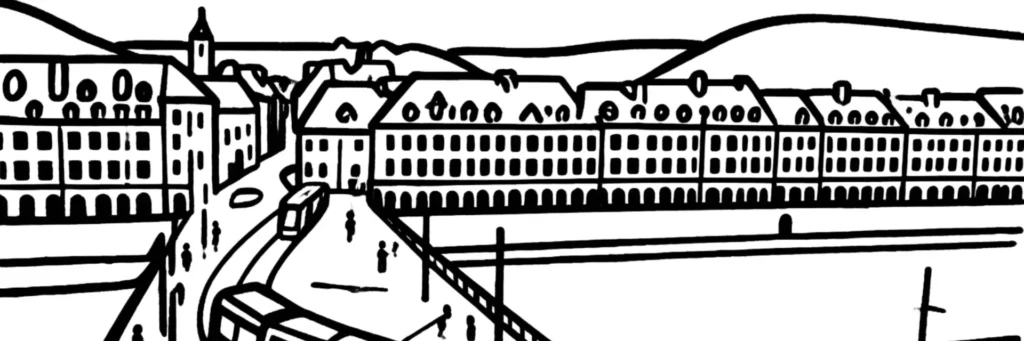
Illustration of Besançon, prefecture of the Doubs department in the Bourgogne-Franche-Comté region, a green town nestled in the Boucle of the Doubs at the foot of the Citadel.
Apartments in Besançon sell at an average price of around 2 272 €/m², based on transactions actually recorded (DVF data, the French database of notarised property sales). It is a measured market for a regional prefecture, appreciably more affordable than the large neighbouring cities. The gaps between districts remain contained: they run from around 1 842 €/m² at Palente, in the east of the town, the most affordable area, to nearly 2 574 €/m² at Brégille, on the heights of the right bank, the most expensive area. The house market sits higher, at around 2 937 €/m². Over twelve months, prices have risen by some 6,6 %, and the town records around 1 540 apartment sales a year.
Prices from the DVF file (Demandes de valeurs foncières, published by the DGFiP), transactions actually recorded at the notary at municipality level. Cross-referenced with the Notaires de France - INSEE indices. Learn more about our methodology.
After 2 098 €/m² in 2021, the average price in Besançon reaches 2 272 €/m² in 2026, roughly +8 % over the period.
Change in the average price per m² over twelve months, district by district, based on the most recent DVF sales.
The average price per m² for an apartment in each district of Besançon covered by Immover, ranked from the most expensive to the most affordable.
The Besançon market remains measured for a regional prefecture. With an average price of around 2 272 €/m² for an apartment, it sits well below the large French cities. Over twelve months, prices have risen by some 6,6 %, a real increase carried by the appeal of the greenest town in France and its high-speed rail link to Paris, and the town records around 1 540 apartment sales a year, the sign of an active market.
Its geography draws contained gaps. The hillside districts along the Doubs, such as Brégille and Velotte, concentrate the most highly rated areas. The Boucle, Battant and les Chaprais, around the Viotte station, form a lively intermediate core of the market. The east, around Palente, remains the most affordable area, a legacy of its working-class history and its 1960s housing.
With an average price of around 2 272 €/m², Besançon sits among the regional prefectures with measured prices covered by Immover. The capital of Franche-Comté offers a balanced market for buyers, far from the levels of the large cities, which makes it a town sought after for buying a main residence as much as for investing, carried by its quality of life and its student population.
Besançon is the prefecture of the Doubs department, in the Bourgogne-Franche-Comté region. With around 119 000 inhabitants, it is the main town of Franche-Comté. Its site is unique: the town was born in the Boucle, an almost perfect meander of the Doubs that wraps around the historic centre on three sides, closed to the south by the hill of the Citadel. This geography of river and hills, together with a recognised green heritage, has earned it the title of greenest town in France.
The town built its identity on its fortifications and its watchmaking. Vauban's Citadel, perched more than a hundred metres above the Doubs and listed as UNESCO World Heritage along with the Vauban fortifications, overlooks the old town. The Boucle holds the Grande rue, which follows the line of the former Roman cardo, the place de la Révolution and its market, the Saint-Jean cathedral and many private mansions. A historic capital of watchmaking, nicknamed the capital of time, Besançon is home to the museum of Time. It is also the birthplace of Victor Hugo, on the place Victor-Hugo, and of the Lumière brothers.
Besançon today draws on the University of Franche-Comté and its Bouloie campus, on the Viotte station at the heart of the town and the Besançon Franche-Comté high-speed station that reaches Paris in two hours, and on a tram line of the Ginko network that crosses the town from Planoise to the Boucle. This setting, combining quality of life, heritage and a university and administrative role, shapes a balanced property market, sought after for main-residence purchases as much as for investment.
The Besançon market attracts first-time buyers, families, public-sector employees and investors, in a regional prefecture with measured prices. Demand focuses on the older apartments of the Boucle and Battant, the houses of the hillside residential areas such as Brégille, Velotte or Saint-Ferjeux, and properties close to the Viotte station and the Bouloie campus. Price levels, more accessible than those of the large cities, make it an open market for buyers and a favoured ground for buy-to-let investment, carried by a large student population.
The average price in Besançon is 2 272 €/m² for an apartment (actual DVF transactions, notarised sales), within a range of 1 713 to 2 681 €/m² depending on the district. Property portals display asking prices, 10 to 20 % higher than the prices actually recorded.
No, but the gaps remain contained for a prefecture. The hillside districts along the Doubs, such as Brégille and Velotte, sit at the top of the range, while Palente, to the east, remains the most affordable area. Between the two, the Boucle, Battant, les Chaprais and Saint-Ferjeux make up an intermediate core of the market.
No, Besançon remains a measured market. With an average price of around 2 272 €/m² for an apartment, the prefecture of the Doubs sits well below the large French cities. It is a market for buyers, where purchasing a main residence remains within reach, and an active market for buy-to-let investment carried by the student population.
Over twelve months, prices have risen by some 6,6 %. The Besançon market has seen a real increase, carried by the appeal of a green town with a recognised quality of life, its university and administrative role and the high-speed rail link to Paris, while remaining more affordable than the large cities.
The town average is not enough: you need to start from the price in your district, then adjust for the floor, the view of the Doubs or the Citadel, the condition of the property and the proximity of the Boucle, the Viotte station or the Bouloie campus. The Immover valuation tool draws on the actual sales closest to your address.
This analysis is published by Immover, an independent observatory founded by Antony Barbier. Data sourced from official sources (DVF, INSEE, Notaries of France).