The average price per m² in Essonnes (Corbeil-Essonnes) is 2 539 €/m² for an apartment, within a range of 2,0 to 2,9 k€ per m², based on actual notarised (DVF) sales. Over the period, the market fell 2 % over 5 years and rose 9,8 % over the last 12 months, with about 20 transactions per year.

Essonnes, the old village in the south of Corbeil-Essonnes, around the église Saint-Étienne.
Apartments in the Essonnes district, in Corbeil-Essonnes, sell at an average price of around 2 539 €/m², based on prices actually recorded (DVF transactions, notarised sales). Between 2 010 and 2 922 €/m² covers half of all sales, the gap depending on the type of property, the floor, the condition of the home and how close the place Léon Cassé is. Five-year change: -2 %.
Prices from the DVF file (Demandes de valeurs foncières, published by the DGFiP), transactions actually recorded at the notary, aggregated at district level using the IRIS zoning of INSEE. Cross-referenced with the Notaires de France - INSEE indices. Learn more about our methodology.
After 2 603 €/m² in 2021, the average price in the Essonnes district of Corbeil-Essonnes reaches 2 539 €/m² in 2026, around -2 % over the period.
The old village concentrates local shops and a market, which serve the whole south of the town.
The église Saint-Étienne, the place Léon Cassé, the rue de la Dauphine and the parc de Nagis shape the district.
Schools, sports facilities and local services serve the families of the area.
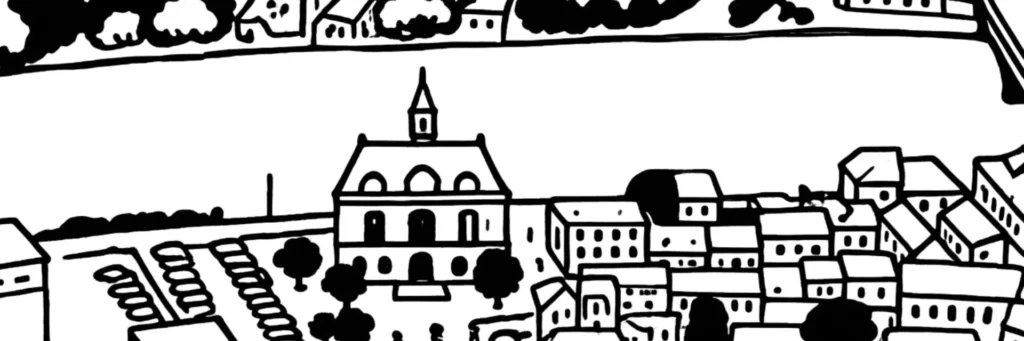
Essonnes, the old village in the south of Corbeil-Essonnes. Google Maps.
Essonnes is the town's second old centre. A village set on the Essonne, it was an independent town until the merger with Corbeil on 9 August 1951, and it gave the town the second half of its name. Its heart remains the place Léon Cassé and the église Saint-Étienne.
The river made the village's fortune: mills, then paper mills and industry in the nineteenth century, before the fabric was transformed in the twentieth. The district today brings together village houses, faubourg blocks and more recent developments, between the rue de Gournay, the rue Lavoisier, the rue de la Dauphine and the parc de Nagis, on its eastern fringe.
On the market, Essonnes sits at around 2 539 €/m² for an apartment, at the town-wide average, on a volume of about 20 sales a year which makes the average sensitive to recent transactions. The district median, at 2 533 €/m², is very close to it, which points to a tight market. The average price has risen by around 10 % over twelve months and remains almost stable over five years.
Essonnes attracts first-time buyers and families looking for a local centre with its shops, its schools and its market, away from the centre of Corbeil. Demand covers the village houses and the apartments of the small blocks, in an older fabric where the condition of the property weighs heavily on the price.
The average price in Essonnes is 2 539 €/m² for an apartment (actual DVF transactions, notarised sales), within a range of 2 010 to 2 922 €/m² depending on the building, the floor and the condition.
The district takes up the south of the town, on the Essonne, around the place Léon Cassé and the église Saint-Étienne. It stretches from the rue de Gournay to the rue Lavoisier and the rue de la Dauphine, as far as the parc de Nagis on its eastern fringe.
Essonnes sits at around 2 539 €/m² for an apartment, at the Corbeil-Essonnes average, on about 20 sales a year. That limited volume makes the average sensitive from one year to the next. The district median, at 2 533 €/m², is very close to the average: the market there is tight.
Essonnes was an independent town until 1951, with its village centre, its church and its market square. The merger with Corbeil created Corbeil-Essonnes, but the district has kept its role as a local centre for the whole south of the town.
This analysis is published by Immover, an independent observatory founded by Antony Barbier. Data sourced from official sources (DVF, INSEE, Notaries of France).