The average price per m² in Corbeil-Essonnes is 2 541 €/m² for an apartment, within a range of 2,1 to 2,9 k€ per m², based on actual notarised (DVF) sales. Over the period, the market fell 6 % over 5 years and rose 4,4 % over the last 12 months, with about 422 transactions per year.

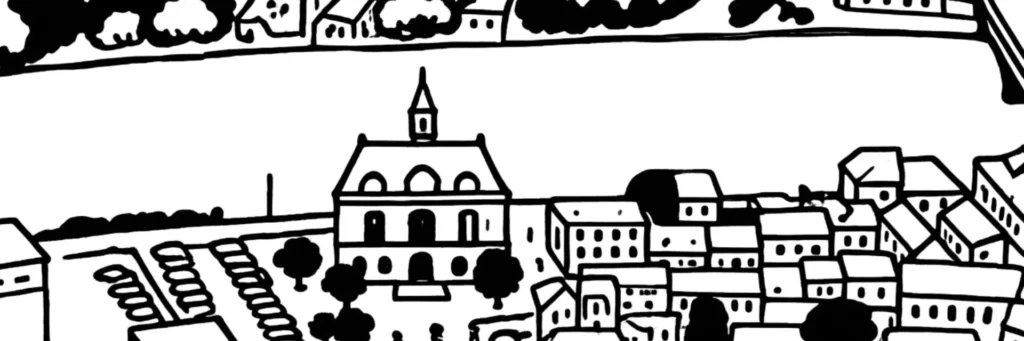
Illustration of Corbeil-Essonnes, at the confluence of the Essonne and the Seine, between the Grands Moulins and the cathédrale Saint-Spire.
Apartments in Corbeil-Essonnes sell at an average price of around 2 541 €/m², based on prices actually recorded (DVF data, the French notarised sales database). Created in 1951 by the merger of Corbeil and Essonnes, the town is laid out around two old centres separated by the Essonne valley, and a third area on the right bank of the Seine. Prices run from around 2 127 €/m² in L'Ermitage, to the south-east, to 3 227 €/m² in Coquibus, to the west, where the housing stock is the most recent. Pressoir-Prompt, the busiest district in the town, sits at around 2 535 €/m², and the town centre at around 2 511 €/m². Houses, at around 3 017 €/m², trade above apartments.
Prices from the DVF file (Demandes de valeurs foncières, published by the DGFiP), transactions actually recorded at the notary at municipality level. Cross-referenced with the Notaires de France - INSEE indices. Learn more about our methodology.
After 2 716 €/m² in 2021, the average price in Corbeil-Essonnes reaches 2 541 €/m² in 2026, around -6 % over the period.
Change in the average price per m² over twelve months, district by district, based on the most recent DVF sales.
The average price per m² for an apartment in each district of Corbeil-Essonnes covered by Immover, ranked from the most expensive to the most affordable.
The Corbeil-Essonnes market is that of an outer-suburb town well linked to Paris but which has stayed away from Paris-region price levels. With an average price of around 2 541 €/m² for an apartment, the town sits well below Paris and the inner suburbs, and at a level close to that of the towns of the southern Essonne. Houses, at around 3 017 €/m², trade above apartments: detached housing weighs in local demand.
The DVF series shows a decline of around 6 % over five years, with a marked trough in 2024 and then a partial recovery in 2025. The gap between districts remains contained: apart from Coquibus, whose recent housing stock and small number of sales pull the average up, and L'Ermitage, at the other end, ten districts out of twelve stay between 2 367 and 2 797 €/m². With around 422 apartment sales a year, the town-wide average is solid, but that of the least active districts, starting with Coquibus and L'Ermitage, varies from one year to the next.
With an average price of around 2 541 €/m², Corbeil-Essonnes remains far more affordable than Paris and the inner suburbs, while offering three RER D stations, direct access to the A6 motorway and a local employment base. Its setting at the confluence of the Essonne and the Seine, next to Évry-Courcouronnes, makes it a town sought after by first-time buyers and families of the southern Paris region.
Corbeil-Essonnes stands at the confluence of the Essonne and the Seine, some thirty kilometres south-east of Paris. That position explains the town's history: the Grands Moulins de Corbeil, on the quai de l'Apport-Paris, supplied Paris with flour for centuries, and the river port long governed activity on the left bank, around the cathédrale Saint-Spire and its cloister.
To the south, on the Essonne, Essonnes formed a separate town, with its village centre around the église Saint-Étienne and the place Léon Cassé. The river turned mills there, then paper mills and gunpowder works in the nineteenth century. The two towns merged on 9 August 1951. In the twentieth century industry took over with the Safran Aircraft Engines site to the west and the semiconductor plant in the south, founded by IBM in 1964, operated under the name Altis and then taken over by X-FAB.
The geography of prices follows that three-stage history. To the west, Coquibus forms the top of the market, on a recent housing stock and a small sales volume. To the south, Moulin-Galant and Pressoir-Prompt concentrate a large share of the transactions, in developments built mostly after the war. The two old centres, that of Corbeil and that of Essonnes, hold the middle of the range, with an older and more scattered housing stock. The urban renewal areas of the north-west and the eastern slope bring up the rear.
The Corbeil-Essonnes market is aimed first of all at first-time buyers and families from the Essonne and the southern Paris region, as well as at people working in Évry-Courcouronnes, on the town's industrial sites or in Paris. The three RER D stations, the A6 motorway and the Francilienne ring road carry demand oriented towards the apartments of the post-war developments and the houses of the residential areas. Prices remain well below those of the inner suburbs, which supports activity.
The average price in Corbeil-Essonnes is 2 541 €/m² for an apartment (actual DVF transactions, notarised sales), within a range of 2 064 to 2 904 €/m² depending on the district. Property portals show asking prices, 10 to 20 % above the prices actually recorded.
No. Coquibus, to the west, shows the highest average price, at around 3 227 €/m², on a recent housing stock but a small sales volume that makes that average sensitive. L'Ermitage, to the south-east, remains the most affordable area, at around 2 127 €/m². Between the two, most districts stay within a tight range, from 2 367 €/m² in Montconseil to 2 797 €/m² in Moulin-Galant.
The town combines three RER D stations within its boundaries, direct access to the A6 motorway and the Francilienne ring road, a local employment base with the southern Paris region hospital, the Safran site and the semiconductor plant in the south, and prices well below those of the inner suburbs. The average price, around 2 541 €/m² for an apartment, remains affordable some thirty kilometres from Paris.
No, not over the recent period. The DVF average for apartments has gone from around 2 716 €/m² to 2 593 €/m² in five years, a decline of around 6 %, with a low point in 2024 and a partial recovery in 2025. With around 422 apartment sales a year, the volume is enough for that underlying trend to be readable.
The town-wide average price is not enough: you have to start from the price in your own district, then adjust for the type of property, the floor, the condition, the aspect, whether there is parking and the distance to one of the three RER D stations. The gap between apartments and houses is also clear. The Immover valuation tool draws on the actual sales closest to your address.
This analysis is published by Immover, an independent observatory founded by Antony Barbier. Data sourced from official sources (DVF, INSEE, Notaries of France).