The average price per m² in Saint-Quentin is 1 208 €/m² for an apartment, within a range of 0,9 to 1,4 k€ per m², based on actual notarised (DVF) sales. Over the period, the market rose 1 % over 5 years and rose 1,4 % over the last 12 months, with about 125 transactions per year.

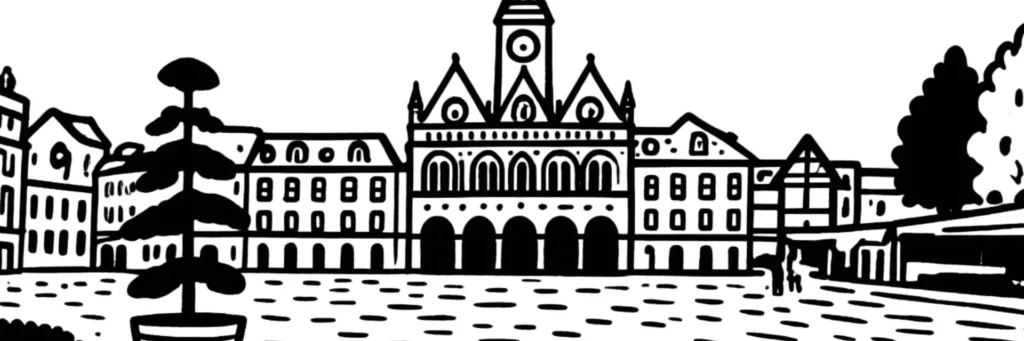
Illustration of Saint-Quentin, between the basilica, the Art Deco centre and the Isle marshes.
Apartments in Saint-Quentin sell at an average price of around 1 208 €/m², based on transactions actually recorded (DVF data, the French database of notarised sales). The largest town of the Aisne by population, it offers one of the most affordable price levels in northern France. Prices run from about 987 €/m² in Vermandois, to the west, to 1 510 €/m² in the Europe district, to the north. The town centre, which alone accounts for more than two thirds of apartment sales in the town, stands at around 1 204 €/m². Houses, at around 1 181 €/m², trade at the same level as apartments: the Saint-Quentin market is first of all a market for houses.
Prices from the DVF file (Demandes de valeurs foncières, published by the DGFiP), transactions actually recorded at the notary at municipality level. Cross-referenced with the Notaires de France - INSEE indices. Learn more about our methodology.
After 1 195 €/m² in 2021, the average price in Saint-Quentin reaches 1 208 €/m² in 2026, a change of roughly +1 % over the period.
Change in the average price per m² over twelve months, district by district, based on the most recent DVF sales.
The average price per m² for an apartment in each district of Saint-Quentin covered by Immover, ranked from the most expensive to the most affordable.
The Saint-Quentin market is that of a mid-sized northern town, industrial and then rebuilt, which never saw the pressure of the large cities. With an average price of around 1 208 €/m² for an apartment, Saint-Quentin sits well below Lille and Reims, and at the level of the mid-sized towns of the Aisne and the Somme. Houses, at around 1 181 €/m², trade at the same level: the signature of a market where apartments carry no premium.
The gap between districts stays contained in absolute terms but is clear in proportion. The north, around the Europe district, and the south-east, in the Faubourg d'Isle, form the top of the range. The town centre accounts for more than two thirds of apartment sales, in a building stock produced for the most part by the reconstruction of the 1920s. The west, with the most detached housing, brings up the rear. With about 125 apartment sales a year across the whole town, the averages of districts other than the centre rest on few transactions and move from one year to the next.
With an average price of around 1 208 €/m², Saint-Quentin ranks among the most affordable towns in France for buying an apartment. Its Art Deco heritage, its basilica and its rail position between Paris, Lille and Reims make it a town sought after by first-time buyers and investors.
Saint-Quentin sits on high ground overlooking the valley of the Somme, at the meeting point of the Vermandois and Picardy. The town owes its name and its early fortune to its collegiate church, later a basilica, one of the great Gothic buildings of northern France, and to its textile trade. The Saint-Quentin canal, opened at the start of the nineteenth century, linked it to the Scheldt basin and made it a crossroads of inland navigation.
The First World War overturned that history. Occupied from August 1914 to October 1918, the town was some 80 % destroyed. The reconstruction of the 1920s gave it its present face: more than three thousand Art Deco facades, a town hall whose flamboyant Gothic front of 1509 was preserved with the building rebuilt behind it by Louis Guindez in 1925 and 1926, and a restored basilica with stained glass dating in part from that period. The musée Antoine-Lécuyer holds the pastels of Maurice Quentin de La Tour, born in the town.
The geography of prices follows this pattern. The north of the town, around the Europe district, forms the top of the market. The town centre concentrates the volume, in a building stock largely produced by the reconstruction. The Faubourg d'Isle, to the south-east, borders the Isle marshes nature reserve. The west, from Vermandois to Saint-Martin, remains the most affordable area and the one with most detached housing: what sells there is mainly houses.
The Saint-Quentin market attracts first-time buyers, families and working households from the Aisne, along with investors seeking yields the neighbouring metropolitan areas no longer offer. Demand centres mainly on houses, plentiful in the outer districts, and on apartments in the rebuilt centre. The station, the A26 motorway and the position halfway between Lille, Reims and Paris support a steady market, at prices among the lowest of the mid-sized towns of the north.
The average price in Saint-Quentin is 1 208 €/m² for an apartment (actual DVF transactions, notarised sales), within a range of 940 to 1 378 €/m² depending on the district. Listing portals show asking prices, 10 to 20 % above the prices actually recorded.
No. The Europe district, to the north, shows the highest average price, around 1 510 €/m², while Vermandois, to the west, remains the most affordable area, around 987 €/m². The town centre, which accounts for most apartment sales, stands at around 1 204 €/m². The gap between the extremes exceeds 50 %, which makes the district price more useful than the town average.
Saint-Quentin combines recognised heritage, with its Gothic basilica and one of the largest Art Deco ensembles in France, the amenities of a sub-prefecture town and prices among the most affordable in the north of the country. The station links the town to Paris, Lille and Reims, the A26 motorway passes nearby, and the Isle marshes nature reserve offers 48 hectares of protected wetland in the middle of the town.
Over five years, the DVF average for apartments has stayed flat, at around 1 200 €/m². The Saint-Quentin market saw neither the surge of the large cities nor the fall that followed it: it moves in small steps. With about 125 single-lot apartment sales a year, the volume remains modest, which suggests reading the town average as an order of magnitude.
The two are close: about 1 208 €/m² for an apartment, 1 181 €/m² for a house. Saint-Quentin is above all a market for houses, with close to 900 sales recorded over the last two years against 250 for apartments. In the western and southern outer districts, the supply is almost exclusively detached housing.
This analysis is published by Immover, an independent observatory founded by Antony Barbier. Data sourced from official sources (DVF, INSEE, Notaries of France).