The average price per m² in Centre-ville (Saint-Quentin) is 1 204 €/m² for an apartment, within a range of 0,9 to 1,4 k€ per m², based on actual notarised (DVF) sales. Over the period, the market fell 8 % over 5 years and fell 1,5 % over the last 12 months, with about 86 transactions per year.

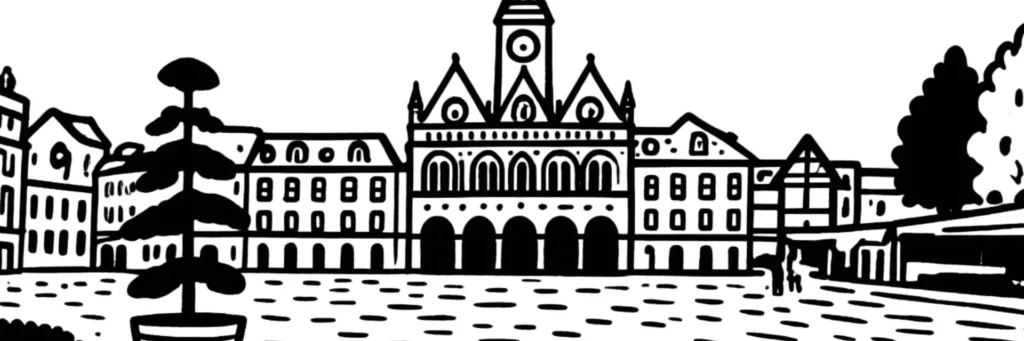
The town centre of Saint-Quentin, between the basilica, the town hall and the Art Deco facades.
Apartments in the Centre-ville district of Saint-Quentin sell at an average price of around 1 204 €/m², based on prices actually recorded (DVF transactions, notarised sales). Between 950 and 1 382 €/m² covers half of all sales, the gap reflecting the floor, the presence of a lift, the condition and the proximity of the basilica. Five-year trend: -8 %.
Prices from the DVF file (Demandes de valeurs foncières, published by the DGFiP), transactions actually recorded at the notary, aggregated at district level using the IRIS zoning of INSEE. Cross-referenced with the Notaires de France - INSEE indices. Learn more about our methodology.
After 1 303 €/m² in 2021, the average price in the Centre-ville district of Saint-Quentin reaches 1 204 €/m² in 2026, a change of roughly -8 % over the period.
The rue d'Isle and the main square concentrate the retail offer of the town, complemented by the covered market.
The basilica, the town hall, the musée Antoine-Lécuyer and the parc des Champs-Élysées give the centre its structure.
Sub-prefecture offices, schools, secondary schools and cultural venues are all gathered in the centre.
The town centre of Saint-Quentin, around the basilica and the town hall. Google Maps.
The town centre of Saint-Quentin sits on the high ground overlooking the Somme, between the basilica to the north and the station to the south. It is the historic core of the town, that of the collegiate church and the textile trade, organised around the main square and the rue d'Isle, the principal shopping street.
Close to 80 % destroyed during the First World War, it was rebuilt in the 1920s. Its present appearance dates from that period: more than three thousand Art Deco facades, a town hall whose flamboyant Gothic front of 1509 was preserved with the building rebuilt behind it by Louis Guindez in 1925 and 1926, and a restored basilica. The musée Antoine-Lécuyer, the parc des Champs-Élysées and the Pierre-Ratte sports hall, on the eastern edge, complete the picture.
On the market, the town centre concentrates most of the activity: about 86 single-lot apartment sales a year, more than two thirds of those in the whole town. The average stands at around 1 204 €/m², in line with the town figure, with a wide spread: a quarter of sales take place below 950 €/m² and a quarter above 1 382 €/m², depending on condition and floor.
The town centre attracts first-time buyers, investors looking for rental yield and households who want to do everything on foot. Demand centres on apartments in the reconstruction blocks, often spacious, and on the town houses of the adjoining streets. It is the only district of Saint-Quentin where apartments clearly dominate.
The average price in Centre-ville is 1 204 €/m² for an apartment (actual DVF transactions, notarised sales), within a range of 950 to 1 382 €/m² depending on the building, the floor and the condition.
The centre occupies the high ground overlooking the Somme, between the basilica to the north and the station to the south. It is organised around the main square, the rue d'Isle, the rue Émile-Zola and the ring boulevards, and takes in the parc des Champs-Élysées to the east.
The centre stands at around 1 204 €/m² for an apartment, in line with the town average, on about 86 single-lot sales a year. The spread is wide: a quarter of sales take place below 950 €/m² and a quarter above 1 382 €/m², depending on condition, floor and the presence of a lift.
The building stock is dominated by the blocks of the 1920s reconstruction, with apartments that are often spacious and well proportioned, complemented by town houses in the adjoining streets. It is the area of choice for investors and for buyers who want to do without a car.
This analysis is published by Immover, an independent observatory founded by Antony Barbier. Data sourced from official sources (DVF, INSEE, Notaries of France).