The average price per m² in Île Sud (Sète) is 3 445 €/m² for an apartment, within a range of 2,7 to 4,1 k€ per m², based on actual notarised (DVF) sales. Over the period, the market rose 13 % over 5 years and rose 9,7 % over the last 12 months, with about 100 transactions per year.

The Île Sud district, the historic heart of Sète around the Canal Royal and the Quartier Haut, with its quays and its water jousting.
Apartments in the Île Sud district, in Sète, sell at an average price of around 3 445 €/m², based on actual recorded prices (DVF transactions). Between 2 732 and 4 094 €/m² covers half of the sales, the gap depending on the floor, the aspect and the condition of the property. Five-year change: +13 %.
Prices from the DVF file (Demandes de valeurs foncières, published by the DGFiP), transactions actually recorded at the notary, aggregated at district level using the IRIS zoning of INSEE. Cross-referenced with the Notaires de France - INSEE indices. Learn more about our methodology.
After 3 059 €/m² in 2021, the average price in the Île Sud district of Sète reaches 3 445 €/m² in 2026, roughly +13 % over the period.
Shops, restaurants, markets and covered halls keep the historic centre and the quays lively all year round.
The canals, the water jousting, the museums and the cultural life make the atmosphere of the Île Sud, heightened in season.
Schools, public services and local amenities serve a town centre lived in all year round.
The Île Sud district, in Sète. Google Maps.
The Île Sud forms the historic heart of Sète, on the southern part of the peninsula, between the Canal Royal and the sea. It is where the town was built from the port founded in 1666, along the canals that earned it the nickname of Venice of Languedoc. The Cadre Royal, the old royal canal, hosts the water jousting each summer and concentrates the life of the town.
The district mixes the older buildings of the quays, the shopping streets of the centre and the Quartier Haut, the former quarter of fishermen who came from the Amalfi coast, nicknamed Little Naples for its narrow lanes and its colourful houses perched above the port. Now a haunt of artists and workshops, this area keeps a strong identity, between maritime heritage and neighbourhood life.
The heart of life in Sète, the Île Sud attracts demand for the apartments of the quays and the historic centre, between heritage, atmosphere and closeness to everything. Prices, in line with the town-wide average, vary with the condition of the older buildings, the floor and the view over the canals or the port.
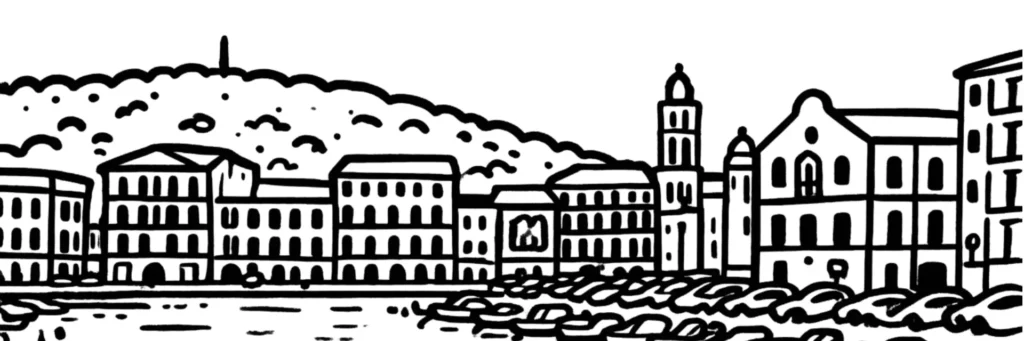
The Île Sud attracts first-time buyers, working people, investors and lovers of a lively historic centre, along with buyers of a pied-à-terre close to the canals. Demand covers the apartments of the quays and the centre, sought after for their location and their character. Neighbourhood life, the shops and the activity of the canals make it a prized central area of Sète.
The average price in the Île Sud is 3 445 €/m² for an apartment (actual DVF transactions, notarised sales), within a range of 2 732 to 4 094 €/m² depending on the building, the floor and the condition.
The average price in the Île Sud is around 3 445 €/m² for an apartment, based on actual DVF sales. The historic heart of the town, around the Canal Royal, sits in line with the town-wide average, with gaps depending on the condition of the buildings and the view.
The Quartier Haut is the former fishermen's quarter perched above the port, on the Île Sud. Nicknamed Little Naples for the Italian origin of its residents, it keeps its narrow lanes, its colourful houses and a strong presence of artists and workshops.
Mostly apartments in the older buildings of the quays and the historic centre, from studios to large apartments. The condition of the building, the floor and the view over the canals or the port make prices vary.
Yes. It is the heart of life in Sète, with its shops, its restaurants, its markets and the activity of the canals, heightened in season by the water jousting and the festivals. That is one of the attractions of the area as a place to live.
This analysis is published by Immover, an independent observatory founded by Antony Barbier. Data sourced from official sources (DVF, INSEE, Notaries of France).