The average price per m² in Toulon is 2 939 €/m² for an apartment, within a range of 2,1 to 3,4 k€ per m², based on actual notarised (DVF) sales. Over the period, the market rose 12 % over 5 years and rose 2,2 % over the last 12 months, with about 2,392 transactions per year.

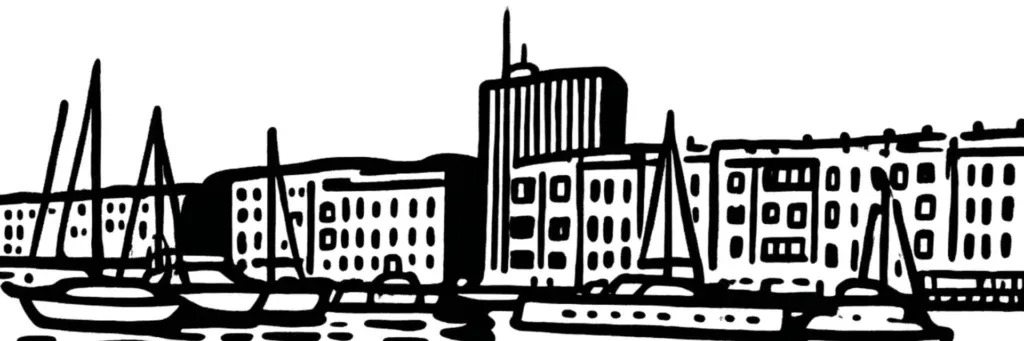
Illustration of Toulon, between the harbour and Mont Faron.
The average price for apartments in Toulon stands at 2 939 €/m², based on actual recorded transactions (DVF data, the French notarised sales database). Depending on the district, prices range from around 2 200 €/m² in Le Pont du Las to more than 3 275 €/m² in Le Mourillon, on the seafront. The eastern heights and the coastline concentrate the highest values, while the faubourgs and the north remain more affordable.
Prices from the DVF file (Demandes de valeurs foncières, published by the DGFiP), transactions actually recorded at the notary at municipality level. Cross-referenced with the Notaires de France - INSEE indices. Learn more about our methodology.
After 2 617 €/m² in 2021, the average price in Toulon reaches 2 939 €/m² in 2026, roughly +12 % over the period.
Change in the average price per m² over twelve months, district by district, based on the most recent DVF sales.
The average price per m² for an apartment in each district of Toulon covered by Immover, ranked from the most expensive to the most affordable.
Toulon long developed in the background of the other cities on the Mediterranean coast. Its market has recovered in recent years, supported by its maritime setting, its harbour and prices that have stayed affordable compared with Nice and Marseille.
The contrasts between districts shape the market. Le Mourillon and the residential heights of the east keep a premium linked to the coast and views over the harbour, while the eastern faubourgs and the northern districts carry a broader demand at more moderate prices.
Toulon sits well below Nice and under Marseille, at a level that remains affordable for a large city on the Mediterranean coast.
Toulon, the prefecture of the Var department, grew up around its harbour, one of the largest in the Mediterranean, and its arsenal, which has made it France's leading naval port since the seventeenth century. The old town, the port and the cours Lafayette form its historic core.
Overlooked by Mont Faron, reached by cable car, the city rises in tiers between the coastline, the centre and the hills of the east and north. The Mistral bus and water bus network serves the conurbation and the harbour; the city has no tram, its former network having disappeared in the mid-twentieth century.
Long kept in the background of the other cities on the coast, Toulon has seen its market recover and its prices rise, supported by its maritime setting and levels still affordable compared with Nice or Marseille. The market remains uneven between the seafront at Le Mourillon, the residential heights and the working-class faubourgs.
The Toulon market attracts families, working people and first-time buyers drawn by the maritime setting and moderate prices, as well as buyers looking for a second home near the beaches. Le Mourillon and the eastern heights concentrate the strongest demand, while the eastern faubourgs and the northern districts meet a broader, more affordable demand. Small units, sought after for renting and investment, trade above the average price per m².
The average price in Toulon is 2 939 €/m² for an apartment (actual DVF transactions, notarised sales), within a range of 2 105 to 3 429 €/m² depending on the district. Listing portals show asking prices, 10 to 20 % above the prices actually recorded at signing.
No. Le Mourillon, on the seafront, exceeds 3 200 €/m², while areas such as Le Pont du Las remain around 2 200 €/m². Proximity to the coast, views over the harbour and the residential character of the heights explain most of the gaps.
The Toulon market has recovered in recent years, supported by its maritime setting and prices still affordable compared with the rest of the coast. Levels remain uneven from one district to the next, from the seafront to the faubourgs.
No. Toulon has no tram. Getting around relies on the Mistral bus network, water buses that cross the harbour and the cable car up to Mont Faron.
The city average is not enough: you have to start from the price in your district, then adjust for the floor, the aspect, the view, the condition and any outbuildings. The Immover estimator draws on the actual sales closest to your address.
This analysis is published by Immover, an independent observatory founded by Antony Barbier. Data sourced from official sources (DVF, INSEE, Notaries of France).