The average price per m² in Chartres is 2 417 €/m² for an apartment, within a range of 2,0 to 2,8 k€ per m², based on actual notarised (DVF) sales. Over the period, the market rose 2 % over 5 years and rose 2,2 % over the last 12 months, with about 402 transactions per year.

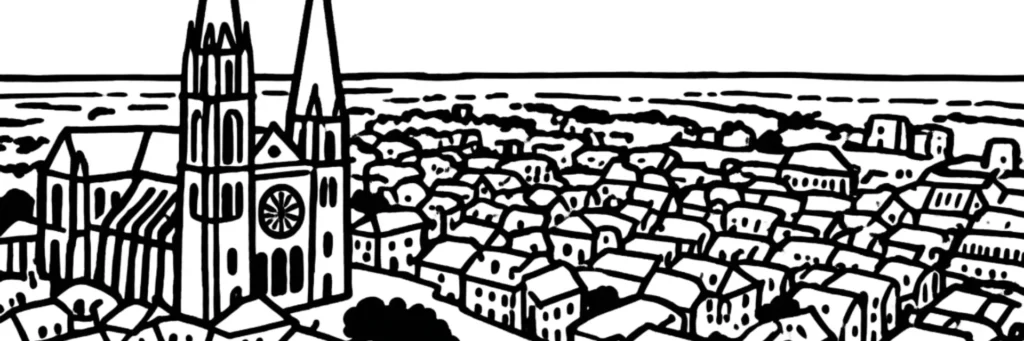
Illustration of Chartres, from Notre-Dame cathedral down to the banks of the Eure river.
Apartments in Chartres sell at an average price of around 2 417 €/m², based on transactions actually recorded (DVF data, the French database of notarised property sales). The prefecture town of Eure-et-Loir, set on the Eure river and one hour from Paris-Montparnasse by train, shows marked differences from one district to another. Prices range from around 1 585 €/m² in La Madeleine, to the south-east, to 2 695 €/m² in La Petite Venise. The town centre, which accounts for close to a third of all sales, sits at 2 546 €/m². Houses trade at around 2 675 €/m².
Prices from the DVF file (Demandes de valeurs foncières, published by the DGFiP), transactions actually recorded at the notary at municipality level. Cross-referenced with the Notaires de France - INSEE indices. Learn more about our methodology.
After 2 381 €/m² in 2021, the average price in Chartres reaches 2 417 €/m² in 2026, roughly +2 % over the period.
Change in the average price per m² over twelve months, district by district, based on the most recent DVF sales.
The average price per m² for an apartment in each district of Chartres covered by Immover, ranked from the most expensive to the most affordable.
The Chartres market is that of a heritage prefecture town within the orbit of Paris. With an average price of around 2 417 €/m² for an apartment, Chartres sits above most prefecture towns of its size, a direct effect of the rail service and of the appeal of the historic centre. Houses, at around 2 675 €/m², trade 11 % above apartments, a moderate gap.
The gap between districts is wide: 70 % separates La Petite Venise from La Madeleine. The old centre, the banks of the Eure and the station area hold the top of the market, the ring of faubourgs forms the base, and the large housing estates of the south-east close the ranking. Volume is comfortable, at 402 apartment sales a year, close to a third of them in the town centre alone. Two districts should be read with caution: Le Coteau d'Aboville, whose 17,8 % rise over twelve months rests on 24 annual sales, and Les Bas Bourgs, whose 14 % decline over five years follows a high point reached in 2022.
With an average price of around 2 417 €/m², Chartres sits below the major French cities but above most prefecture towns of its size. Its cathedral, its historic centre and its rail service towards Paris-Montparnasse make it a mid-sized town with a well-supported market.
Chartres is defined by the way it is seen from the Beauce plain: the two asymmetric spires of Notre-Dame cathedral, one Romanesque, the other Flamboyant Gothic, are visible for kilometres. Rebuilt after the fire of 1194, the building has kept most of its thirteenth-century stained glass and its sculpted portal, which earned it a place on the UNESCO World Heritage list.
Below the cathedral, the town unfolds on two levels. The upper town, medieval, fits within the perimeter of the former ramparts. The lower town descends towards the Eure, with its washhouses, its mills and its footbridges, in the area local residents call La Petite Venise, the little Venice. Beyond that, the faubourgs carried the expansion of the nineteenth and twentieth centuries, from Le Grand Faubourg in the west to the large housing estates of the east and south.
The geography of prices follows that structure. The old centre and the banks of the Eure form the top of the market, between 2 480 and 2 695 €/m², including Rechèvres and the station area. The ring of faubourgs, from Beaulieu to Les Comtesses, sits between 2 090 and 2 250 €/m². La Madeleine, to the south-east, closes the ranking at 1 585 €/m². The gap between the most expensive district and the most affordable one reaches 70 %.
The Chartres market has two faces. It is first local, driven by first-time buyers, families and working households from the local employment area, where healthcare, cosmetics and public administration weigh heavily. It is then a Paris-region market: the town is 60 to 70 minutes from Paris-Montparnasse, with more than thirty return services a day, which attracts buyers looking in the Beauce for floor areas out of reach in the Île-de-France. This dual demand explains the resilience of the market in the centre and around the station.
The average price in Chartres is 2 417 €/m² for an apartment (actual DVF transactions, notarised sales), within a range of 1 960 to 2 847 €/m² depending on the district. Property portals display asking prices, which run 10 to 20 % above the prices actually recorded.
No, the gap is clear. La Petite Venise, on the banks of the Eure, shows the highest average price, around 2 695 €/m², while La Madeleine, to the south-east, sits at around 1 585 €/m², which is 41 % lower. Between the two, the town centre, Rechèvres and Le Grand Faubourg range from 2 480 to 2 560 €/m².
The town combines world-class heritage with its cathedral, a preserved historic centre, and a dense rail service towards Paris-Montparnasse, 60 to 70 minutes away, with more than thirty trains a day in each direction. Prices remain three to four times below those of Paris, which makes it a serious alternative for a working buyer from the Paris region.
Over five years, the average price gains around 2 %, with a peak in 2022 followed by a slowdown and then a recovery. Over the last twelve months, the municipality gains 2,2 %. The movement is not uniform: Rechèvres and Le Grand Faubourg are rising while La Petite Venise and La Madeleine are easing.
The town average is not enough: you need to start from the price in your own district, then adjust for the age of the building, its condition, its energy rating, the floor and, in the upper town, the presence of a lift or a parking space, both rare in the medieval fabric. The Immover valuation tool draws on the actual recorded sales closest to your address.
This analysis is published by Immover, an independent observatory founded by Antony Barbier. Data sourced from official sources (DVF, INSEE, Notaries of France).