The average price per m² in Grenoble is 2 561 €/m² for an apartment, within a range of 2,0 to 3,1 k€ per m², based on actual notarised (DVF) sales. Over the period, the market fell 2 % over 5 years and fell 2,1 % over the last 12 months, with about 2,266 transactions per year.

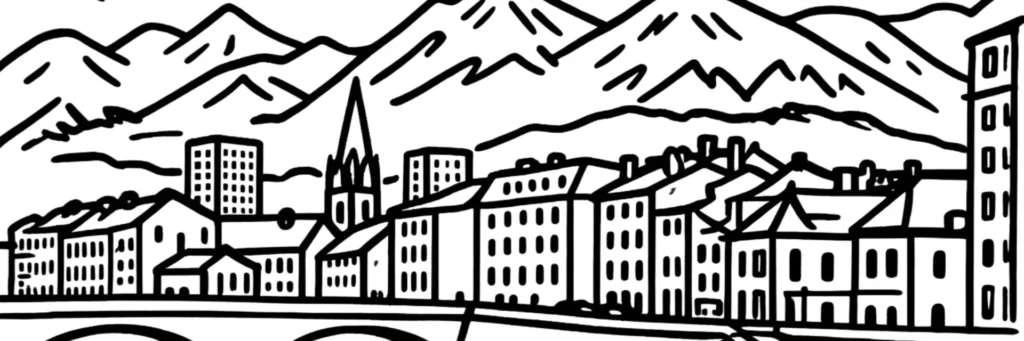
Illustration of Grenoble, prefecture of the Isère and capital of the Alps, at the meeting point of the Drac and the Isère, framed by three massifs.
Apartments in Grenoble sell at an average price of around 2 561 €/m², based on transactions actually recorded (DVF data, the French database of notarised property sales). This is the market of a large Alpine city, more affordable than Lyon but supported by the scientific and university weight of the urban area. Gaps between districts are wide: they run from around 1 221 €/m² at La Villeneuve, in the south of the city, the most affordable area, to nearly 3 520 €/m² at Île Verte, to the north near the teaching hospital, the most sought-after area. The house market sits higher, at around 3 866 €/m². Over twelve months, prices have edged down by around 2 %, and the city records about 2 266 apartment sales a year.
Prices from the DVF file (Demandes de valeurs foncières, published by the DGFiP), transactions actually recorded at the notary at municipality level. Cross-referenced with the Notaires de France - INSEE indices. Learn more about our methodology.
After 2 619 €/m² in 2021, the average price in Grenoble reaches 2 561 €/m² in 2026, roughly -2 % over the period.
Change in the average price per m² over twelve months, district by district, based on the most recent DVF sales.
The average price per m² for an apartment in each district of Grenoble covered by Immover, ranked from the most expensive to the most affordable.
The Grenoble market is that of a large Alpine city, more affordable than Lyon but supported by the weight of its scientific and university hub. With an average price of around 2 561 €/m² for an apartment, it sits in the middle of the range for large French cities. Over twelve months, prices have edged down by around 2 %, and the city records about 2 266 apartment sales a year, the sign of an active market carried by student and family demand.
Its geography draws wide gaps. The north, around Île Verte and the teaching hospital, and the centre, from the city centre to Championnet, hold the most highly rated areas, above 3 000 €/m². The west, towards Europole and Berriat, forms an intermediate market core under transformation. The south, around Teisseire and La Villeneuve, remains the most affordable and carries a share of the city's transactions.
With an average price of around 2 561 €/m², Grenoble sits in the middle of the range for the large French cities covered by Immover. The prefecture of the Isère offers a market more affordable than Lyon, while remaining supported by its scientific and university hub and by the appeal of the mountains, which makes it a large city where buying remains within reach.
Grenoble is the prefecture of the Isère, in the Auvergne-Rhône-Alpes region, in the south-east of France. With around 156 000 inhabitants, it is the main city of the French Alps and the heart of an urban area of nearly half a million people. The city spreads across a plain where the Drac meets the Isère, framed by three massifs that draw its horizon: the Vercors to the west, the Chartreuse to the north and Belledonne to the east. That position at the foot of the mountains, which earned it the name of capital of the Alps, shapes its living environment and its relationship with nature.
The city has built its identity on science and on the mountains. The Bastille fort, reached by the cable car opened in 1934 and its cabins nicknamed the Bubbles, overlooks the old town and offers a view over the peaks. The historic centre, around the place Grenette, the place Victor-Hugo and the Notre-Dame cathedral, has kept Haussmann-era buildings and pedestrian streets. The Perret tower, in the Paul Mistral park, is a legacy of the 1925 Exhibition, and the 1968 Winter Olympics left their mark on the city, from the Olympic Village to several facilities.
Grenoble today rests on a leading scientific hub, concentrated on the Polygone scientifique and the Presqu'île: the CEA, the ESRF synchrotron, the Minatec campus and the Grenoble Alpes university make it one of the main French research centres. The city is served by five tram lines, a high-speed rail station linking Paris in about three hours and Lyon, and a very extensive cycle network. That setting, combined with measured prices for a large city, shapes a property market supported by student, scientific and family demand.
The Grenoble market attracts first-time buyers, families, working people from the scientific and university hub and investors, in a large Alpine city with prices more measured than Lyon. Demand focuses on the period apartments of the centre and the northern districts, on properties close to the campuses and the tram lines, and on sought-after residential areas such as Île Verte or Championnet. The large student population and the immediate closeness of the mountains support both home ownership and buy-to-let investment.
The average price in Grenoble is 2 561 €/m² for an apartment (actual DVF transactions, notarised sales), within a range of 1 964 to 3 078 €/m² depending on the district. Property portals show asking prices, 10 to 20 % above the prices actually recorded.
No. The gaps are wide. Île Verte, to the north near the teaching hospital, goes beyond 3 500 €/m², while La Villeneuve, in the south, stays at around 1 220 €/m². Between the two, the centre, Championnet and Europole form a more expensive market core, and the southern and eastern districts such as Teisseire or La Bajatière sit in a more affordable range.
Grenoble sits in the middle of the range for large French cities, at around 2 561 €/m² for an apartment. The city remains more affordable than Lyon or the large coastal cities, while being supported by the weight of its scientific and university hub and by the appeal of the mountains.
Over twelve months, the Grenoble market has edged down by around 2 %. Movements vary from one district to another: some northern and eastern areas are rising, while other parts of the centre are easing. The market remains active, with about 2 266 apartment sales a year.
The city average is not enough: you have to start from the price of your district, then adjust for the floor, the view over the massifs, the condition of the property and the closeness of the centre, of a tram line, of the teaching hospital or of the campuses. The Immover valuation tool draws on the actual sales closest to your address.
This analysis is published by Immover, an independent observatory founded by Antony Barbier. Data sourced from official sources (DVF, INSEE, Notaries of France).