The average price per m² in Rocabey (Saint-Malo) is 5 038 €/m² for an apartment, within a range of 4,3 to 5,5 k€ per m², based on actual notarised (DVF) sales. Over the period, the market rose 25 % over 5 years and fell 10,4 % over the last 12 months, with about 45 transactions per year.

The Rocabey district, the shopping centre of Saint-Malo, around its square and its market, between the station and the Sillon beach.
Apartments in the Rocabey district, in Saint-Malo, sell at an average price of around 5 038 €/m², based on actual recorded prices (DVF transactions). Between 4 288 and 5 488 €/m² covers half of the sales, the gap depending on the floor, the aspect and the condition of the property. Five-year change: +25 %.
Prices from the DVF file (Demandes de valeurs foncières, published by the DGFiP), transactions actually recorded at the notary, aggregated at district level using the IRIS zoning of INSEE. Cross-referenced with the Notaires de France - INSEE indices. Learn more about our methodology.
After 4 030 €/m² in 2021, the average price in the Rocabey district of Saint-Malo reaches 5 038 €/m² in 2026, roughly +25 % over the period.
The Rocabey market, the food shops and the local chains keep the district lively all year.
The closeness of the Sillon beach and of the facilities of the centre offers a practical, lively setting.
Schools, the station, public services and healthcare serve a central district lived in all year.
The Rocabey district, the shopping centre of Saint-Malo. Google Maps map.
Rocabey is the central, shopping district of Saint-Malo, between the old town, the station and the Sillon beach. Developed on the mainland as the town spread beyond the ramparts, it is arranged around the square and the market of Rocabey, a lively, down-to-earth hub of daily life. It is the centre of everyday Saint-Malo, where people live and do their shopping all year.
The district mixes tenement buildings, local shops and residential streets. Its central position, a few minutes from the beach and the station, makes it a practical, sought-after area for year-round living, less turned towards tourism than the seafront or the old town. The Rocabey market, its shops and its schools give the district its rhythm.
Rocabey is valued for that balance between a central position, shops and quick access to the sea and the station. Demand comes as much from year-round residents as from buyers looking for a well-placed pied-à-terre. Prices, more measured than on the seafront, remain sustained by the closeness of the beach and the convenience of the district.
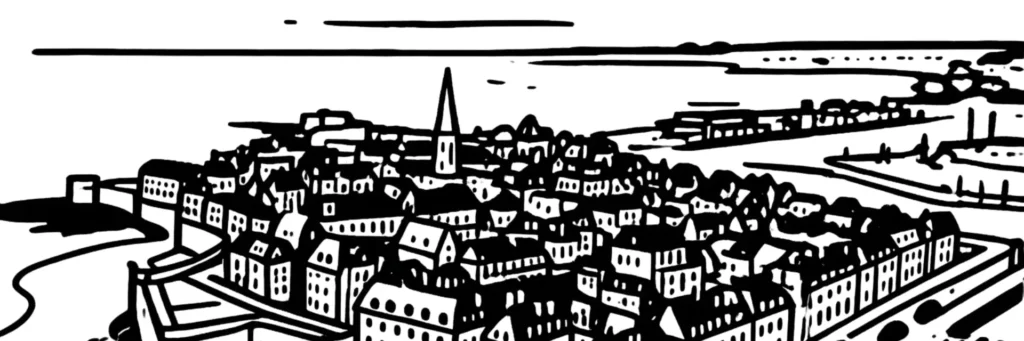
Rocabey attracts year-round residents, first-time buyers, people working in Saint-Malo or commuting to Rennes by train, and buyers looking for a central pied-à-terre. Demand focuses on apartments close to the market, the shops and the station, from the studio to the family unit. The central position, quick access to the Sillon beach and year-round neighbourhood life make it a practical area, at prices more affordable than the seafront.
The average price in Rocabey is 5 038 €/m² for an apartment (actual DVF transactions, notarised sales), within a range of 4 288 to 5 488 €/m² depending on the building, the floor and the condition.
Yes. Rocabey is the shopping centre of the town, around its square and its market, between the old town, the station and the Sillon beach. It is a district of year-round life, practical and well served.
The average price of apartments in Rocabey sits at around 5 000 €/m², based on actual DVF sales, a level sustained by the central position and the closeness of the beach, while remaining more affordable than the Sillon seafront.
Mainly apartments, from the studio to the family unit, in the blocks of the centre, along with a few town houses. The district suits a main home just as well as a central pied-à-terre.
Yes. The district is central, a few minutes' walk from the station of Saint-Malo (Rennes in under an hour) and from the Sillon beach, and served by the Malo Agglo Transports bus network.
This analysis is published by Immover, an independent observatory founded by Antony Barbier. Data sourced from official sources (DVF, INSEE, Notaries of France).