The average price per m² in Les Ulis is 2 474 €/m² for an apartment, within a range of 2,0 to 2,7 k€ per m², based on actual notarised (DVF) sales. Over the period, the market rose 3 % over 5 years and rose 4,7 % over the last 12 months, with about 136 transactions per year.

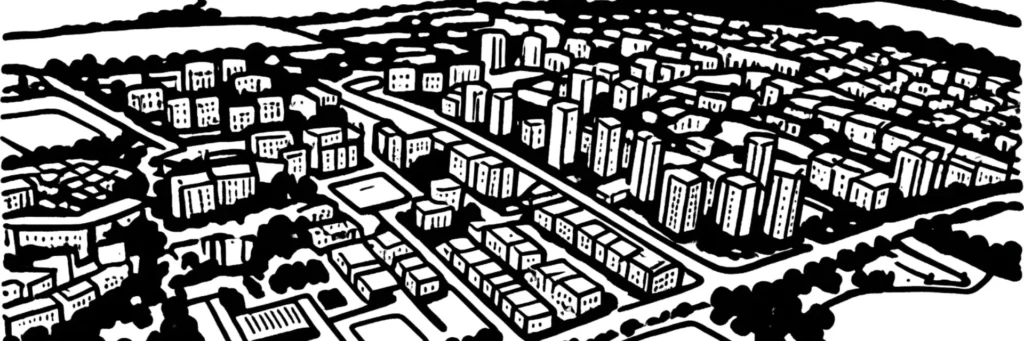
Illustration of Les Ulis, on the Courtabœuf plateau, the youngest town in the Paris region.
Apartments in Les Ulis sell at an average price of around 2 474 €/m², based on actual recorded transactions (DVF data, the French database of notarised property sales). It is the town in the Immover coverage most dominated by flats: 136 apartments a year are sold there against sixteen houses. Prices run from about 1 990 €/m² in Anjou to 3 756 €/m² in la Queue d'Oiseau, the only enclave of detached houses in the town. Houses, at 3 298 €/m², trade 33 % above apartments, but on a very narrow market.
Prices from the DVF file (Demandes de valeurs foncières, published by the DGFiP), transactions actually recorded at the notary at municipality level. Cross-referenced with the Notaires de France - INSEE indices. Learn more about our methodology.
After 2 413 €/m² in 2021, the average price in Les Ulis reaches 2 474 €/m² in 2026, roughly +3 % over the period.
Change in the average price per m² over twelve months, district by district, based on the most recent DVF sales.
The average price per m² for an apartment in each district of Les Ulis covered by Immover, ranked from the most expensive to the most affordable.
The Les Ulis market is that of a plateau housing estate turned into a town, with no station and backing onto one of the largest business parks in Europe. With an average price of 2 474 €/m² for an apartment and 136 sales a year, Les Ulis sits well below its neighbours on the RER B. The price gains 3 % over five years and 4,7 % over twelve months: the market is moving up slowly but without jolts.
The geography of prices is one of a break, not of a gradient. Six housing-estate districts sit between 1 990 and 2 524 €/m², within a spread of 27 %, and la Queue d'Oiseau, the only enclave of detached houses, comes out at 3 756. Two districts call for cautious reading: Anjou shows 31,9 % over twelve months and Franche-Comté -9,7 %, but both on only nine annual sales, which makes those movements weakly robust. Conversely Bourgogne, Champagne, Cévennes and Île-de-France, each weighing 21 to 30 sales a year, all move between 1,6 and 6,4 %: that is where the town's real trend can be read.
Les Ulis compared with the major French cities, on the average price per m² for an apartment.
Les Ulis is the youngest town in the Paris region. It came into being by prefectoral order on 17 February 1977, detached from Orsay and Bures-sur-Yvette, after a referendum on 14 March 1976 in which a little over half of the voters in the two towns came out for independence. The housing estate itself is older: it was launched in the 1960s on the Courtabœuf plateau, on the town-planning principles of Le Corbusier, to house the staff of the French atomic energy commission and of the Orsay science faculty. The first residents arrived at the end of that decade.
The town still carries the mark of that project. Its avenues bear the names of former French provinces, laid out according to real geography: Provence to the south-east, Guyenne to the south-west, Berry in the middle, Alsace and Champagne to the north-east, Normandy to the north-west. But day to day, residents do not say Bourgogne or Cévennes: they say les Amonts, le Bosquet, les Avelines, les Fraisiers, Courdimanche, la Treille, les Hautes Bergères, after the name of their housing scheme. The Ulis 2 shopping centre, opened in 1973, is one of the oldest large regional centres in the region.
A founding mismatch explains much of today's geography: the town was designed for managers and researchers, and it ended up housing mainly manual and clerical workers. Today it counts 15,8 % managers and professionals and 16,4 % manual workers, 57,8 % tenants and 39,3 % social housing, and two priority neighbourhoods, East and West, which together hold 38,2 % of the population. La Queue d'Oiseau, to the south-east, escapes that pattern: it is the only enclave of detached houses in the town, cut off from the expressway by a green corridor, and it counts 31,8 % managers and professionals. Its price per square metre says as much.
Les Ulis reads as two markets, not as a gradient. The six housing-estate districts sit between 1 990 and 2 524 €/m², a spread of 27 %. La Queue d'Oiseau, the only enclave of detached houses, comes out at 3 756, 52 % above the town average. There is no continuum between the two: it is a break. The typical buyer in the town is a first-time buyer priced out of the north of the Essonne, who finds here a square metre far below Massy or Palaiseau, and who often works on site at Courtabœuf, or on the Saclay plateau. The point to know before buying is the absence of a station: the RER B runs through the valley below the plateau, and you have to go down to it by bus. In an outer-suburban town, that is the leading discount factor, and it will not change.
The average price in Les Ulis is 2 474 €/m² for an apartment (actual DVF transactions, notarised sales), within a range of 2 044 to 2 684 €/m² depending on the district. Property portals show asking prices, 10 to 20 % above the prices actually recorded.
For one main reason: Les Ulis has no station. The RER B runs through the valley below the Courtabœuf plateau, and you have to go down by bus towards Orsay-Ville or Bures-sur-Yvette. Add to that the nature of the housing stock, a 1960s estate with 39,3 % social housing. The average price there is 2 474 €/m² against about 3 780 in Palaiseau and 4 040 in Massy.
La Queue d'Oiseau, to the south-east, at 3 756 €/m², 52 % above the town average and 89 % above Anjou, the most affordable. It is the only enclave of detached houses in the town, cut off from the expressway by a green corridor, with 31,8 % managers and professionals against 15,8 % across the town. It is not the top of a gradient, it is a separate market.
Because we find no single-lot apartment sale there over the period. Property portals nonetheless show between 3 310 and 3 680 €/m², which would put Saintonge ahead of every other district, while its immediate neighbour Anjou, with identical building stock and in the same priority neighbourhood, is quoted at about 2 080. A gap of 60 % between two adjoining sectors with the same buildings is not credible: it is a calculation artefact. We would rather publish no price than publish a false one. The sector is covered in the Anjou page.
Very few. Sixteen houses a year are sold there against 136 apartments, a ratio of 8 in favour of flats, the most lopsided in the Immover coverage. Detached housing is almost entirely concentrated in la Queue d'Oiseau. A house trades at 3 298 €/m², 33 % above an apartment, but on a market so narrow that the figure moves quickly.
Start by knowing which side of the break you are on: the detached housing of la Queue d'Oiseau or the flats of the plateau. The gap between the two reaches 89 %, and no adjustment for finish closes it. Within the flats, then look at the layout type, whose effect is clear, from a studio at 3 232 €/m² to a T4 and larger at 2 185, then at condition, energy rating and parking. The Immover estimator draws on the actually recorded sales closest to your address.
This analysis is published by Immover, an independent observatory founded by Antony Barbier. Data sourced from official sources (DVF, INSEE, Notaries of France).