The average price per m² in Le Trottel (Ajaccio) is 4 879 €/m² for an apartment, within a range of 4,0 to 5,7 k€ per m², based on actual notarised (DVF) sales. Over the period, the market rose 24 % over 5 years and rose 7,4 % over the last 12 months, with about 33 transactions per year.

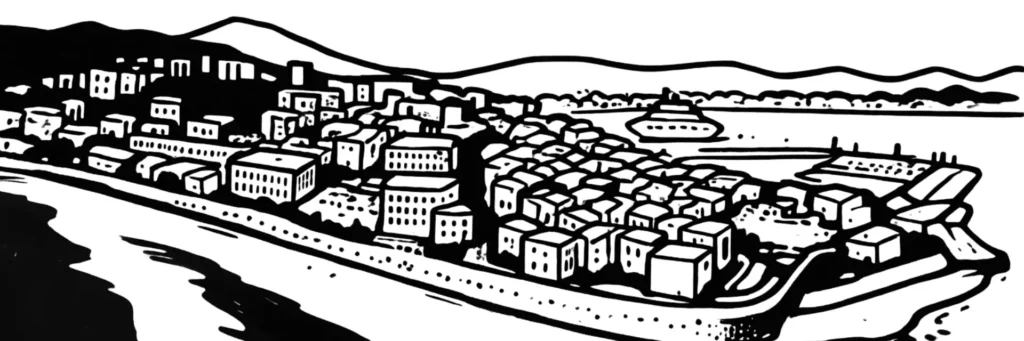
Le Trottel, the south-western seafront of Ajaccio.
Apartments in the Le Trottel district, in Ajaccio, sell at an average price of around 4 879 €/m², based on the prices actually recorded (DVF transactions). Between 3 961 and 5 693 €/m² covers half of the sales, the spread coming down to the sea view, the storey, the condition of the property and the distance from the seafront. Five-year change: +24 %.
Prices from the DVF file (Demandes de valeurs foncières, published by the DGFiP), transactions actually recorded at the notary, aggregated at district level using the IRIS zoning of INSEE. Cross-referenced with the Notaires de France - INSEE indices. Learn more about our methodology.
After 3 926 €/m² in 2021, the average price in the Le Trottel district of Ajaccio reaches 4 879 €/m² in 2026, roughly +24 % over the period.
Local shops, cafés and restaurants along the seafront, complemented by the retailers of the nearby town centre.
The Trottel beach, the boulevard Lantivy, the boulevard Albert-Ier and the rue Miss Campbell structure the district.
The seafront promenade and the beaches of the south-west border the district along its whole length.
Le Trottel, the south-western seafront of Ajaccio. Google Maps map.
Le Trottel spreads south-west of the centre, from the boulevard Lantivy out to the edge of Parc Berthault, between the sea and the slopes that climb towards Le Casone. The beach that gives it its name marks the middle of this seafront.
This is the area that Ajaccio residents still call the foreigners' quarter: it is here that European winter visitors had villas, hotels and tenement buildings built, from the end of the nineteenth century, along the boulevard Albert-Ier, the boulevard Pugliesi-Conti, the boulevard Madame-Mère and the boulevard Pascal-Rossini, and in the rue Miss Campbell, the rue de Solférino, the rue de Rivoli and the rue Colomba. The fabric has stayed dense and heavily built up, with no break from the centre.
On the market, Le Trottel sits at around 4 879 €/m² for an apartment, on around 33 sales a year. It is the district that has risen the most in the town over five years, with a rise of around 24 %, and the movement continues with around 7 % over twelve months. The volume remains moderate, which makes the average sensitive to recent transactions.
Le Trottel attracts buyers looking for the seafront within walking distance of the centre, in older building stock with character. Demand covers the apartments of the seafront buildings, where the view and the storey make the difference, and the properties needing work in the streets set back, which are more affordable.
The average price in Le Trottel is 4 879 €/m² for an apartment (actual DVF transactions, notarised sales), within a range of 3 961 to 5 693 €/m² depending on the building, the storey and the condition.
The district occupies the south-western seafront, from the boulevard Lantivy out to the edge of Parc Berthault, around the Trottel beach. It takes in the boulevard Albert-Ier, the boulevard Pugliesi-Conti, the boulevard Madame-Mère and the boulevard Pascal-Rossini, as well as the rue Miss Campbell, the rue de Solférino and the rue Colomba.
Le Trottel sits at around 4 879 €/m² for an apartment, on around 33 sales a year. It is the most dynamic district in Ajaccio over five years, with a rise of around 24 %. That moderate volume makes the average sensitive from one year to the next; the median for the district comes out at 4 673 €/m².
The area mixes tenement buildings of the nineteenth and early twentieth centuries, winter visitors' villas and more recent developments. It suits buyers looking for the seaside and the character of older stock, the view and the storey weighing heavily on the price.
This analysis is published by Immover, an independent observatory founded by Antony Barbier. Data sourced from official sources (DVF, INSEE, Notaries of France).